

Maharashtra declares drought in 265 talukas, long dry spell likely after this week
Drought has been declared under Trigger 1 in 265 of Maharashtra's 358 talukas as rain deserted the state during the crucial crop period.
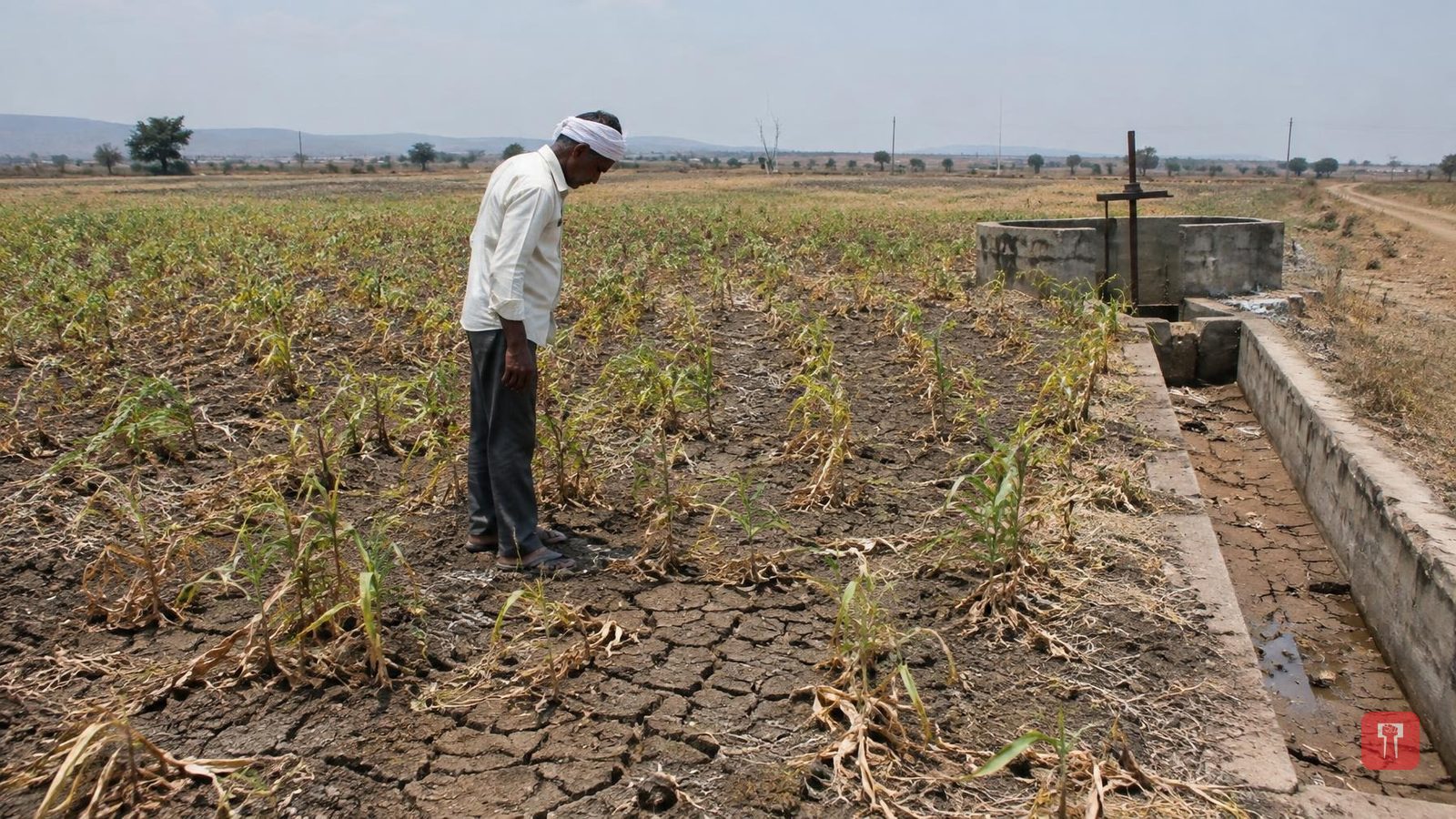
This monsoon season has been a rollercoaster for Maharashtra's farmers. Heavy rain fell in some areas at the start of the season, but the long dry spell that followed damaged crops in many places. Drought has now been declared under Trigger 1 in 265 of the state's 358 talukas, meaning around 75 percent of Maharashtra is facing drought-like conditions. With rain disappearing just as crops were ready, farmers face a major crisis, and people in many areas are still waiting for rain. The state government has approved 12 immediate relief measures for the drought-hit areas, and the administration has speeded up the panchnama process to assess crop damage.
Chief Minister Devendra Fadnavis has assured that the government will help everyone in the 265 talukas declared drought-hit. Talukas that do not appear in the current provisional list will be reassessed, and necessary areas will be added under Trigger 3 so that affected farmers get help. Fadnavis said any farmer who has genuinely suffered losses will not be denied government assistance.
On the weather outlook, the Chief Minister also referred to El Nino, which forms when the temperature of the Pacific Ocean's waters rises. Experts estimate that El Nino's effect could peak in February, after which the ocean temperature will begin to fall and conditions will gradually return to normal. Until then, the administration and the public will need to be prepared to deal with it.
Given the drought conditions, special attention is being paid to water management. Districts have been directed to draw up separate plans so that existing water stocks last until next July-August. After that, any remaining water will be reused for the rabi season and for factories through locally planned schemes, so that none goes to waste and existing stocks are used economically.
According to the Regional Meteorological Centre, Colaba, a yellow alert for heavy rain with strong winds and thunder has been issued for Monday, September 8, in seven districts of the state: Pune ghatmatha, Satara ghatmatha, Kolhapur ghatmatha, Kolhapur district, Beed and Dharashiv. On Tuesday, a heavy rain warning is in place for eight districts: Nashik ghatmatha, Raigad, Ratnagiri, Pune, Satara, Sangli, Kolhapur and Solapur. Farmers and the public have been advised to keep watching alerts from the weather department.
The temperature of the Pacific and Indian Oceans has a direct bearing on the monsoon. In the equatorial Pacific, water temperature is around 18 degrees Celsius near Peru, 24 degrees near Ecuador, 26 degrees near Colombia and 28 degrees near Kali. In the western Indian Ocean, water temperature is around 27 degrees Celsius, and with no major rise expected, the Indian Ocean Dipole, or IOD, is currently said to be in a neutral state. This has led to an assessment that rainfall in Maharashtra could taper off into a long dry spell after this week. The monsoon is currently over roughly half of Rajasthan and is expected to withdraw rapidly soon. Light to moderate rain is possible in Maharashtra during the monsoon's withdrawal.
Weather expert Panjabrao Dakh has also given his own assessment of rainfall ahead in the state. According to him, there could be a 10-day lull in rain starting September 26, after which rain could return to the state, with the monsoon's withdrawal expected in the first week of October. However, conditions will not be uniform across Maharashtra during this period. Vidarbha is currently seeing heavy rain, and it is expected to be stronger in eastern Vidarbha. He forecast heavy rain over the next two days in Gadchiroli, Wardha, Nagpur, Bhandara, Gondia, Chandrapur and Yavatmal districts. In contrast, only scattered rain is likely in western, southern and northern Maharashtra, with most areas expected to stay dry.
With this break in rainfall having already hit the kharif season, the rabi season could now face its own water challenge. Careful planning of existing water stocks will therefore be an important issue going forward. If the dry spell continues, it could put pressure on the water available for rabi crops. Planning will need to take into account each district's water stock, crop conditions and local rainfall outlook. The government has also directed that existing water be conserved until July-August, with the rest reused for the rabi season.
Some districts may get relief from heavy rain over the next few days, but a long dry spell is then likely across many parts of the state. Panjabrao Dakh has forecast rain returning in the first week of October after the 10-day lull starting September 26. For now, every drop of rain is precious for farmers, and strict water planning alongside the proper implementation of government relief will both prove decisive.
This story has published but the live thread has not started. Updates appear here the moment the desk files one.
