

How to identify snakes, which are venomous and what not to do after a snakebite
Not every snake is venomous, and identifying one by colour or shape alone can be dangerous, so keep away and call a trained snake rescuer.
 Images are not validated/verified
Sightings of snakes in fields, around homes, in cattle sheds and in orchards are being reported frequently during the monsoon. In summer too, snakes seek cool spots and come to rest indoors or in shaded places. The subject is important and concerns safety. There is much about snakes that people do not know. Not every snake is venomous, and snakes do not all look alike. Some have clear round markings on the body, some have spots, and some are green or brown. Trying to identify a snake with certainty from its colour or shape alone can therefore prove dangerous.
Four snakes are considered the main causes of serious snakebite in India: the cobra, the common krait, the Russell's viper and the saw-scaled viper. The Russell's viper has a thick body, with three rows of dark brown, rounded blotches along its back. It is considered more venomous. Its bite causes the muscles to stop working one after another, leading to death.
The cobra has a hood behind its neck, and some cobras have a spectacle-like mark on the hood. The krait is usually black and may have white crossbands on its body. The saw-scaled viper is relatively small and brown, with wave-like markings on its body. These are only pointers for first identification. A snake should be identified only by those who know snakes. Touching or catching any snake on the basis of appearance alone can be very dangerous.
The dhaman, or rat snake, is a non-venomous snake found in Maharashtra. Its body is long and tapers towards the front. Its colour may appear brown, yellowish or slate-grey. The dhaman and the cobra can sometimes look alike, so if a snake cannot be identified, one should avoid going near it. The python is a large, thick-bodied snake with clear brown and pale markings on its body. In the Konkan and Western Ghats region, different species are found according to local conditions. In parts of the Sahyadri such as Amba Ghat, snakes such as the Malabar pit viper may also be found.
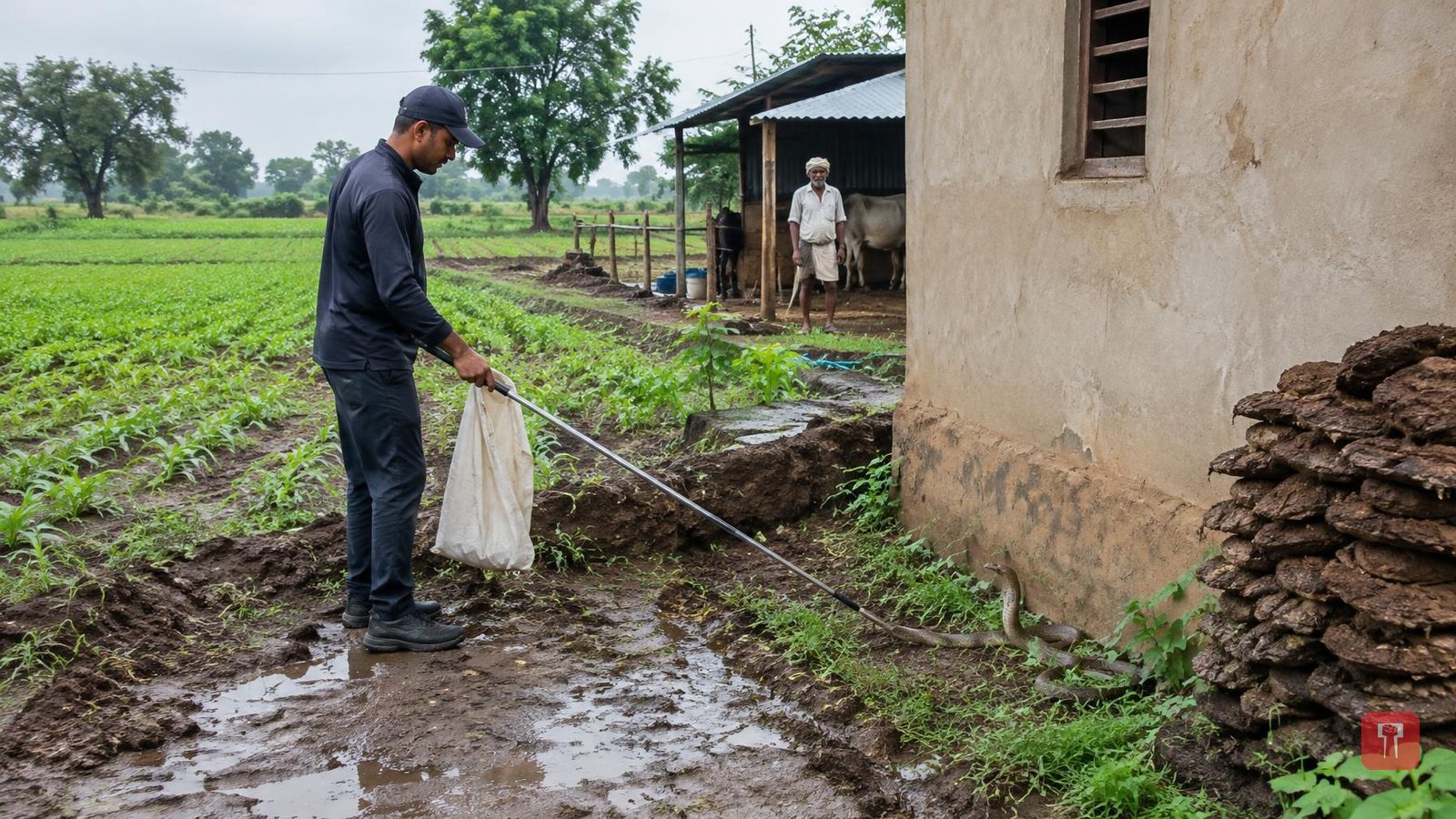
Why do snakes come close to human settlements in the rains? Water entering their burrows, the breeding season, the search for food and the availability of rats or frogs keep bringing snakes close to populated areas. If a snake is seen in the house, keep small children and pets away. Do not kill the snake, do not chase it away with a stick and do not try to catch it. Keep watch from a safe distance and seek the help of a trained snake rescuer.
What should be done in the first moments after a snakebite? Keep the person calm, keep movement to a minimum and keep the bitten hand or leg still. The lower the blood pressure and movement, the less the venom will spread. Remove rings, watches and tight items, and take the person to hospital immediately. Do not try to suck the venom out with the mouth, do not cut the wound, do not tie a rope tightly and do not try home remedies. Photograph the snake only if it can be done from a safe distance, and do not waste time on it.
Even if the pain is slight or symptoms do not appear immediately after a snakebite, treatment should never be delayed. Reaching hospital in time and taking treatment under the supervision of doctors is extremely important for saving life.
