

73% of Gadchiroli farmers hold under 2 hectares, making higher farm income a challenge
Agriculture census data shows small holdings dominate farming in the tribal-majority district, and experts say group farming could help raise incomes.
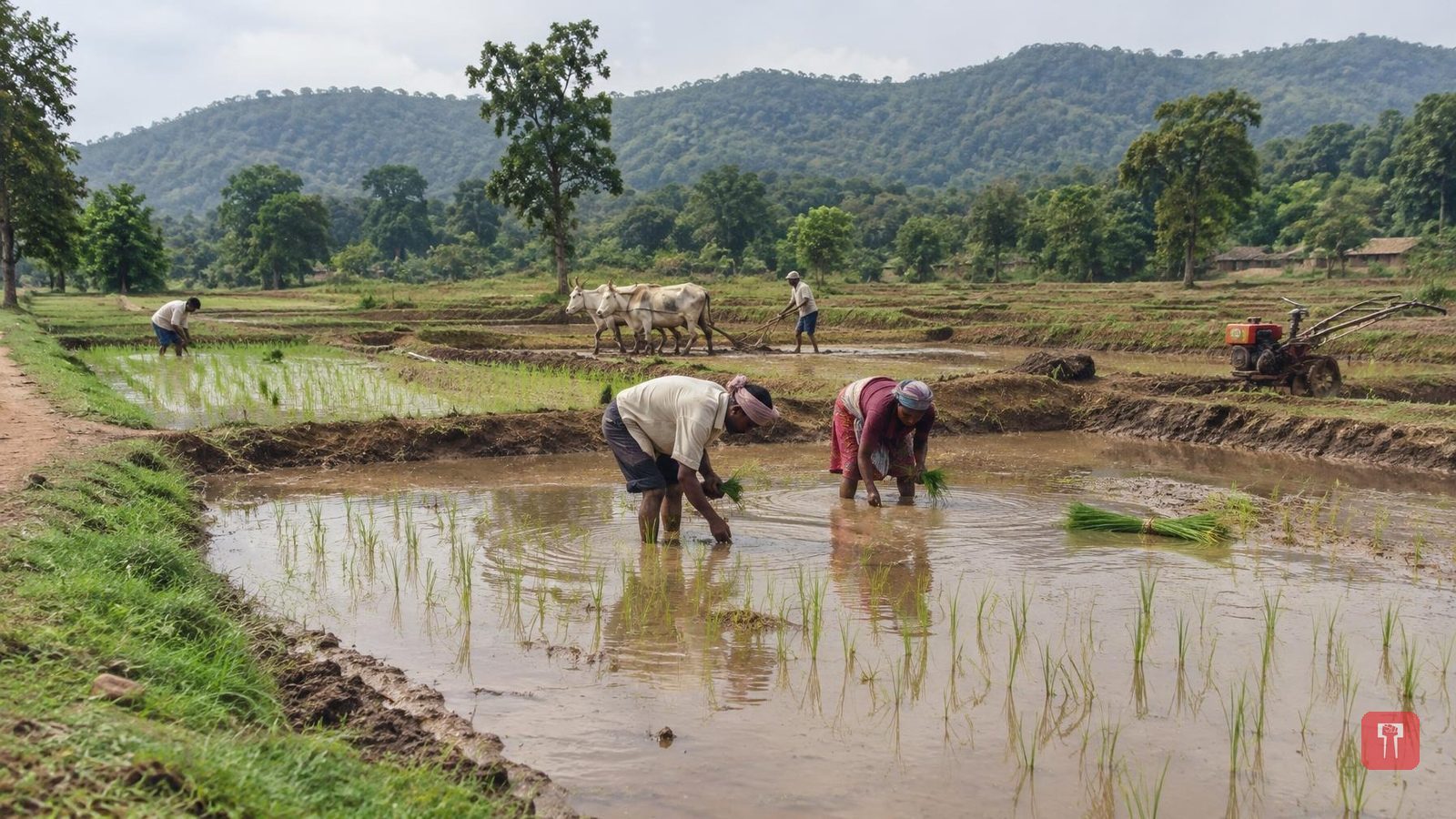 Images are not validated/verified
Agriculture census data shows that farming in Gadchiroli district is mostly done by small farmers with little land. The district has 1,51,733 landholders with about 2,42,451.69 hectares of agricultural land between them.
However, the distribution of this land shows that most farmers hold very little of it. This has made it a major challenge to make farming viable and profitable.
In the tribal-majority district, farmers with up to 2 hectares make up 73.02 per cent of the total and hold 39.59 per cent of the district's total agricultural area. Farmers with 2 to 5 hectares make up 22.80 per cent and hold 39.89 per cent of the total agricultural area. This means about 96 per cent of farmers have less than 5 hectares.
In contrast, farmers with 5 to 10 hectares are only 3.55 per cent. Those with 10 to 20 hectares account for 0.55 per cent, while farmers with more than 20 hectares are just 0.08 per cent.
Small holdings create several difficulties. Because fields are divided into small plots, there are obstacles to using modern machinery, irrigation, crop diversification, storage, agro-processing industries and access to markets. As a result, production costs rise but income does not rise in proportion. For this reason, many farmers have to depend on labour or other employment alongside farming.
According to experts, collective or group farming can be an effective option in a district like Gadchiroli. If several farmers come together and jointly handle ploughing, seeds, fertiliser, irrigation, mechanisation, harvesting, storage and sales, production costs can be reduced and productivity can improve. Farmer producer companies, cooperative societies and group farming could also give farmers a chance to get better prices in the market.
Notably, joint holdings account for 24.92 per cent of the district's holding area. If this area is used effectively to adopt collective farming, mechanisation, irrigation and modern farming methods, it could help raise the incomes of small farmers.
Subsidy schemes alone will not be enough for small farmers. To turn farming into an enterprise, effective implementation is needed of schemes for group farming, value addition, agro-processing industries, organic farming, agri-tourism and linking farmers directly to the market. Otherwise, it will be difficult to achieve the goal of raising farm incomes, experts in the agriculture sector fear.
