

Conflicting NMC replies on Georgia MBBS leave students confused about FMGE eligibility
 Images are not validated/verified
Different answers from the National Medical Commission on Georgian MBBS degrees have left aspiring doctors unsure, and consultants and agents are exploiting the confusion.
Students hoping to become doctors abroad are facing serious confusion. The National Medical Commission (NMC) has given differing statements on MBBS study in countries such as Georgia. Self-styled education consultants and agents are using this ambiguity to mislead students, which could put the careers and futures of thousands at risk.
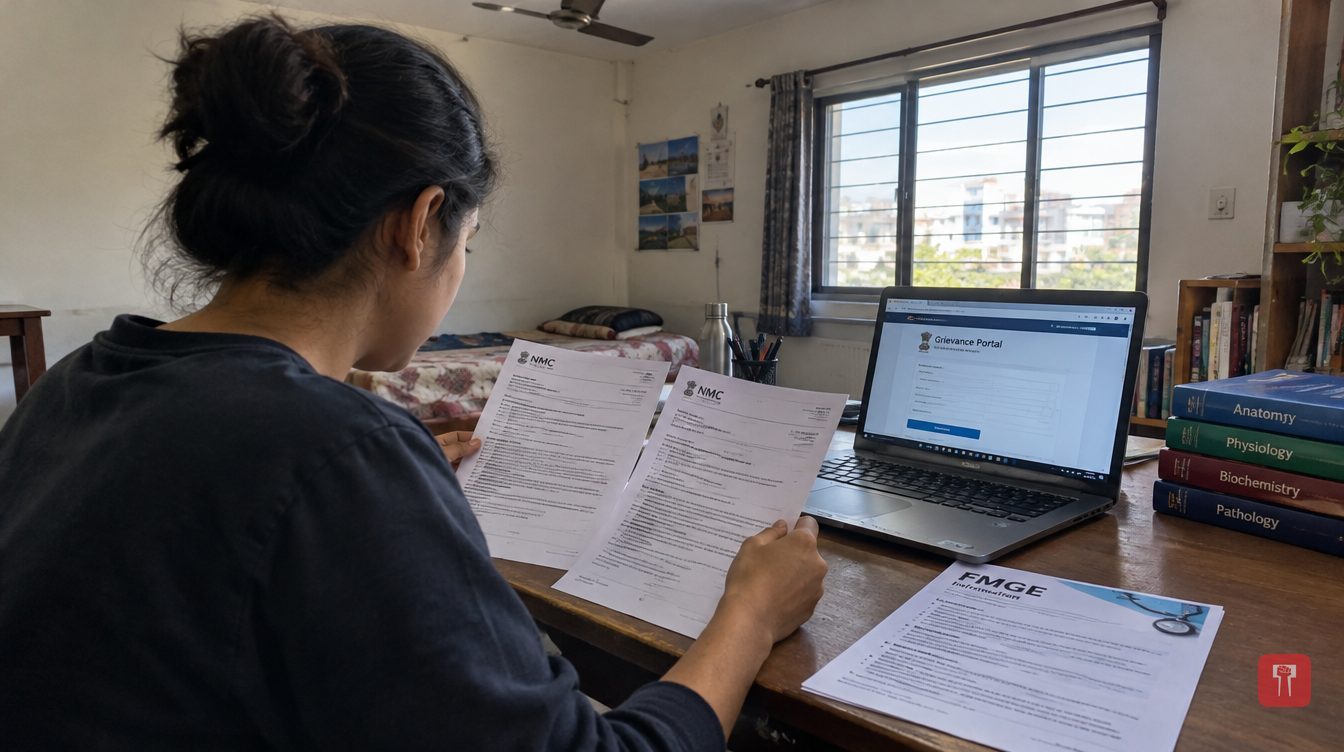
Under the rules, students who take an MBBS degree from a foreign medical institution outside India must pass the Foreign Medical Graduate Examination (FMGE) to practise in India. In a related matter, two aspiring doctors asked the same question at different times on the "Pradhan Mantri Grievance Portal" (PM Grievance Portal): whether students who complete the six-year MBBS course in Georgia would be eligible to take the FMGE in India. The NMC's replies made the matter more complicated.
On September 24, citing its 2021 rules, the NMC clarified that a foreign degree would be considered valid only if the country concerned (such as Georgia) grants students a licence to practise independently immediately after completion of the course.
But when a second candidate asked the same question on October 13, the commission's stand appeared to have changed. This time the reply said that a competent authority and an expert committee were examining these provisions relating to the independent licensing system.
A third student then asked which of the two answers was correct. The NMC merely repeated the old 2021 rules. Clarification sought from NMC secretary Raghav Langer drew no response.
Sachin Jain, an advocate at the Delhi High Court who specialises in medical matters, said education consultants charging heavy commissions are exploiting this ambiguity. They show students the NMC's second reply and give false assurance that "the independent licence condition will soon be removed or some other way will be found." According to legal experts, such false promises can ruin students' futures, because the NMC cannot change the law itself. Laws are made in Parliament, and the NMC can only recommend changes to the government.
Replies from Georgia's National Centre for Education Quality Enhancement (NCEQE) have added to the muddle. The NCEQE claims that Georgia meets all the NMC's requirements for foreign medical graduates. Its own rules, however, say that graduates of MD programmes can work as "junior doctors" without any additional examination but cannot practise independently. They must work under the supervision of an authorised doctor.
A Supreme Court lawyer said the NMC's rules are perfectly clear: students must be able to obtain a licence for independent practice in the country where they studied. The NCEQE's claims, he said, are therefore misleading for Indian students and benefit Georgia's medical colleges.
In view of the situation, legal experts and lawyers have asked the Union Health Ministry and the NMC to issue, at the earliest, an official and clear list of foreign universities that fully meet all FMG eligibility conditions, along with both orders.
Reach readers on the ward they actually live in.
Advertise with Prime Time 24Reach readers on the ward they actually live in.
Advertise with Prime Time 24Reach readers on the ward they actually live in.
Advertise with Prime Time 24
Comments
No comments yet. Be the first.