

Social thinker says habit of delay in government offices, not holidays, hinders Viksit Bharat
 Images are not validated/verified
Sanjay Agrawal argues that how effectively working days are used and how timely citizens' services are matters more than the number of holidays, and suggests eight reforms.
Nagpur: India is moving towards becoming the world's third-largest economy and achieving the goal of a developed nation. The country has youth power, talent, resources and entrepreneurship. But the question is whether the administrative system is moving at the same pace. Are the speed, accountability and productivity of government offices in step with the country's economic ambitions?
Social thinker Sanjay Agrawal, in his analysis, has raised serious questions about government work culture, the system of holidays, citizens' complaints and administrative accountability. He argues that the problem is not merely the count of holidays. The real issue is how effectively the available working days are used and how well the responsibility of serving citizens on time is discharged.
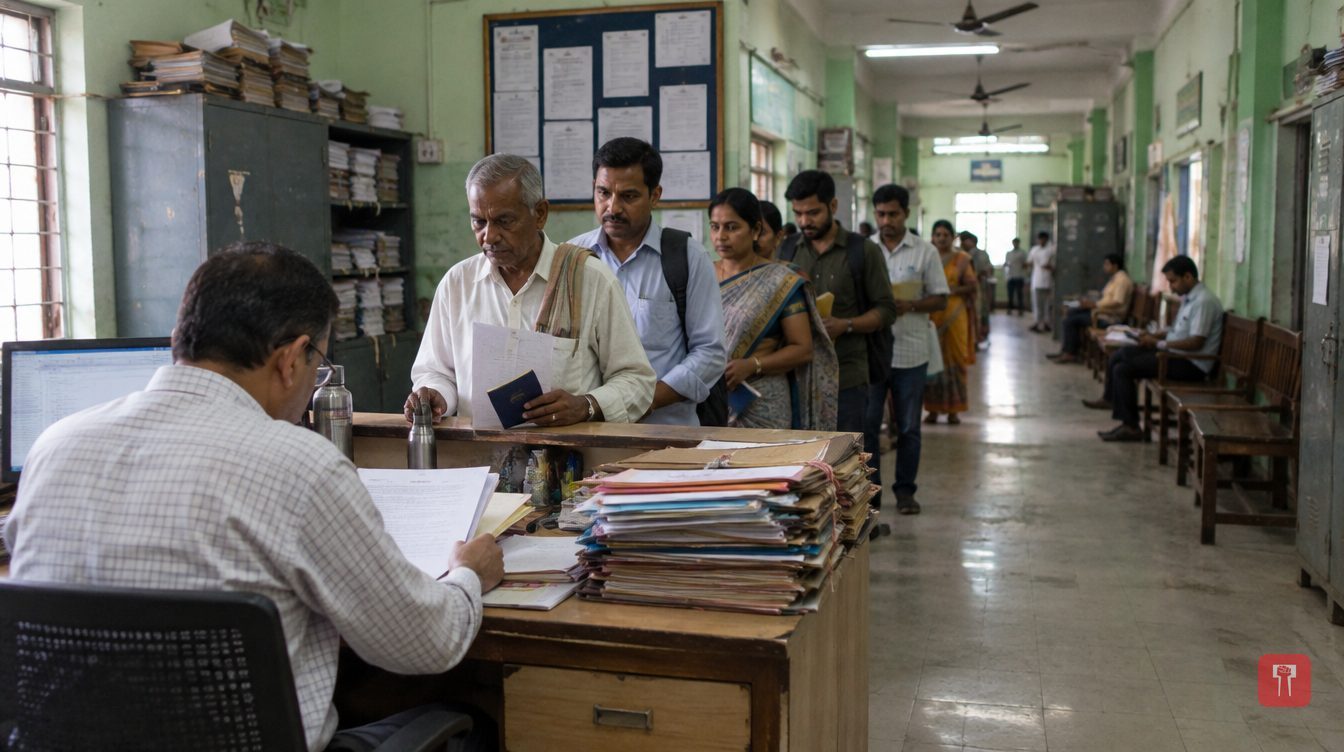
According to him, two kinds of work culture are visible in the country. The farmer struggles with weather, debt and market uncertainty, the labourer must work every day for a livelihood, the private-sector employee is under pressure to meet targets and the trader faces competition every day. On the other side, there are continuing complaints of delays in government services, stuck files, officers who cannot be met and citizens being made to make repeated trips to offices. The difference is not only in the way of working. It has a direct bearing on people's time, the cost of doing business, the investment climate and economic productivity. Agrawal also says it is not right to view all government employees through the same lens. A large number of employees work with full dedication in difficult conditions. The question is about the shortcomings and negligence because of which citizens do not get services on time.
On holiday figures, he said central government general administrative offices remain closed 104 days a year because of the weekly Saturday and Sunday off. In addition, 17 gazetted holidays have been declared for central government offices in Delhi in 2026. However, it would not be correct to add the two numbers directly and call it the total number of holidays, since some gazetted holidays may fall on a Saturday or Sunday. The lists of holidays also differ across states and departments. In a diverse country like India, festivals and religious occasions have social importance, so abolishing holidays is not the solution. If an office does not open on time, files do not move, decisions are needlessly delayed and people are called repeatedly, extra working days will not deliver results either. A system run on taxpayers' money must understand the value of the public's time and effort.
On accountability, Agrawal says the quality of work, deadlines and performance are generally reviewed regularly in the private sector. The government system also has rules for evaluation and discipline, but it is not easy for a citizen to know which officer is sitting on an application and who is responsible for the delay. Weeks of waiting for a certificate, elderly people going from office to office for pension work, or a farmer not receiving help on time are not just administrative inconveniences. They also affect people's money, time and opportunities. Employee unions have a role too. Along with demands for rights, fair pay, adequate staff and better conditions, there should be an emphasis on efficiency, discipline and quality of service.
Citing figures, he said that on the Centralised Public Grievance Redress and Monitoring System (CPGRAMS), a total of 1,11,89,384 complaints have been registered from 2021 to February 2026, of which 22,78,256 were registered in 2025 alone. According to the available data, the average time taken to dispose of complaints in central ministries in 2025 was 15 days, and 82.1 per cent of complaints were disposed of within 21 days. These figures cannot be taken only as proof of administrative failure, since better digital access and greater awareness about lodging complaints may also have played a part. Even so, a scale of complaints this large points to the need to review service quality and recurring problems.
A 2014 study published by the National Bureau of Economic Research (NBER) in the United States estimated the annual salary cost of unauthorised absence of government teachers in India at about 1.5 billion US dollars. This is an estimate based on the 2014 study, not a figure for actual losses in 2026. The study also found indications that stepped-up monitoring reduced teacher absence. A teacher's absence affects children's learning, the continuity of the syllabus and, especially, the opportunities of children from poor families.
PRS Legislative Research's April 2026 review estimated India's nominal GDP for 2025-26 at about Rs 345 lakh crore. On that basis, as a mathematical illustration, 0.1 per cent would be Rs 34,500 crore, 0.5 per cent would be Rs 1,72,500 crore and 1 per cent would be Rs 3,45,000 crore. Agrawal makes clear that these are mathematical illustrations of percentages of GDP, not the actual loss caused by government negligence. A separate and systematic study would be needed to learn the real economic impact of delays and low productivity. Even so, in an economy this large, even a small gain in productivity matters.
According to him, the mindset of putting off work is a bigger problem than leave. Taking leave is not an employee's fault; statutory and sanctioned leave is part of their entitlement. The trouble arises when files are deliberately held back before a holiday, pending cases are not cleared even after the office reopens, or a citizen is made to wait several weeks over a minor shortcoming. Those whose livelihood depends on daily work bear the brunt. A daily-wage labourer loses a day's wages, a small trader's business is affected and a farmer may suffer losses if essential work is not done on time.
Elections, floods, law-and-order situations and employee agitations can also affect work. Elections are essential for democracy and relief and rescue come first in a disaster. Even so, arrangements should be made to keep essential citizen services running as far as possible at such times. Clear plans can be made for this, including deployment of alternate staff, online applications, handing over work between authorised officers and continuity of essential services. The aim is not to limit employees' rights but to ensure that citizens are not left completely helpless under any circumstances.
Agrawal has suggested eight steps for reform. First, along with biometric attendance, it should be checked how much work was done in the set time and of what quality. Second, clear deadlines should be fixed for certificates, pensions, licences and other services, reasons should be recorded for delays and action should be taken against negligence as per rules. Third, the annual appraisal should give due weight to pending cases, timely disposal, quality of work and citizens' feedback. Fourth, in cases of repeated unauthorised absence, deliberately holding files or corruption, there should be a fair inquiry and action as per rules, and the employee concerned should also get a chance to put forward their side. Fifth, those who do good work on time should be given recognition, training and opportunities for promotion.
Sixth, applications, payments and file status should be available online, and there should be a system of assigning work to an authorised alternate officer when an officer is absent. Seventh, the holiday system should be reviewed from time to time and, as needed, essential services kept running on rotation, while respecting employees' statutory rights. Eighth, each department's annual report should make public the number of applications received, disposed of and pending, the average disposal time and the main reasons for delay.
Agrawal says the responsibility for making India developed does not lie only with industry, farmers, entrepreneurs and the private sector. The administration has a central role in implementing policies on the ground, delivering services to citizens and speeding up economic activity. Criticism of government employees should not be meant to insult them, and it is not right to expect better results from them without adequate staff, better training, modern technology and necessary resources. The responsibility for reform rests with the government, administrative leadership and employees alike. But a system run on public money must deliver results in the public interest. Just as employees should get timely salary and job security, citizens too should get services within a fixed time. In his words, leave is a right, but negligence is not a right. The goal of a developed India will be meaningful only when, in administration, productivity is fixed along with attendance, responsibility along with rank, and accountability along with salary.
Reach readers on the ward they actually live in.
Advertise with Prime Time 24Reach readers on the ward they actually live in.
Advertise with Prime Time 24Reach readers on the ward they actually live in.
Advertise with Prime Time 24
Comments
No comments yet. Be the first.