

No inspection squad or committee at WCL Nagpur HQ to police smoking and intoxicants, RTI reply shows
 Images are not validated/verified
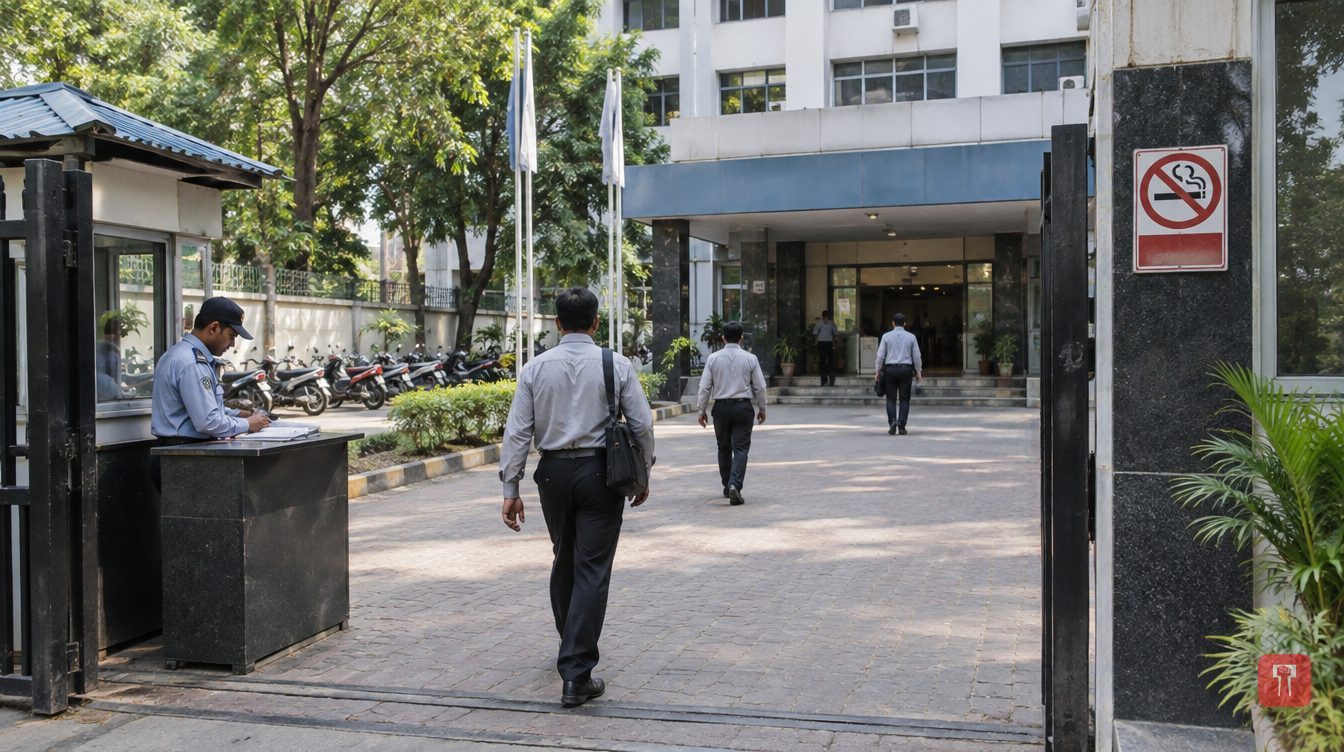
An RTI reply says Western Coalfields Limited has no inspection squad, committee or flying squad at its Nagpur headquarters to monitor smoking, liquor, gutkha and pan masala use.
Serious questions have been raised over how rules are followed and enforced at the Nagpur headquarters of Western Coalfields Limited (WCL), according to an official reply received under the Right to Information (RTI) Act. The company provides for an advance of Rs 12,500 a year to employees for uniforms. But no inspection squad, committee or flying squad has been appointed at the headquarters to stop smoking, liquor, gutkha and pan masala use on office premises.
Rajiv Ranjan Kushwaha, a Nagpur resident, filed the RTI application (letter no. Wekoli/JA/SuKaA/2026/6719) on September 3, 2026. In reply, WCL's industrial relations department supplied some documents. The reply was prepared on the basis of a note (no. Wekoli/Au.Sam./2026/346) recorded on September 16, 2026 by WCL's senior manager, and was sent to the public information officer on September 17.
The application asked five questions. For the standard operating procedure or government resolution on uniforms, WCL supplied a revised order of Coal India Limited (CIL). On the ban on intoxicants in office and mining premises, the management said the ban falls under the company's certified Standing Order, which is available on its website. WCL also said the provision for action against rule violations is in the Standing Order itself. On a monitoring and inspection committee, the management stated clearly that no inspection squad, committee or flying squad is currently appointed at the WCL headquarters in Nagpur. Details of annual inspections and punitive action were sought, but were not given because there is no committee or squad.
In other words, rules and penalty provisions exist, but there is no special arrangement at the headquarters to check whether they are followed. This is the most significant point of the reply.
A Coal India Limited office memorandum (CIL/C-5B/JBCCI-XI/Uniform Dress-Code/20) dated April 28, 2026, attached to the RTI reply, describes the revised uniform arrangement. After Coal India's 490th board meeting, the earlier order of June 6, 2025 was replaced. Under the revised arrangement, each employee will get Rs 12,500 for three sets of uniform a year. Earlier, the bill had to be submitted within a month; now the GST bill must be submitted within two months. If the bill is not submitted in time, the amount can be recovered from salary. An employee who is retiring must submit the bill within two months or before the final salary is released, whichever is earlier.
Under Annexure-A, male employees get three grey formal shirts and three black formal trousers. Female employees have three options: a grey or maroon shirt with black trousers, a grey or maroon kurta with a black salwar and dupatta, or a grey or maroon saree with a black blouse. They must keep at least three sets of uniform according to the option chosen. The colour codes are grey, PMS 444; maroon, PMS 209; and black, PMS 426.
According to sources, employees who do not wear the prescribed uniform are seen coming and going at various regional headquarters, including the one in Nagpur. Allegations have also surfaced that smoking takes place openly in some sections of the office. If the allegations prove true, they raise the question of how effective the monitoring arrangement is when the company already has rules and penalty provisions.
Several questions now await answers. Are the uniform rules applied equally to everyone at the headquarters? Who monitors action on complaints of violations of the ban on smoking and intoxicants? Why has no special inspection arrangement been set up despite the penalty provisions? Will the chairman and managing director (CMD) review the matter and clarify the state of compliance at the headquarters? And should the vigilance department or another competent authority examine the need for an inquiry on the basis of the facts?
The absence of an inspection committee does not automatically mean that no action has ever been taken. That requires an independent check of available records and the situation on the ground. Attention now turns to what steps WCL management takes to make the uniform rules and the ban on smoking and intoxicants effective, and whether a monitoring arrangement is set up at the headquarters or the replies remain confined to orders on paper.
Reach readers on the ward they actually live in.
Advertise with Prime Time 24Reach readers on the ward they actually live in.
Advertise with Prime Time 24Reach readers on the ward they actually live in.
Advertise with Prime Time 24
Comments
No comments yet. Be the first.