

Musk asks why Starlink has no India licence; government denies bias in satcom rules
The Communications Ministry says India's satellite framework is fair and transparent, after Elon Musk questioned why Starlink still lacks a licence despite five years of compliance.
 Images are not validated/verified
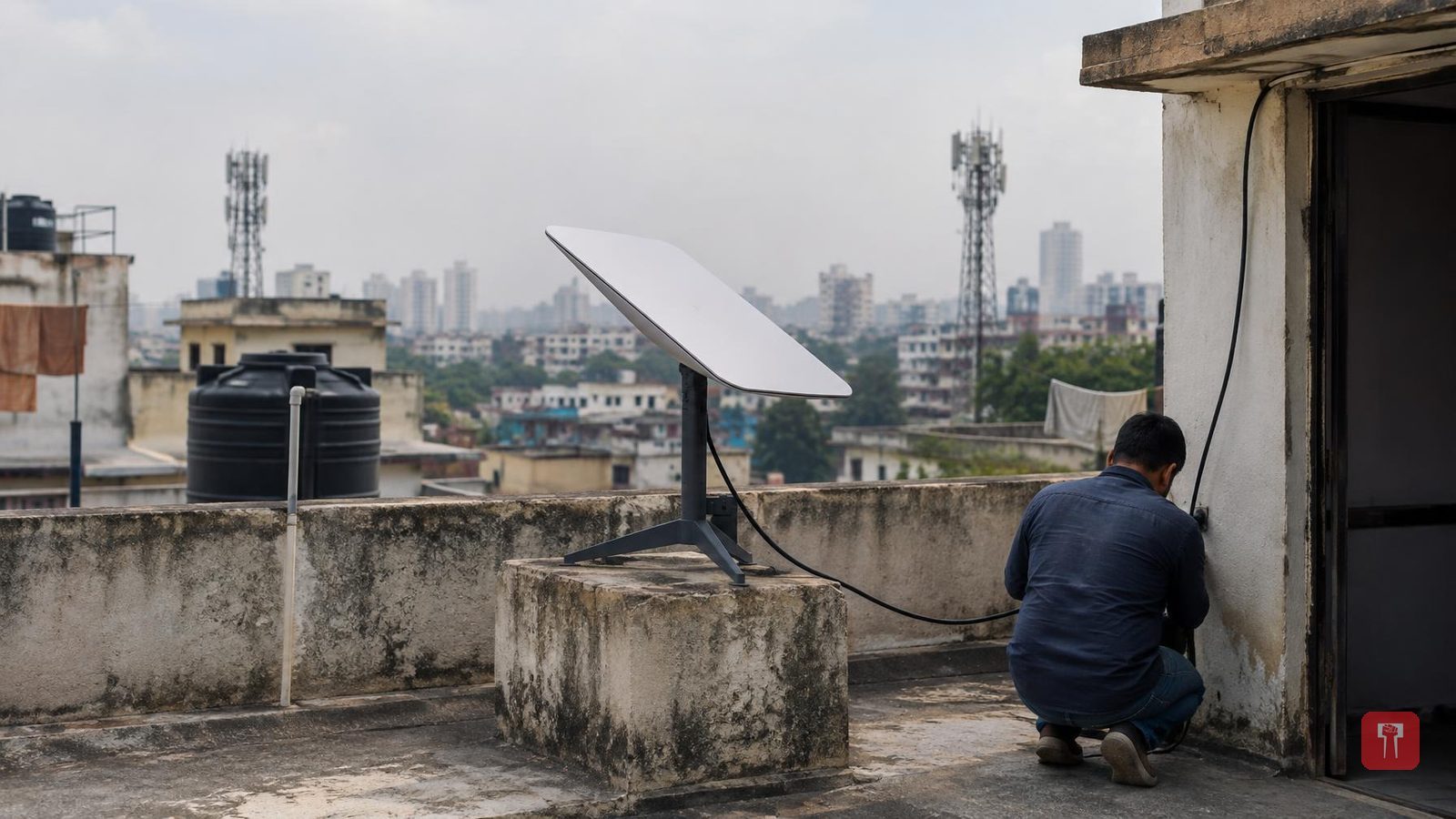
A row has erupted over why Elon Musk's Starlink has still not received a licence to begin commercial services in India. Starlink provides internet services through satellites worldwide. In a post on X on October 8, 2026, Musk wrote that Starlink has received licences in more than 165 countries, and asked why it has none in India after spending five years complying with every law and condition of the Indian government. In the same post he asked, "Is Ambani really the true boss of India?"
Through his X and Instagram accounts, Musk has questioned the Indian government's regulatory process. According to him, Starlink has followed every law, rule and security norm of the Centre to the letter in order to launch commercial services in a large country like India, yet has not received a licence. The question was seen as an indirect allegation that a few industrialists dominate India's telecom market.
The Union Communications Ministry responded with an official statement. The government said India's satellite communication regulatory framework is fair, transparent and non-discriminatory. It also said the claim that any one company or individual is being favoured is wholly wrong and baseless. According to the ministry, the same rules apply to all telecom companies, foreign and domestic. Any international company launching services in India must meet conditions linked to national security. The ministry indicated that these rules are also being strictly examined in Starlink's case.
Former Union minister Rajeev Chandrasekhar also posted on X on October 9, 2026, addressing Musk. He said he is no longer in government and does not speak on its behalf. He wrote that India's telecom sector was plagued by opacity and corruption for decades, but that under Prime Minister Narendra Modi the technology sector runs on three principles: open, secure, and trusted and accountable. In Chandrasekhar's view, all three satcom licence holders are at roughly the same stage of security clearance, and the order is first assurance of security and trust, then spectrum. He also said satellite-based internet services have many security implications. He wrote that he considers Starlink's technology excellent, but that the country must decide in its own interest and for that, patience is needed.
Musk has earlier criticised large Indian telecom companies without naming them. He had alleged that some oligarchs and established industrialists are trying to keep Starlink out of India. He had demanded that satellite spectrum be allocated in India the way it is in Europe and the United States. On the other side, Reliance Jio and Bharti Airtel say the rules for spectrum allocation should be the same for satellite internet and telecom companies, so that healthy competition is preserved in the market.
Technical readiness alone is not enough to offer satellite internet services in India. Companies must pass security tests by the Union Home Ministry, the Department of Telecommunications (DoT) and ISRO. The government is laying special emphasis on the route the data sent through satellites takes and how Indian agencies will control it. Although Starlink has said it has accepted all the conditions, the final approval and spectrum allocation remain unresolved. All eyes are now on what final decision the Centre takes in response to Musk's question.
