

Israeli forces withdraw from Hebron after 10-day siege; Palestinian security forces take control
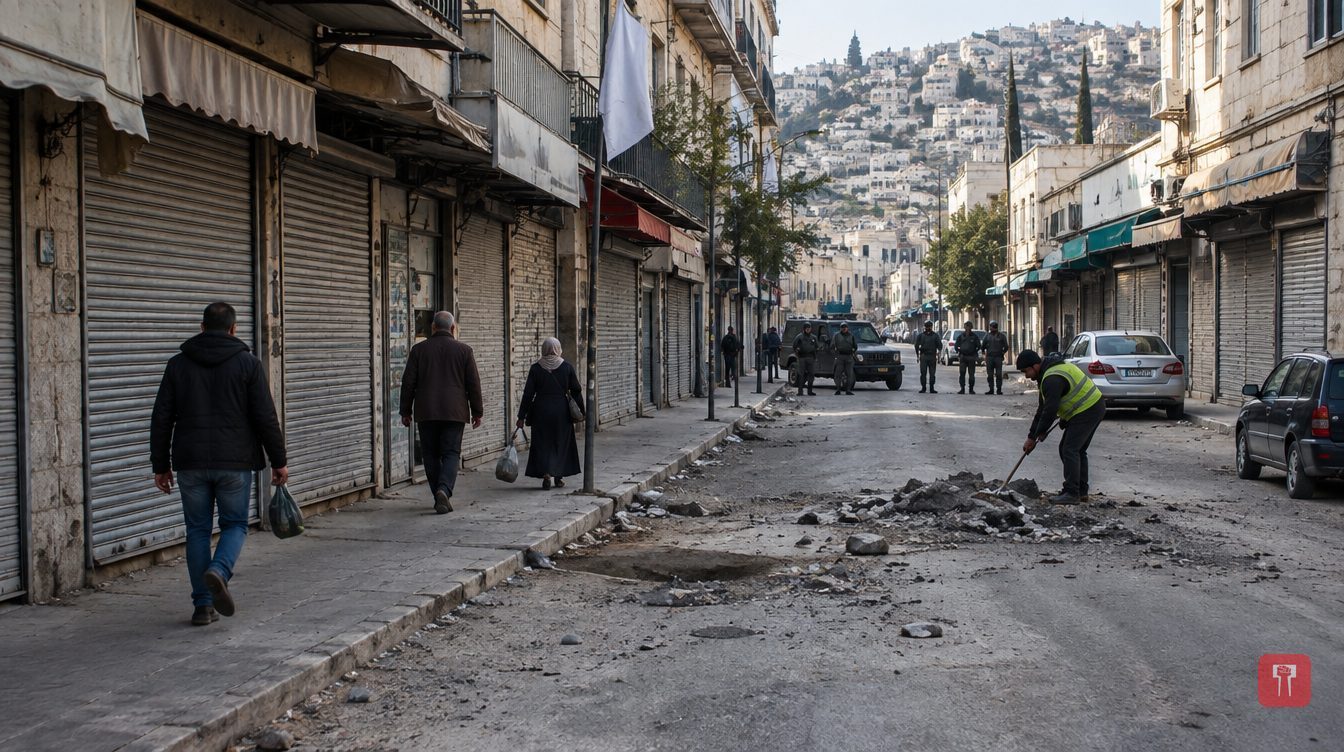 Images are not validated/verified
Hebron's governor says the Israeli army has left the whole city, and hundreds of displaced Palestinian families have been allowed to return home.
The Israeli military (IDF) has pulled out of the West Bank city of Hebron after an operation in which the city was besieged for more than 10 days in a row.
According to official information from Hebron Governor Khaled Dudin, the Israeli army has left the entire city and Palestinian security forces now have full control of the area. Hundreds of Palestinian families who had to leave their homes because of the siege have now been allowed to return.
The siege began after an attack near Hebron on October 23 in which two Israel Defense Forces soldiers were killed. The Israeli force then surrounded the whole area and kept the city's roads shut for 10 days.
According to figures from the local municipality, the 10-day operation directly affected more than 3,300 Palestinian civilians. Many families had to leave their homes for safer places. During this period many houses were destroyed and local businesses came to a complete halt.
Hebron Mayor Yusuf al-Jabari gave details of the damage caused by the siege. He said the city suffered an economic loss of 12 million shekels a day, or more than about $3.8 million, over the 10 days.
The mayor said infrastructure such as roads, water and power systems suffered damage of more than $1.9 million. The health system and the environment were hit to the extent of an estimated $160,000. He said the Israeli force demolished 15 houses and other important structures, while 327 businesses and shops were forcibly shut.
Al-Jabari said the most serious impact was on children's education. Because of the continuous operation and the restrictions, about 80,000 students could not go to school for 10 days in a row, causing a major break in their studies.
Hebron alone is considered to account for about 40 per cent of the Palestinian economy. It is an industrial and commercial centre. The mayor made the serious allegation that holding the city for 10 days was, in a way, collective punishment.
Meanwhile, there are major developments in Israel's domestic politics as well. In the results of the recent elections there, the ruling coalition won 53 seats, while the opposition won 67. The opposition's 67 seats include 48 won by Zionist parties and 19 by Arab non-Zionist parties.
With parties of conflicting ideologies together in the opposition alliance, forming a government poses a major challenge. The newly elected Knesset (the Israeli parliament) is to be formally sworn in on November 10, after which the picture of Israel's new political direction will become clear.
Reach readers on the ward they actually live in.
Advertise with Prime Time 24Reach readers on the ward they actually live in.
Advertise with Prime Time 24Reach readers on the ward they actually live in.
Advertise with Prime Time 24
Comments
No comments yet. Be the first.