

Israel exit polls show no clear majority: five routes to forming a government
 Images are not validated/verified
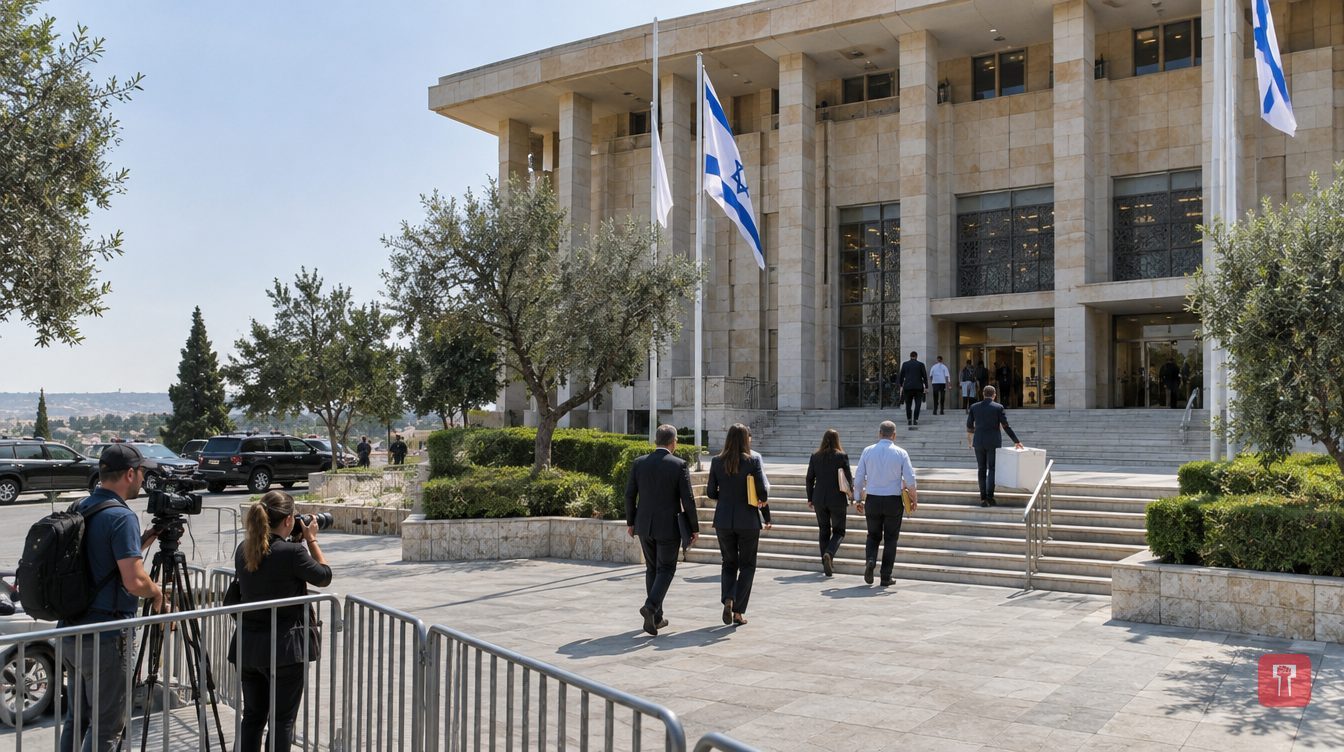
Early exit polls suggest no party will win a clear majority in Israel's Knesset, leaving five possible paths to a government before official results on November 4.
Voting in Israel has ended, and official results are due to be announced on November 4. Early exit polls do not indicate a clear majority for any single party. The outcome is being widely discussed in political circles, and the world is watching what options the leaders and the President will have if the Knesset is hung.
Israel's 120-member parliament is called the Knesset. Forming a government requires the support of at least 61 members. This time, no party appears able to reach that magic figure.
In Israel's system, becoming the largest party is one thing and forming a government is quite another. Voters do not directly elect the Prime Minister; they vote for parties. After the results, President Isaac Herzog holds detailed talks with the leaders of all the parties elected to the Knesset. The leader who appears best placed to gather the support of 61 or more members is then invited to form a government. That leader gets 28 days to build a coalition, with a further 14 days possible if needed. If no agreement is reached in this time, several complicated situations can arise.
If no party gets a clear majority in the November 4 results, the parties will have five routes open to them.
The first and most likely is that of the bloc led by incumbent Prime Minister Benjamin Netanyahu. This bloc could try to cross the 61-seat mark by bringing in smaller, right-leaning parties. If the President places his trust in him, he could again stake a claim to form a coalition government.
The second route is a coming together of opposition parties, which are said to include Gadi Eisenkot and other leaders. The difficulty is that the opposition parties have deep ideological differences and intense rivalry. Even if they all unite on an anti-Netanyahu agenda, it is very hard for them to guarantee a stable majority.
The third route could involve taking the support or cooperation of Arab parties. According to early estimates, Arab parties could win a good number of seats in this election, so they could play the role of kingmaker in forming the government. But both major political blocs face sharp ideological and political obstacles in joining hands with Arab parties.
The fourth option is a National Unity Government. In it, major opposition and ruling parties come together to form a government to deal with the crises facing the country. This requires agreement on the post of Prime Minister, the distribution of ministries and policies. The route is challenging because of sharp differences, but it can still be effective in breaking a political deadlock.
The fifth and last option could be a Minority Government. Such a government does not have 61 members of its own, but survives by taking outside support from other parties during confidence motions or important Bills. The supporting parties have to be continually placated, so the stability of such a government is always under threat.
What happens if all efforts fail, and will there be fresh elections? If the leader given the first chance cannot prove a majority within the stipulated period, the President can give another leader a chance. If that too fails, 61 members of the Knesset can together demand that some other member be given the chance to form a government. If, even after this entire constitutional process, no leader or coalition gets a majority, the Knesset has to be dissolved and the way opens for fresh elections.
However, lack of a majority does not mean elections the very next day. Every possible legal and parliamentary effort is made to put together a coalition. In Israel's recent politics, the country saw five general elections in a row in just three years between 2019 and 2022: April 2019, September 2019, March 2020, March 2021 and November 2022. The repeated elections left the public and the economy facing heavy political instability.
Reach readers on the ward they actually live in.
Advertise with Prime Time 24Reach readers on the ward they actually live in.
Advertise with Prime Time 24Reach readers on the ward they actually live in.
Advertise with Prime Time 24
Comments
No comments yet. Be the first.