

US, Russia and China race to build nuclear reactors on the Moon to power permanent bases
 Images are not validated/verified
The three powers want lasting lunar bases and say only nuclear reactors can supply the continuous, safe power that scientists living there for long periods would need.
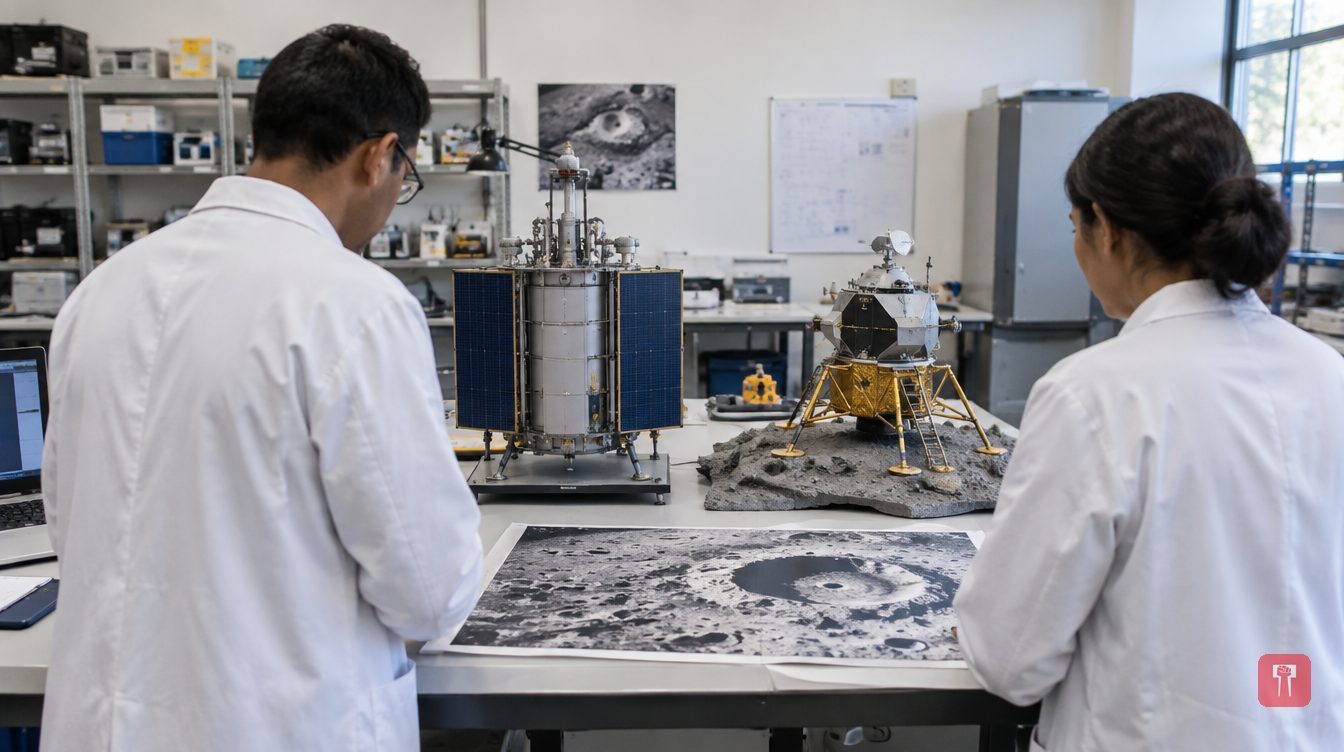
The human who dreamed of setting foot on the Moon is now preparing to settle there. The United States, Russia and China have begun a fierce race to build nuclear reactors on the Moon. All three want permanent bases where scientists can stay for long periods and carry out research. The uninterrupted and safe power this needs can come only from nuclear reactors, so the projects are being given top priority. Behind this lie not only scientific progress but also future geopolitical and economic dominance.
Many people ask why solar panels are not used on the Moon. On one side of the lunar surface, sunlight does not reach for about 14 days, and solar panels are of no use during that time. Supplying power from batteries is very costly and difficult. Carrying diesel or other fuel from Earth into space would be an expensive deal running into crores of rupees.
According to Simon Middleburgh, director of the Nuclear Futures Institute at Bangor University, future human bases on the Moon will need power without a break, and only nuclear energy can meet that need. Ice lies hidden in deep craters near the Moon's south pole. At least three to four reactors may be needed to find it and convert it into minerals.
Some parts of the south pole have not received sunlight for millions of years, so there is a strong likelihood of water ice there. Scientists plan to make drinking water, oxygen for breathing and rocket fuel from this ice. Lunar soil also holds large quantities of valuable minerals such as aluminium, titanium and silicon. In future they would be useful for building satellites and for new missions.
NASA, the US space agency, announced in January that it would build Lunar Reactor-1. NASA's target is to complete the project by the end of 2023. The reactor will generate about 20 kilowatts of power and can run for the next five years without maintenance. Its weight is to be kept below 6,000 kg so that it can be carried easily on a spacecraft.
Russia, in cooperation with China, is working on a reactor called Selena. It will have a capacity of 10 kilowatts and can last 10 years without maintenance. Russia aims to have it ready by 2036 to power a China-led base on the Moon. It could weigh roughly 1,100 to 1,300 kg.
The idea of a nuclear reactor in space is not new. During the Cold War, the Soviet Union sent more than 30 small reactors into Earth orbit from the late 1960s to the 1980s. They were used to power spy satellites. Over the past 70 years, the United States has spent nearly $20 billion on nuclear power programmes in space. Even so, it has not fully succeeded in sending a reactor into space since a 1965 experiment, in which an electrical component failed and the reactor shut down after only 43 days.
There are risks too. Before a reactor is started, the uranium in it poses little danger, but once it is running the risk of a radioactive accident rises. In 1978, the Soviet Union's Cosmos-954 satellite, which carried a reactor, fell to Earth and spread large amounts of radioactive debris in Canada. Scientists say, however, that if such an accident happened on the Moon, its effect would be confined to a limited area.
If bases are built on the Moon, who owns them is a big question. Under the 1967 Outer Space Treaty, no country will have legal ownership of the Moon or any part of it, and no country can assert sovereignty there. The treaty also says, however, that equipment and facilities sent there will remain the property of the country concerned. The treaty does not directly prohibit the use of nuclear power in space. The only conditions are that it be used for peaceful purposes alone and that the space environment not be harmed. This means the US, Russia and China can legally install reactors on the Moon and carry out research and mining.
Reach readers on the ward they actually live in.
Advertise with Prime Time 24Reach readers on the ward they actually live in.
Advertise with Prime Time 24Reach readers on the ward they actually live in.
Advertise with Prime Time 24
Comments
No comments yet. Be the first.