

Gondia farmers trained for country's first joint sarus conservation and natural farming pilot
 Images are not validated/verified
A district-level training in Gondia on Oct 30 prepared farmers for a pilot at Ghattemani village, covering 40 farmers and about 100 acres in the sarus crane habitat.
Gondia, Oct 30: A district-level training was held in Gondia to protect sarus cranes and their natural habitat and to promote sustainable, environment-friendly farming. The programme, on "sarus crane promotion and natural farming", was meant for farmers in the sarus habitat area. It was organised jointly by MITRA, the district administration and the Gujarat Natural Farming Science University, and was held at the District Planning Committee hall of the Collector's office.
Dr Parashram Patil, senior adviser (agriculture) in the Chief Minister's Office in Mumbai, gave guidance at the training. Additional District Magistrate Abhijit Ghorpade, Deputy Conservator of Forests Pawan Jong, District Superintending Agriculture Officer and ATMA project director Nilesh Kanwade, university scientists Dr Swapnil Deshmukh and Dr Raghunandan B. L., and MITRA representative Vinay Zhote also briefed the farmers. Mukund Dhurve of the Bombay Natural History Society (BNHS), Savan Bahekar of SEWA and MITRA representative Tejas Bankar were also present.
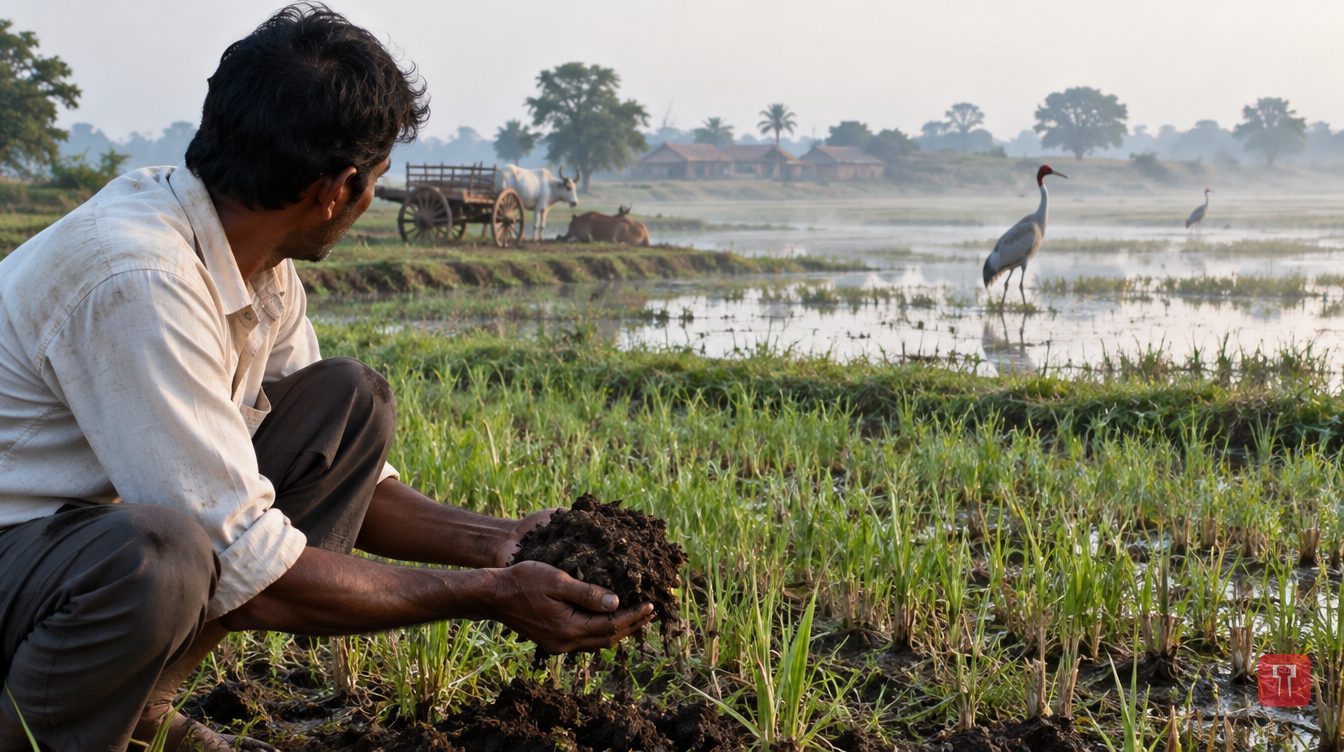
In line with the Chief Minister's vision, the target is to extend natural farming to 25 lakh hectares in the state over the next two years. An important step is being taken in this direction in Gondia district. At Ghattemani village in Amgaon tehsil, where sarus cranes live, the first joint sarus conservation and natural farming pilot project in the country is planned over about 100 acres of farmland. It will look at farmers' income, soil health, biodiversity and the sarus habitat together.
A district-level natural farming committee, chaired by the Gondia District Magistrate, has been formed to carry the project forward, monitor it regularly and provide guidance. The committee will coordinate between departments and periodically review the project's progress, farmers' participation and field work.
The project is expected to promote local biodiversity along with the sarus habitat. Farmers' production costs are also expected to fall as dependence on chemical inputs declines. BNHS and SEWA will take an active part in the project. The Chief Minister's Office, MITRA Mumbai, the district administration, the agriculture department, ATMA and the forest department will also be involved in coordination.
For technical guidance, MITRA, a Maharashtra government body, has signed an agreement with the Gujarat Natural Farming Science University at Halol in Gujarat. The university is considered the world's first university dedicated to natural farming. Its experts will guide on natural farming methods, biological inputs, soil health, demonstrations and building farmers' capacity.
At the start of the training, Nilesh Kanwade introduced the programme and explained why such training is needed for sarus conservation and natural farming in Gondia district. Dr Parashram Patil spoke on the background of sarus conservation, the importance of biodiversity and the role of natural farming. He said that while protecting the sarus, the entire farming system, wetlands and local biodiversity must be considered together.
Deputy Conservator of Forests Pawan Jong spoke about the sarus's habitat needs, the main threats to its survival, and the protection of wetlands and farm surroundings. He said coordination among the forest department, agriculture department, local organisations and farmers is important for sarus conservation. Additional District Magistrate Abhijit Ghorpade stressed the importance of viewing sarus conservation and natural farming together. He emphasised coordination among departments and active participation by farmers to protect biodiversity and develop sustainable farming.
In the technical session, Dr Swapnil Deshmukh, associate professor at the Gujarat Natural Farming Science University, spoke in detail on the basic principles of natural farming, crop planning, seed arrangements, reducing the use of chemical inputs, and improving the health of the soil and farm surroundings. Dr Raghunandan B. L., also an associate professor at the university, gave technical information on biological inputs in natural farming, soil health, soil fertility and management of environment-friendly farming.
As preparation for the project, a field visit was scheduled on October 28 to Ghattemani (Amgaon tehsil) and Jhilmili (Gondia tehsil) to study the sarus habitat, wetlands and natural farming areas. Its aim was to understand the relationship between local farming practices, the sarus habitat and biodiversity.
The pilot will include 40 landholding farmers from an area of about 40 hectares (roughly 100 acres). The plan is to run the project for three crop seasons in a year. The proposals include financial assistance for seeds, farm implements and other necessary inputs for all three seasons. Farmer-owned biological input resource centres (BRC) are to be set up, one for every five farmers. Financial assistance is also proposed as an incentive for each farmer to keep up to two indigenous cows.
Permanent iron information and awareness boards for sarus conservation are to be installed, and publicity material will be provided. Samples will be collected and analysed to test organic carbon (OC) and microbial counts in the soil. Samples will also be taken for tests of pesticide residue. Plans also include certification of natural farming, setting up and strengthening a farmer producer organisation (FPO), farmer training, demonstrations and study tours.
SEWA is proposed to help with facilitating the project, monitoring, evaluation, documentation, branding, packaging and marketing. BNHS will be involved in monitoring sarus, evaluating the results of conservation and documenting case studies.
In connection with the proposed project, a team from the Chief Minister's Office visited Ghattemani village and spoke to local farmers. It gathered information on the present condition of the fields in the sarus habitat, the adoption of natural farming, farmers' expectations and what is needed to implement the project.
The training laid special emphasis on community participation in sarus conservation, awareness among farmers, the spread of natural farming, protection of biodiversity and coordination among departments. With the participation of the agriculture department, ATMA, BNHS and SEWA, various aspects of community conservation were discussed. At the end of the programme, participants' feedback was taken, and Rupesh Meshram, deputy project director of ATMA Gondia, thanked the dignitaries, guiding scientists, officials and farmers present.
After the training, a discussion was held with representatives of the district administration and the Gujarat Natural Farming Science University on the present state of natural farming in Gondia district, field implementation, technical support, capacity building, demonstrations and opportunities for future cooperation.
Reach readers on the ward they actually live in.
Advertise with Prime Time 24Reach readers on the ward they actually live in.
Advertise with Prime Time 24Reach readers on the ward they actually live in.
Advertise with Prime Time 24
Comments
No comments yet. Be the first.