

Bhagwat at Nagpur Vijayadashami: regulate OTT, and let protests seek answers, not discord
At the RSS Vijayadashami event in Nagpur marking the end of its centenary year, Mohan Bhagwat spoke on OTT regulation, drugs, protests and unity.
 Images are not validated/verified
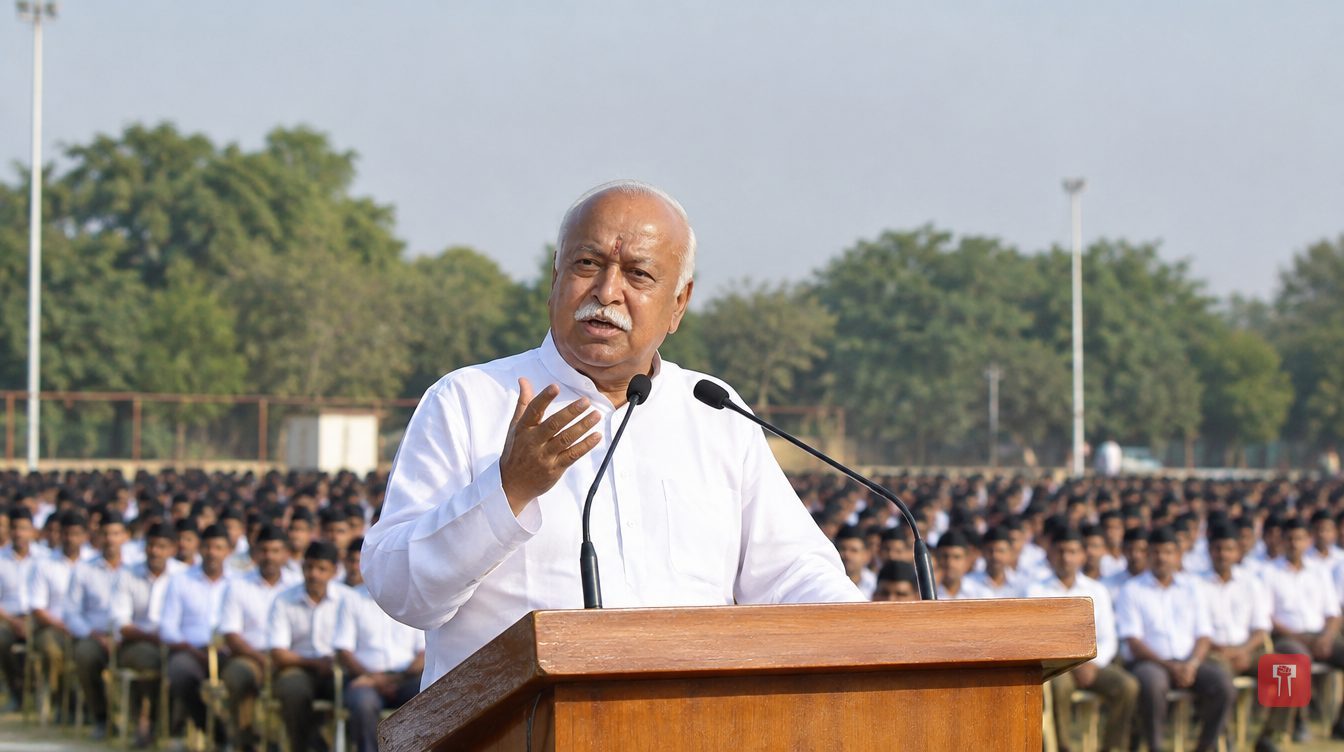
RSS chief Dr Mohan Bhagwat used the Vijayadashami gathering in Nagpur to speak on a wide range of subjects, from the Sangh's hundred years of work to the screens in young people's hands. The event, held at the Reshimbagh ground, closed the organisation's centenary year. The festival is a fixture of the Sangh calendar, and the address was the part everyone waited for.
Bhagwat looked back on the Sangh's journey and on India's cultural identity. He urged people to come together and take part in building the nation. He asked for a stronger sense of "swa" (self) and for swadeshi to be practised in daily life, not just spoken about.
Turning to the Constitution, he pointed out that its opening words, "We, the people of India", treat the country as one citizenry that stays emotionally united despite its many differences. The directive principles in the same document, he added, make it plain that this bond has to be reinforced again and again.
The speech named several figures from the past whose lives, he said, should inspire people today. These included Sant Shiromani Ravidas, whose 650th birth anniversary falls this year, and Swami Shraddhanand, who was martyred a century ago. He also mentioned the work of Swami Laxmanananda Saraswati. Bhagwat recalled the late Raj Narayan Basu of Bengal, who inspired and promoted the Hindu Mela and used swadeshi fairs to rouse the same self-awareness that these men gave their lives for. Basu's 200th birth year is now under way.
Bhagwat voiced concern about the tragedy in Nepal, where thousands have died. He said the deeper cause, somewhere down the line, is lopsided development across the Himalayan belt that takes in India, Tibet, Bhutan and China. A holistic and balanced approach to development is needed, he said.
On culture, he described Sanatan culture as the chief foundation of the country's unity, one that honours every faith and caste. For positive change in society, he asked people to take up five habits: social harmony, enlightened family life, care for the environment, self-awareness and civic discipline.
On technology, Bhagwat said modern gadgets and social media are doing real harm, and that children must be taught to tell right from wrong. OTT platforms, he said, need proper regulation. He observed that elders at home, school lessons and the wider social atmosphere are passing on such values less with each passing day. In many countries, he said, young people absorb whatever these media show them without any filter, and after seeing the damage those countries have brought in some discipline and limits. In his view, Indian society also feels the need, especially where OTT platforms are concerned.
He linked the same lack of discernment to drugs, saying it is why young people across the world are falling into addiction. He called narcotics a grave national problem and said the government, the administration and society should all act before it is too late. Swayamsevaks, he said, will bring everyone along and try to build resistance to the menace across the country.
Discussing the "Hindu bhav", Bhagwat said it is not tied to any one mode of worship or language. It stands, he said, for spirituality, humanity and a universal brotherhood that can link the entire world. It does not demand any particular form of worship, food, lifestyle, political or social ideology, caste, language or region.
The Sangh chief also asked people to stay watchful about forces that sap the strength of the country. He said everyone present knew this well, but he was saying it again because the mood around was such, or was being made such, that even thoughtful people could be shaken. According to him, a storm has risen in the West with a demonic resolve to wreck whatever decency, auspiciousness and cultural and human values survive in India and elsewhere. Even the so-called advanced countries, he said, are troubled and helpless before it.
Bhagwat said India has, over recent decades, slowly earned its place in the world through its strength and sound ethics. It is now succeeding in every field, he said, because Indian society's effort, firm policy, leadership, national pride and sense of duty towards the world have all woken up.
Those who sow chaos in other countries and plant their own puppets there to serve their interests will see their game end as India advances, he said. That is exactly why, in his words, such forces see India as their toughest rival and also their last and most important target. They plan carefully how to break India, Hindu society and the Sangh, he said, and they find a few like-minded helpers. Some ambitious leaders in the country, he added, also fall in line out of a small hunger for power and a failure of judgment.
On the protests being staged by the Cockroach Janta Party (CJP) and the Opposition, Bhagwat said a society this large is bound to have problems, and the system will have its flaws. Agitation over them is natural, he said, but an agitation should aim to bring answers.
He then addressed everyone involved. Whether it is a section of society on the streets, or the government, the administration or a political leader working to keep order, each must make sure that what they do does not breed discord, hatred, bitterness or division among people who are otherwise united. Even when feelings run strong, he said, conduct should stay inside the Constitution, the law and the bounds of civil behaviour.
Bhagwat also cautioned that the temptation of votes, cheap popularity or political gain must not be allowed to cloud judgment and goodwill. Finally, he said experience has not shown that every social problem can be fixed by the government alone, or by agitation alone. Society's own activism, and talks among its members, can also settle many matters, he said.
