

Pune's CIRT enters 60th year, opens automotive cyber security testing lab at Bhosari
 Images are not validated/verified
The Central Institute of Road Transport announced year-long national programmes on vehicle and road safety and showed its new automotive cyber security penetration testing laboratory.
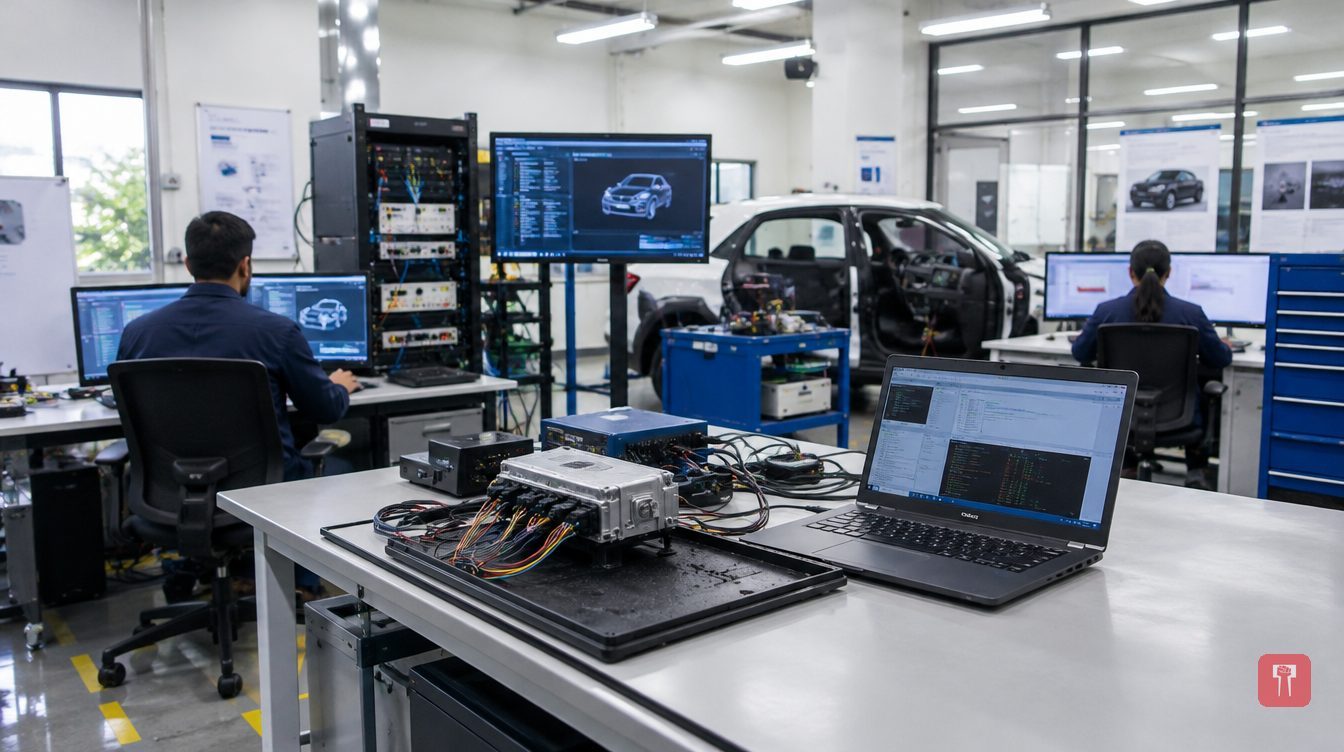
The Central Institute of Road Transport (CIRT), Pune, has announced year-long national programmes focused on vehicle safety, road safety and automotive cyber security. Speaking to the media in Pune on Wednesday, November 5, 2026, the institute also showed its newly built automotive cyber security penetration testing laboratory at its Bhosari campus.
CIRT was set up in 1967. It has completed 59 years and entered its 60th year in September 2026. Programmes on the theme "Ensuring Safer and Secure Mobility" will run from September 2026 to September 2027. Union Road Transport and Highways Minister Nitin Gadkari formally inaugurated the Diamond Jubilee celebrations and unveiled the jubilee logo.
CIRT Director Dr Devendra Singh; Shekhar Dhole, head of the Technical Secretariat; Farukh Makhdoom, head of the Automotive Cyber Security and Management Development Centre; Dr Mangesh Pathak, head of Safety and Homologation; Sanjay Salunke, head of the Automotive Testing Division; and other senior officials were present.
The institute began as a joint initiative of the Union Ministry of Road Transport and Highways (MoRTH) and the Association of State Road Transport Undertakings (ASRTU). Its initial work was to help state transport undertakings across the country with testing and capacity building.
Dr Singh said: "For six decades CIRT has stood behind every safe vehicle and component that has passed through our labs. India is moving towards connected, software-defined, electric and automated vehicles, so safety now also rests on the security of a vehicle's digital systems. Our Diamond Jubilee year is about honouring that legacy and building the testing, certification and human skills needed for the next phase of Indian mobility."
Over the past six decades, CIRT built India's first tyre and wheel rim laboratory, and in 1994 MoRTH authorised it under Rule 124 of the Central Motor Vehicles Rules (CMVR). In 2007 it became a testing agency for whole-vehicle homologation under CMVR Rule 126, and its labs received NABL accreditation. In 2017, its golden jubilee year, it certified India's first retrofitted electric bus and obtained its first patent, for a driver evaluation system.
In 2019 it was authorised under GSR 870 to certify imported vehicles. In 2023 it was made the command and control centre of Bharat NCAP, in 2024 a virtual simulation laboratory began operating, and in 2025 the automotive cyber security division was formed.
Ten of the institute's labs are currently NABL-accredited under ISO/IEC 17025. It has trained more than 80,000 officials in over 2,000 programmes. Between the financial years 2023-24 and 2025-26, CIRT issued 38 official Bharat NCAP safety ratings. More than 115 automated driving test tracks have been set up in Maharashtra, Odisha and Gujarat.
Besides testing and certification, CIRT is the secretariat of the Automotive Industry Standards Committee (AISC) for vehicles above 3.5 tonnes gross vehicle weight (GVW). It is also MoRTH's secretariat for the UNECE Global Forum for Road Traffic Safety, WP.1, and is recognised by the Bureau of Indian Standards (BIS) and SIRO. It also handles monitoring, implementation and project management of MoRTH-funded schemes. These activities support a network of 31 Institutes of Driving Training and Research, 22 Regional Driver Training Centres, 82 Driver Training Centres and five automated fitness testing stations.
The institute advises state governments on buying electric, diesel and CNG buses. It also provides project management consultancy to state transport departments and Union Territory administrations for implementing AI-based automated driving test systems, which aim to bring transparency, fairness and efficiency to driver evaluation.
Modern vehicles depend increasingly on electronic control units, telematics systems and over-the-air (OTA) software updates, which has made cyber security an important part of vehicle safety. CIRT's automotive cyber security division offers testing, evaluation and certification services to vehicle makers and component suppliers. These include auditing of Cyber Security Management Systems (CSMS) and Software Update Management Systems (SUMS) for issuing compliance certificates, and vehicle type approval under AIS-189 and AIS-190.
The division also carries out vulnerability assessment and penetration testing (VAPT) of electronic control units, gateways, telematics, infotainment systems and in-vehicle networks. It also covers the security of OTA updates, V2V and V2X communication systems, and the charging interfaces of electric vehicles. Through the Management Development Centre, CIRT also runs specialised training for OEMs, component suppliers, testing agencies and regulators.
The institute's cyber security activities follow AIS-189 and AIS-190, UN Regulations R155 and R156, ISO/SAE 21434 and ISO 24089. CIRT said that under its impartiality policy, separate independent teams handle advisory and certification services.
Makhdoom said: "Cyber security is now a condition of vehicle safety, not something added on top. With a dedicated penetration testing lab in Pune, Indian manufacturers and suppliers can check the cyber resilience of their vehicles within the country, against both Indian and UN requirements, before the vehicles reach the road."
Under the Diamond Jubilee, national-level initiatives and knowledge-sharing programmes will be held between September 2026 and September 2027. They include a national initiative for safe, reliable and sustainable public transport, focused on public transport safety through testing, certification and skills development. Webinars and workshops will be held on V2V and V2X technology, connected vehicles and communication security. An automotive cyber security talent development ecosystem is proposed to build awareness and specialised skills among students, academic institutions and industry professionals.
Technical workshops and seminars will cover cyber security, bus testing and certification, e-rickshaw and e-cart testing, vehicle registration and fitness, and AI-based automated driving tests. To raise awareness among stakeholders, CIRT will also launch a road safety campaign, "Moving India Safely".
The Diamond Jubilee programme will close in September 2027 with an expo-cum-conference and a valedictory function. Topics expected to feature include vehicle safety, automotive cyber security and the Cyber Resilience Act (CRA), V2V/V2X technology, Bharat NCAP 2.0, testing and certification, and ADAS validation. CIRT said the year-long programme will be a platform for collaboration among government agencies, the automobile industry, testing institutions and academic organisations.
CIRT is based in Pune and is a testing and certification agency authorised by MoRTH. Its activities include vehicle testing and certification, training and capacity building, and research and consultancy. It publishes a quarterly, the Indian Journal of Transport Management, and an annual publication, State Transport Undertakings: Profile & Performance.
Reach readers on the ward they actually live in.
Advertise with Prime Time 24Reach readers on the ward they actually live in.
Advertise with Prime Time 24Reach readers on the ward they actually live in.
Advertise with Prime Time 24Reach readers on the ward they actually live in.
Advertise with Prime Time 24
Comments
No comments yet. Be the first.