

Voyager 1 to reach one light-day from Earth on November 18
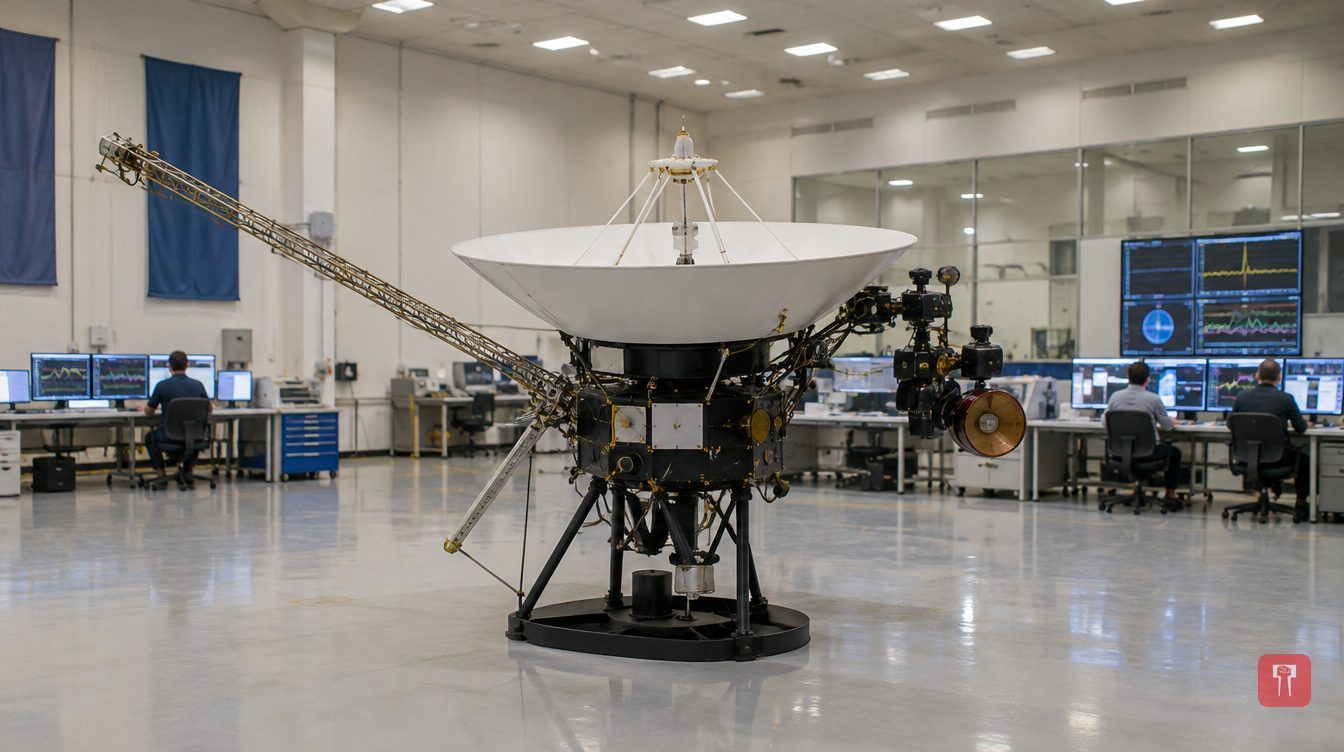 Images are not validated/verified
NASA's Voyager 1, launched on September 5, 1977, will be one light-day from Earth on November 18, so a radio message will take 48 hours for a round trip.
NASA's Voyager 1 spacecraft is about to reach a new milestone in the history of space science. Launched on September 5, 1977, it will be one light-day from Earth on November 18. No object built by humans has gone this deep into the universe.
A light-day is the distance light covers in 24 hours. Light travels about 3 lakh km in a second. The distance works out to about 16.09 billion miles, or 25.89 billion km. Voyager 1 is currently moving out of the solar system at 38,000 miles an hour (61,155 km an hour).
Once it reaches this distance, communication between Earth and the spacecraft will change. Any radio message that engineers at NASA's Jet Propulsion Laboratory (JPL) in California send will take 24 hours to reach Voyager 1, and the reply will take another 24 hours to come back. NASA's team will therefore have to wait 48 hours to complete one round trip of a message.
The 50-year journey has had dramatic moments. This October, the spacecraft briefly lost contact with Earth. On October 18 and 19, NASA tried to contact it at the scheduled time but received no radio signal, and the scientists' anxiety rose.
The spacecraft's own automatic safety system then came into play. Its computer detected a possible fault in the active thrusters, switched on the backup thrusters by itself and brought the spacecraft to a safe state. On October 20, NASA's Deep Space Network picked up Voyager 1's signal again, and a major threat to the mission passed.
Voyager mission manager Kareem Badaruddin (NASA JPL) said, "This is the first time we have seen a spacecraft switch on its safety system by itself like this. But we are at a stage of the mission where we must be ready for any mishap. We are greatly relieved that contact with Voyager 1 has been restored."
Voyager 1 was in fact launched after Voyager 2. But because of its fast trajectory, it overtook its twin on December 15, 1977 and crossed the asteroid belt. The mission's initial aim was only to study Jupiter and Saturn.
Near Jupiter, the spacecraft discovered a very thin ring and two new moons, Thebe and Metis. Passing Saturn, it discovered a new ring called the G-ring and recorded 5 new moons. On August 12, 2012, Voyager 1 crossed the heliopause, the boundary of our solar system. It became the first object in human history to enter interstellar space, where the influence of particles and the magnetic field from the Sun ends.
Billions of kilometres from Earth, sunlight is very weak, so it was not possible to run Voyager 1 on solar power. NASA fitted it with radioisotope thermoelectric generators (RTGs). These convert the heat produced by the natural decay of the radioactive material plutonium-238 into electricity.
Crossing the one light-day distance will make no difference to the spacecraft's functioning or its surroundings. Even so, it is a striking proof of how far human skill and technology have leapt into the vast expanse of the universe. Fifty years on, the spacecraft is still talking to Earth with a radio signal of just 22 watts.
Reach readers on the ward they actually live in.
Advertise with Prime Time 24Reach readers on the ward they actually live in.
Advertise with Prime Time 24Reach readers on the ward they actually live in.
Advertise with Prime Time 24Reach readers on the ward they actually live in.
Advertise with Prime Time 24
Comments
No comments yet. Be the first.