

Vidarbha's people face water cuts while industries get ample supply, raising questions
As drought-like conditions grip Maharashtra and the country, a question arises over whether water-intensive industries in Vidarbha will face cuts like the public.
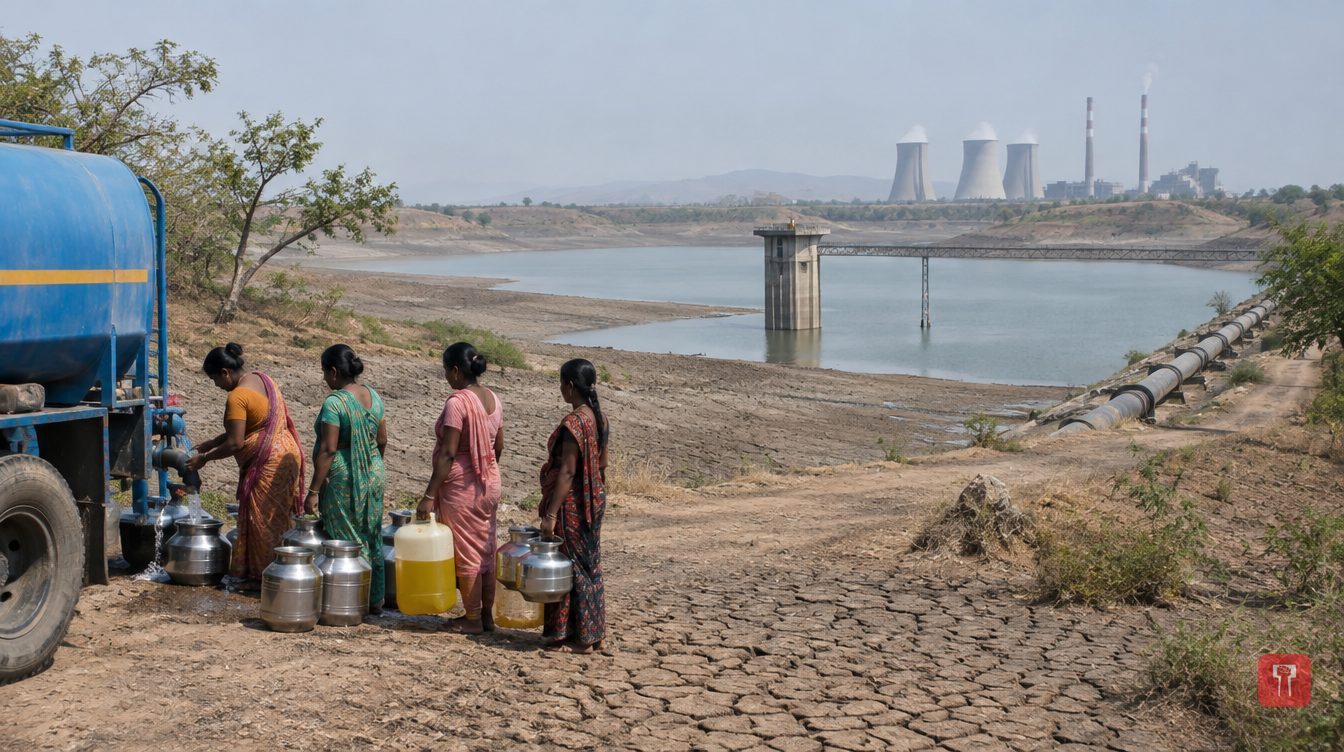 Images are not validated/verified
Nagpur: Maharashtra's Vidarbha region has emerged as an important hub on the country's industrial map. Large projects in defence manufacturing, thermal power generation, cement production and the cleaning of steel and mineral resources have been running successfully for several years. The government and industry want new projects in these sectors to come to Vidarbha as well.
The main argument offered is that Vidarbha has abundant water and an environment that is balanced and favourable to industry. Sectors such as defence, energy, cement, and steel and mineral processing need a great deal of water for production. That is why such water-intensive industries have been set up in Vidarbha and are lining up to come here in future.
But the situation on the ground runs counter to these claims. Drought-like conditions prevail across the country, including Maharashtra, and there is a clamour for water everywhere. Reservoir levels have dropped. The government and administration are repeatedly appealing to people to save water and accept water cuts. Cities are getting water supply on alternate days, while in villages there is a shortage of drinking water and farmland is drying up. The cuts have begun to affect the lives of ordinary people directly.
The biggest question that arises is whether the government will apply a "low water use" policy to water-dependent projects in defence, energy, and steel and mineral processing as well. Will their water be cut too?
If the government's policy is "one rule for all", production is bound to suffer in industries wholly dependent on water if their supply is reduced. Thermal power plants need thousands of litres of water daily for cooling, as do cement plants and ordnance factories. If water falls, production will fall and the power crisis will deepen.
Hundreds of new projects that exist only on paper, such as new defence corridors, expansion of solar and thermal power, and new cement clusters, will remain on paper. The reason is that investors will not put capital into a region where water supply is uncertain.
It remains to be seen how far the government's policy and intent take it in this difficult situation. Will it show courage in this crisis, take an equal decision for all and apply a fair formula for water cuts across all sectors?
Or will it adopt a double standard, in which the public, farmers and farmland have their water cut and are asked to make sacrifices, while industries are given plentiful water without interruption to keep production going?
This is a time of testing, both for the truth about Vidarbha's water and for the government's intent. Water will decide whether Vidarbha's future belongs to industry or to farms, or to a balance between the two.

Comments
No comments yet. Be the first.