

Suzuki launches e-Sky, its cheapest electric car, in Japan with 310 km range
The BYD-battery kei car goes on sale in Japan on November 16, 2026, in three variants priced from 2.12 million yen.
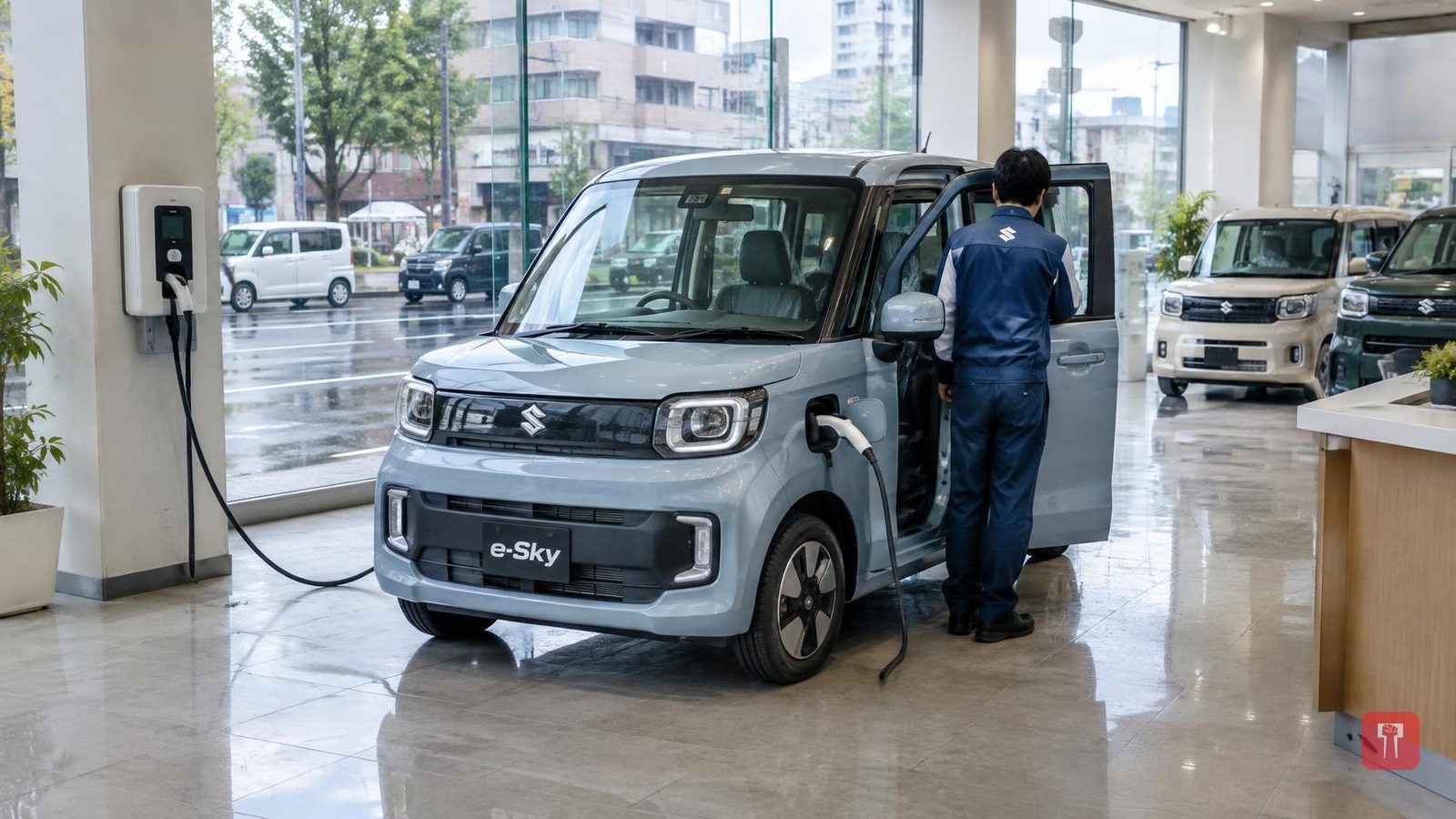 Images are not validated/verified
Suzuki came late to the electric vehicle market, but it has now officially launched the e-Sky, its cheapest and most attractive electric car so far. The car has been introduced in the Japanese market and belongs to the kei car category. It is expected to make waves in the budget electric vehicle segment. Suzuki has used technology from Chinese company BYD in the car and priced it affordably.
Sales of the e-Sky in Japan will begin on November 16, 2026. The company has offered it in three variants: A, G and X.
The base variant A is priced at 21.2 lakh Japanese yen, which works out to roughly Rs 13 lakh. This model will be built to order. The middle variant G costs 23.9 lakh yen, or roughly Rs 14.6 lakh. The top variant X is priced at 27.9 lakh yen, roughly Rs 17 lakh.
With the Japanese government's electric vehicle subsidy (CEV Subsidy), the effective price could fall further to about Rs 9.4 lakh. Suzuki has set a target of selling at least 1,000 cars a month.
The car's biggest feature is its battery. Suzuki has fitted it with a lithium iron phosphate (LFP) battery from Chinese automaker BYD. The battery capacity is 26 kWh, and the car is built on Suzuki's HEARTECT-e platform. The lightweight car can run up to 310 km on a single charge. The figure is the company's claim under the WLTC cycle.
Energy consumption is very low at 97 Wh/km. The car gets a 50 kW DC fast charger, which makes charging easier. Compared with China's BYD Racco, the e-Sky offers good range despite a smaller battery.
On design, the e-Sky has a "tall boy" look. It is 3,395 mm long, 1,475 mm wide and 1,625 mm high, with a wheelbase of 2,460 mm. The car weighs only 1,030 kg.
Inside, features include a 10.1-inch central touchscreen system, a driver display, a push-start button and automatic climate control.
After Japan, the car is likely to reach the UK and European markets by 2027. The company has so far made no official announcement on when it will come to India.
