

Rashtra Sevika Samiti, founded in Wardha in 1936, now spans the country and works abroad
Founded by Laxmibai Kelkar on Vijayadashami in 1936, the women's organisation now runs over 4,886 active shakhas and about 2,866 service projects across India.
 Images are not validated/verified
The Rashtra Sevika Samiti was founded in Wardha on Vijayadashami, October 25, 1936. Its founder was Laxmibai Kelkar, who is also called Mausi ji. Nearly nine decades on, the organisation works across the country and abroad. The details are given in an article by Prof. Aarti Tiwari, the Vidarbha Prant bauddhik pramukh.
According to the article, the nation's identity was wounded during the period of subjugation and conditions were unsettled. Mausi ji felt troubled by this from childhood. She grew increasingly convinced that political freedom alone was not enough for the country's revival and that the inner strength of society also had to be awakened. The Samiti was formed out of the belief that woman is the foundation of the nation. "Sam iti samitih" means the organised strength of women who come together of their own accord with a common goal, common inspiration and devotion to the nation.
Laxmibai was born in Nagpur on July 6, 1905, to Bhaskarrao Date and Yashodabai Date. She was then named Kamal. The fearless atmosphere at home instilled deep patriotic values in her from childhood. In 1915 she married Purushottamrao Kelkar of Wardha and came to be called Laxmibai. When her husband died suddenly in 1932, she was struck by grief, but she continued her self-reflection and social work.
She attended Mahatma Gandhi's prayer meetings. At one meeting the question arose of what ideal women should follow. Gandhi asked that Sita be held up as the ideal, because it was through Sita's radiance, austerity and purity that Ram became Shri Ram. After reading the Ramayana, Laxmibai felt that a woman should learn to protect herself through her own strength. She was also convinced that for the nation's advancement, both women and men must be equally empowered.
Dr Keshav Baliram Hedgewar, founder of the Rashtriya Swayamsevak Sangh, came to Wardha. After a session for parents held at the shakha, Laxmibai met him and put forward the need for an organisation for women, as there was for men. Hedgewar said she should take on the responsibility for a women's organisation herself and that the Sangh would give full support. According to him, the Sangh and the women's organisation would work for the same goal like the two parallel tracks of a railway. The Samiti was founded in 1936.
Under Mausi ji's leadership the shakhas expanded, and work on awakening society grew through conferences, service work and discourses on the Ramayana. A strong cadre of dedicated vistarikas and pracharikas emerged. After Laxmibai Kelkar's death on November 27, 1978, Saraswati Tai Apte of Pune was pramukh sanchalika from 1978 to 1994. Ushatai Chati and Pramilatai Medhe then led the organisation. Shantakkaji is the current pramukh sanchalika. Giving priority to principle over person, the Samiti has accepted the saffron flag in the place of guru.
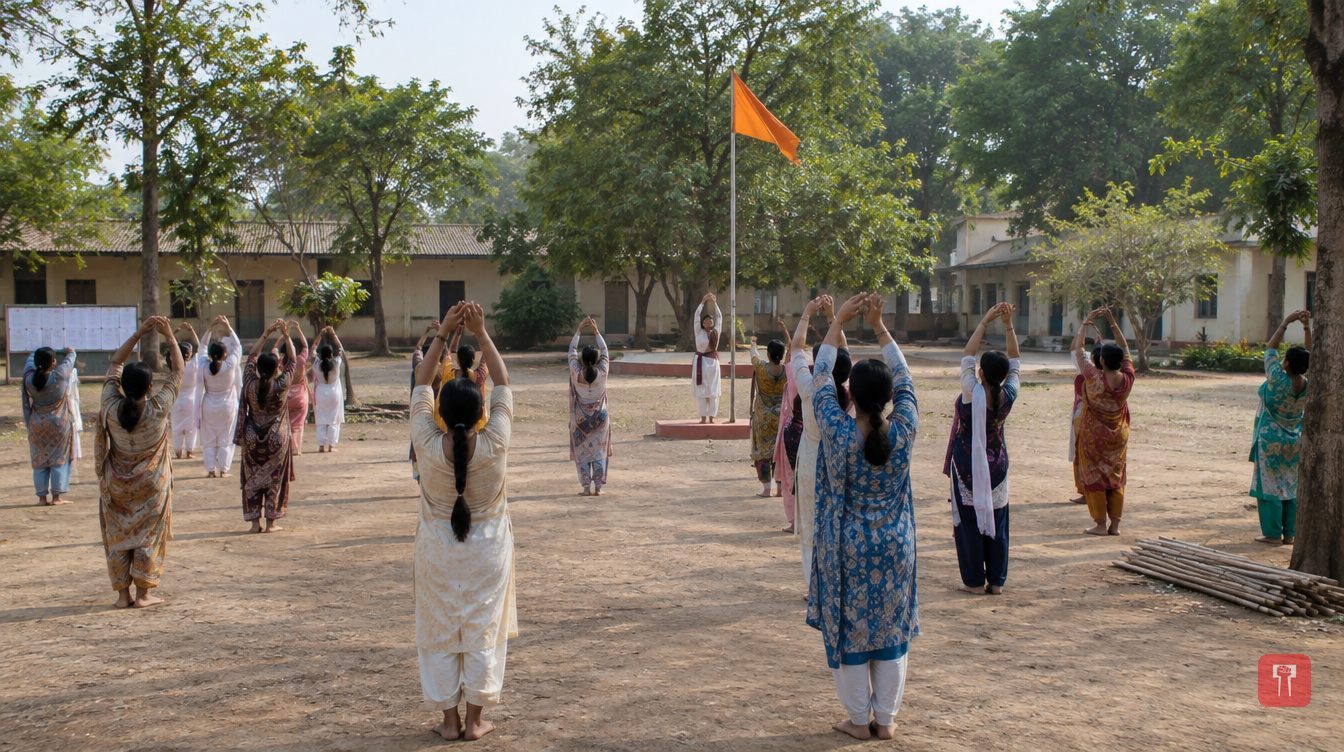
The shakha is the main unit of the Samiti's work. Yoga, Surya Namaskar, dand, yashti, games, patriotic songs, bauddhik discussions and deliberation on current events are held there. There are now more than 4,886 active shakhas across the country, of which about 591 are daily shakhas. More than 1,173 milan gatherings are held for working women and young women. The Samiti has a place for everyone, from a one-year-old girl to a 90-year-old grandmother who walks to the shakha with a stick.
The Samiti runs about 2,866 service projects. More than 60 centres provide training in tailoring, handicrafts, computers, food processing and other vocational skills. Free clinics and health camps are held in remote and tribal areas. A hostel for tsunami-affected girls in Tamil Nadu, the rehabilitation of Mayapur village in Gujarat after the earthquake, the distribution of masks and rations during the Covid period and recent help in flood-hit areas of Nepal are cited as examples of the Samiti's spirit of "Narseva hi Narayan seva".
For girls who are deprived of education or come from families affected by violence, terrorism and farmer suicides, the Samiti runs about 27 free and 9 paid hostels. In some countries abroad, sevikas are working with the Hindu Swayamsevak Sangh (HSS). According to the article, the sapling planted by Laxmibai Kelkar has today become a giant banyan tree.
