

Nagpur air turns unhealthy after Diwali fireworks, AQI 174 at VNIT
 Images are not validated/verified
US AQI at VNIT Nagpur was 174 on November 8, in the "unhealthy" category, while other stations recorded 109 to 118 after Diwali fireworks.
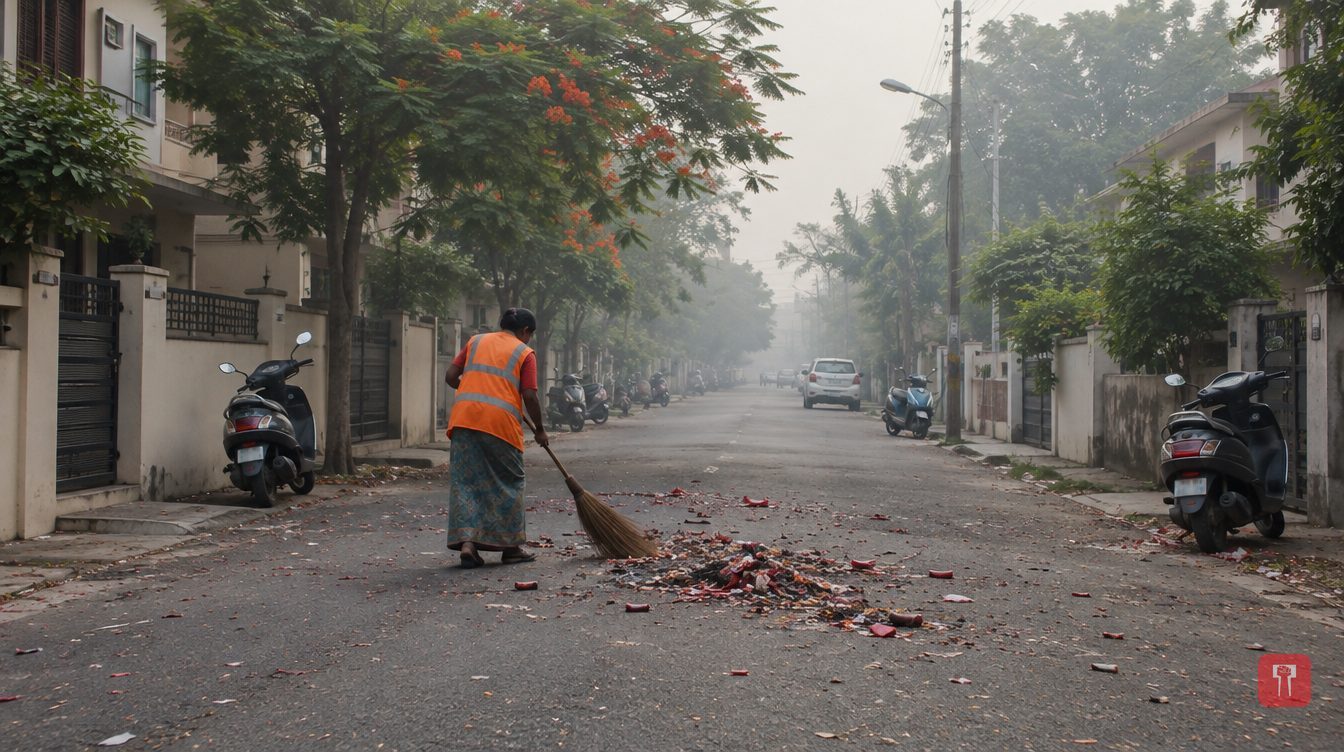
Nagpur lights up every year with Diwali illuminations and fireworks. Behind the colourful bursts in the night sky, however, lies an environmental concern: the effect of firecrackers on the air the city's residents breathe.
The city's air was already worsening before Diwali. Heavy use of firecrackers can add another layer of pollution, especially in the late-night hours, when weather conditions keep pollutants from dispersing quickly.
According to US AQI data for November 8, 2026, VNIT Nagpur recorded 174, which falls in the "unhealthy" category. The station opposite the GPO in Civil Lines recorded an AQI of 118. Ambazari, Mahal and Ramnagar each recorded 109. These three readings fall in the "unhealthy for sensitive groups" category. The readings are indicative and may change, and the figure from a single station does not represent the whole area.
According to available data, PM2.5 levels at the city's monitoring stations were high in the two days before the main Diwali celebrations. The PM2.5 reading was put at 265 on November 5 and 211 on November 6. Pollution was particularly high late at night and in the early morning. Industrial emissions, thermal power plants, vehicle exhaust and open waste burning have been listed among the possible causes.
It is important to understand that firecrackers alone are not responsible for Nagpur's worsening air. Even so, fireworks add a sudden and concentrated burden to an already polluted atmosphere.
Burning firecrackers releases several kinds of pollutants into the air. PM2.5 refers to extremely fine particles that can travel deep into the lungs and reach the bloodstream. PM10 are larger particles that can irritate the airways. Sulphur dioxide can aggravate respiratory illness. Nitrogen oxides cause breathing irritation and play a role in chemical reactions in the atmosphere. To produce colours and effects, fireworks also contain compounds of elements such as barium, aluminium, strontium and potassium. In neighbourhoods where many firecrackers are set off at once, particles, smoke and chemical pollutants in the air rise for a time.
Research in various Indian cities shows that air quality drops sharply during Diwali. A study published in June 2026 examined 14 cities in the Indo-Gangetic region. It found that PM2.5 and PM10 levels during Diwali rose above the national standard and the WHO guideline. The study also identified firecracker smoke as a source of fine particles, heavy metals and gaseous pollutants.
In another study, in Bhubaneswar, PM2.5 was recorded at 113.83 micrograms per cubic metre and PM10 at 204.32 micrograms per cubic metre on Diwali day in 2021. Research in Amritsar found that metallic particles made up a large share of PM2.5 during Diwali fireworks. These studies were not conducted in Nagpur, but they show what heavy use of firecrackers can do to the environment.
The effects of increased pollution are not the same for everyone. Children, the elderly and people with asthma, COPD or other respiratory illnesses are at greater risk. High levels of fine particles can cause coughing, throat irritation, burning or watering of the eyes, breathlessness and wheezing. Asthma and other lung conditions can worsen, and strain on the hearts of vulnerable people can increase. Even healthy people can feel discomfort when exposed to dense firecracker smoke.
The problem is not limited to the minutes when the firecrackers go off. In November, night temperatures fall, wind speeds stay low and the atmosphere remains still, so pollutants do not disperse. Smoke and fine particles can linger close to the ground for longer. The effect on people can therefore persist after the fireworks end.
Nagpur is often known for its greenery and relatively open urban setting. Even so, its air is affected by industry, vehicle exhaust, construction dust, waste burning and weather. Diwali fireworks add to this existing burden.
The question is not whether people should celebrate Diwali, but how to make the celebration less polluting while keeping its cheer. Choosing community celebrations, bursting fewer firecrackers and not staying long in firecracker smoke can help reduce pollution and protect vulnerable people.
Reach readers on the ward they actually live in.
Advertise with Prime Time 24Reach readers on the ward they actually live in.
Advertise with Prime Time 24Reach readers on the ward they actually live in.
Advertise with Prime Time 24Choose primetime24.com as a preferred source on Google Google shows more stories from your preferred sources in Top Stories.
Reach readers on the ward they actually live in.
Advertise with Prime Time 24
Comments
No comments yet. Be the first.