

Kanya Pujan in Navratri: names of the goddess by age and how the ritual is performed
On Ashtami or Navami, many households worship young girls as forms of Adishakti, offering them food and gifts as an expression of respect.
 Images are not validated/verified
In Indian culture, woman is regarded as a form of Shakti. Shardiya Navratri is dedicated to the worship of Adishakti Jagdamba, and different forms of the goddess are worshipped over these nine days. Fasting, chanting, austerities, homa-havan and devotion to the goddess carry special importance during this period. At this time, many households observe the tradition of worshipping young girls on Ashtami or Navami.
The ritual is called Kanya Pujan or Kumari Pujan. Its core idea is to see the form of Adishakti in the girls, honour them, feed them and show respect by giving them gifts.
In the Shakta tradition, Adishakti is regarded as the root of the entire creation. Durga, Lakshmi, Saraswati and Kali are different forms of the goddess, symbolising power, prosperity, knowledge and strength. During Kanya Pujan, there is a religious sentiment of seeing Adishakti herself in young girls. The goddess is seen in the innocence and purity of the girls and in their sinless world. Worshipping them, feeding them respectfully, giving them clothes or gifts and taking their blessings is therefore considered an important tradition of Navratri devotion. Kanya Pujan is performed on a large scale on Ashtami or Navami, especially in north India. Many families in Maharashtra also observe the tradition with devotion.
The names of the Kumarikas by age and their religious significance are described as follows. A girl of two is called Kumari, a symbol of innocence and purity, and it is believed that worshipping her removes poverty. A girl of three is Trimurti, a symbol of the powers of creation, sustenance and transformation, and worshipping her is believed to bring happiness and prosperity. A girl of four is Kalyani, a symbol of well-being and auspiciousness, and it is held that worshipping her brings welfare to the family.
A girl of five is Rohini, a symbol of health and growth, and it is a religious belief that worshipping her frees one from illness. A girl of six is Kalika, a symbol of strength and the power to face crises, and it is believed that worshipping her brings fame and strength. A girl of seven is Chandika, a form of the goddess who destroys evil tendencies, and it is believed that worshipping her brings prosperity.
A girl of eight is Shambhavi, a symbol of Shiva-Shakti, and it is said that worshipping her brings victory. A girl of nine is Durga, a form of Adishakti who protects from crises, and it is held that worshipping her brings victory over enemies. A girl of ten is Subhadra, a symbol of auspiciousness, and it is believed that worshipping her fulfils wishes. These fruits are part of religious faith. The order of names and the fruits of worship may differ somewhat across scriptures or regional traditions.
Kanya Pujan places greater weight on devotion, a pure heart and respect for the girls than on show. The ritual can be performed simply, according to the family's tradition. Girls are invited home for a meal on Ashtami or Navami. Nine girls are commonly invited, but in some families three, five or seven girls are worshipped. In many places a small boy is also fed along with them, as a symbol of Batuk Bhairav.
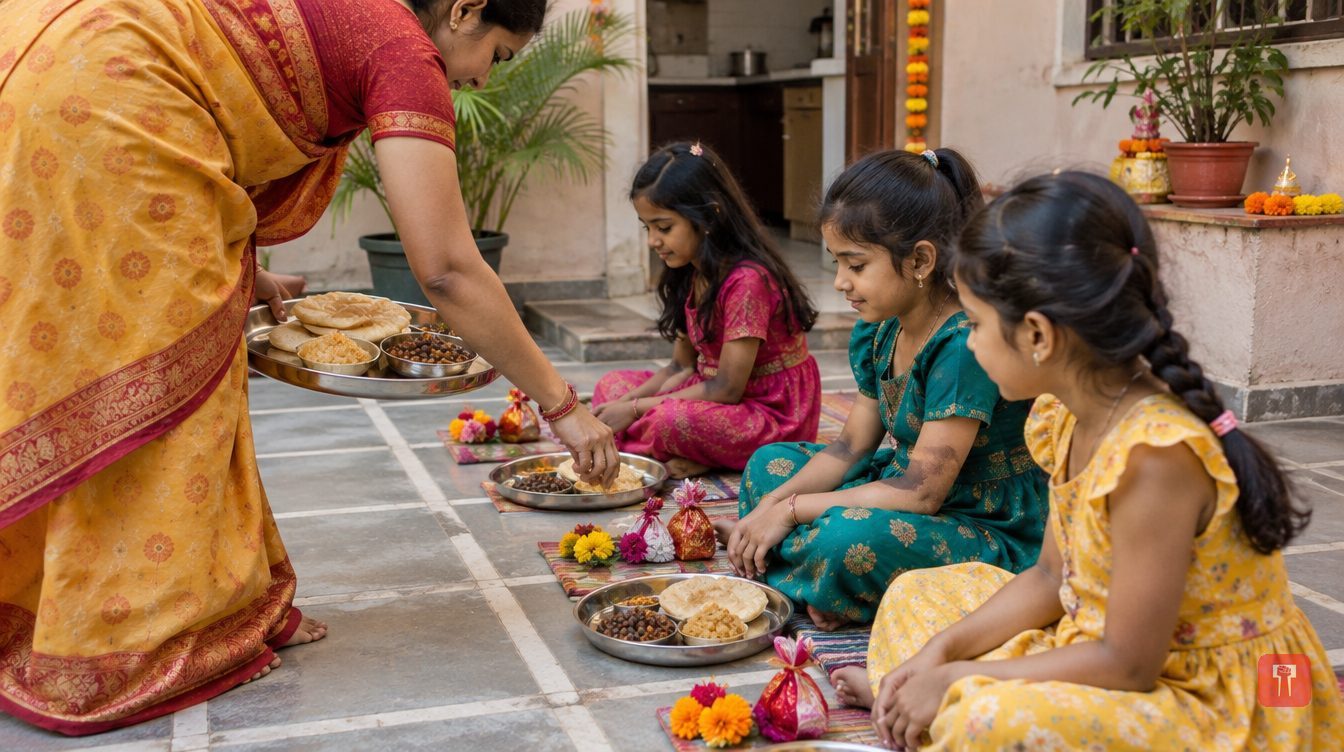
When the girls arrive, welcome them warmly. In the traditional method, their feet are washed with clean water and they are seated on a clean seat or low stool. This is a symbol of respect and humility. Haldi-kumkum and akshata are then applied to their foreheads and a flower or gajra is offered. The worship is performed with a sincere mind, remembering the goddess. Then, according to the family's tradition, an aarti, stotra or mantra recitation for Goddess Durga can be performed.
The most important part of Kanya Pujan is feeding the girls lovingly. Puri, black chana and halwa or sheera are offered as prasad in many places. In Maharashtra, according to the family's tradition, kheer, sweets or other sattvik food is also served. After the meal, the girls are given fruit, stationery, useful items, bangles, clothes or dakshina according to one's means. The gift need not be expensive; what matters more is that it is given with love and respect.
Finally, bow to the girls, take their blessings and bid them farewell with affection. Throughout the ritual, take care that the girls feel no hesitation or discomfort. Their wishes, convenience and cleanliness should come first.
