

Kagal-Pune highway has toll plazas but no dedicated fire response
Five toll plazas dot the busy Kagal-Pune highway, but none has its own firefighting unit to tackle vehicle fires after accidents
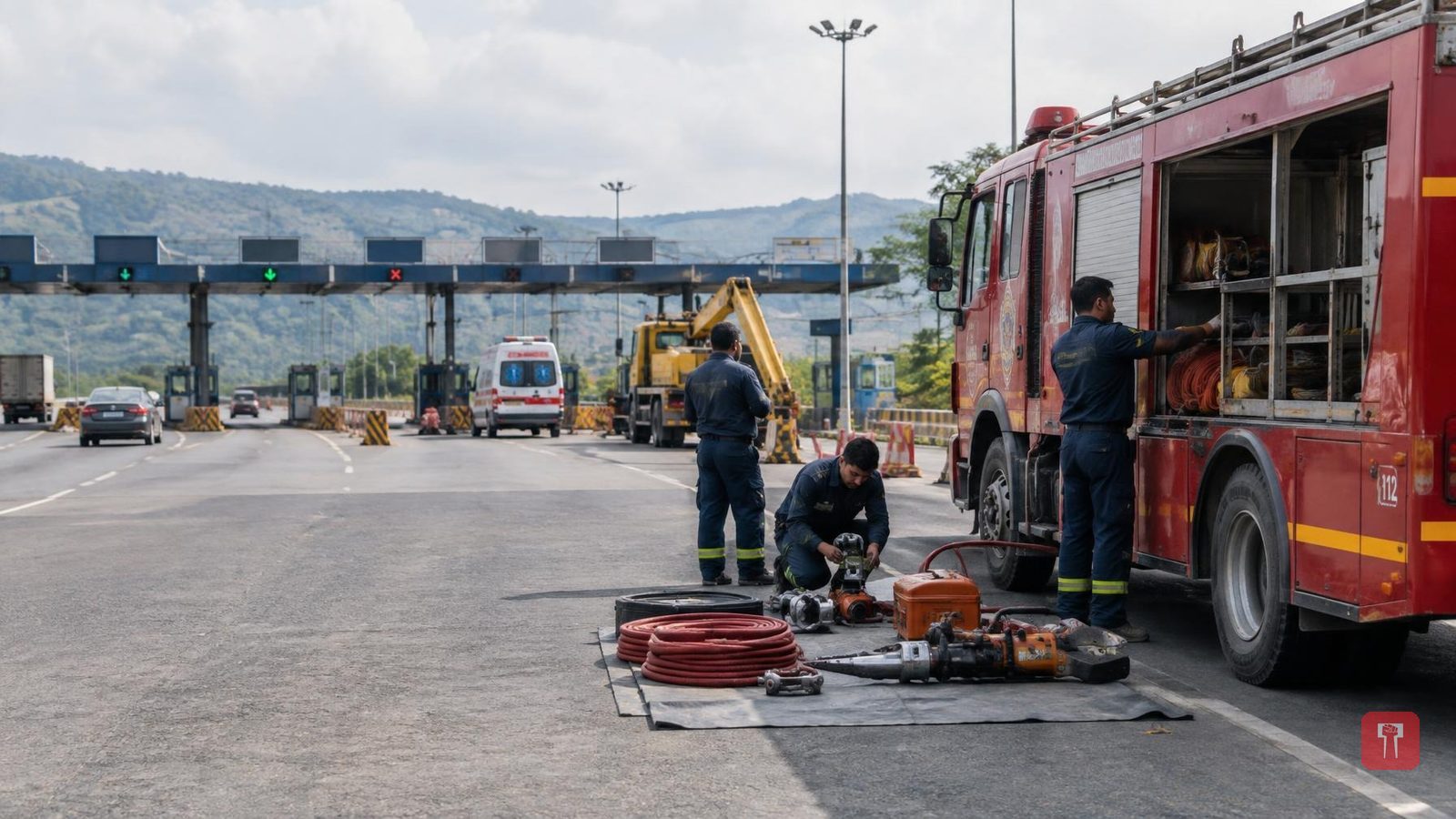
The national highway from Kagal to Pune via Shendre in Maharashtra is one of the busiest and most important routes in the state. There are five toll plazas along the entire route: Kagal, Kini, Taswade, Anewadi and Khed-Shivapur. Every toll plaza has facilities like ambulances and cranes, but the National Highway Authority's toll system does not have its own firefighting arrangement to quickly douse a fire if a vehicle catches fire after an accident. As a result, the highway has to depend on fire brigades from the Malkapur, Karad and Satara municipal councils, as well as the Ajinkyatara, Krishna and Sahyadri sugar factories. With rising traffic on the highway, there is now a growing feeling that this system needs to change.
Today's vehicles use far more advanced electronic systems, sensors, computerised mechanisms, wiring, battery management systems and other electrical parts compared to before. This has improved vehicle performance, safety and convenience, but if there is a fault in the electrical system, the risk of fire also remains. Cases of fire due to short circuits in wiring, faults in batteries or electrical parts, wiring damaged in accidents, or fuel leaks continue to be reported.
If a fire breaks out within moments of a high-speed accident on the highway, the situation can turn extremely serious. If the driver and passengers are trapped in the vehicle, they may have only a few minutes to be pulled out. Because modern vehicles have electronic locking and other automatic systems, a power supply cut or system failure after an accident can make it difficult to open the doors. There have been cases where passengers could not get out immediately because the vehicle's doors were locked. This makes it critical to get people out of the vehicle safely before the fire spreads.
This is why ambulances and cranes alone are not enough. A dedicated firefighting and rescue system is urgently needed to deal with fires and to extricate people from vehicles trapped in accidents. Every minute it takes for a fire brigade vehicle to reach the accident site is precious. If a fire brigade has to come from a distant town and the fire reaches the vehicle's cabin in the meantime, the risk to life increases sharply.
Despite having five toll plazas along the entire Kagal-Pune route, each toll system should keep an advanced firefighting and rescue team ready in its own area. There is a natural case for the National Highways Authority of India (NHAI) to set up a separate fire response centre every 35 kilometres. These centres should have advanced firefighting vehicles, foam tenders, an adequate water stock, hydraulic cutters, rescue tools to cut doors and vehicle parts, fire-resistant equipment and trained staff. A system could be built so that the moment CCTV or the control room at a toll plaza gets information about an accident, a firefighting team is dispatched to the spot. A separate emergency control system could also be set up to coordinate between ambulances, cranes, police and fire brigades. This would make it possible not just to put out fires but also to pull trapped people out and get them medical help immediately.
Vehicles worth thousands of crores of rupees run on this highway today. Vehicle prices and technology have gone up, and so has speed, but it is time to ask whether the system for saving lives immediately after an accident has kept pace. Fire brigades from the Malkapur, Karad and Satara municipal councils, along with the Ajinkyatara, Krishna and Sahyadri sugar factories, have helped many times in emergencies. But it would be far more effective if the highway's emergency firefighting arrangement were part of NHAI's own system rather than depending on local bodies for help. An ambulance saves the lives of the injured, a crane clears the accident vehicle, but it is the firefighter who reaches within the first few minutes that can prove decisive in pulling living people out of a burning vehicle. Therefore, along with collecting tolls, a decision to set up advanced firefighting and rescue centres every 35 kilometres on the Kagal-Pune highway needs to be taken soon, giving priority to passenger safety.
Small and big accidents keep happening on the national highway. Several times, vehicles have also caught fire after accidents. In some cases passengers have lost their lives, while in others, goods worth lakhs of rupees have burned along with vehicles, causing major financial loss. This makes it essential to have a firefighting system that can reach the spot immediately after an accident.
A few days ago, smoke was seen coming out of a goods truck at Umbraj. Had fire brigade help arrived in time, the fire could have been brought under control on the spot and a major financial loss avoided. Given the possibility of such incidents on the highway, NHAI's own advanced firefighting and rescue arrangement should be operational on the highway instead of depending on local fire brigades, said Amol Kamble, an MNS Yuva Sena office-bearer from Umbraj.
