

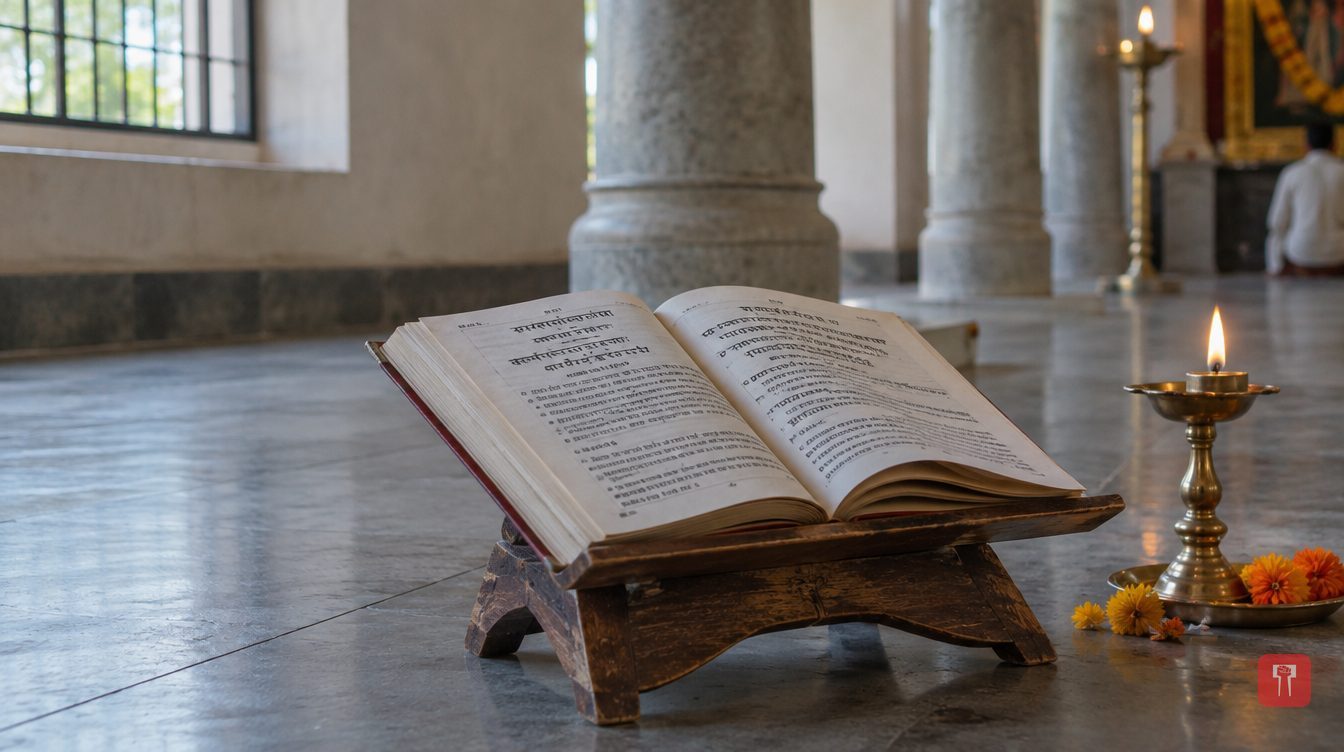
Bhagavad Gita has 18 chapters and 700 verses; tradition credits Ved Vyasa with compiling it
 Images are not validated/verified
The Gita, part of the Bhishma Parva of the Mahabharata, records Krishna's teaching to Arjuna at Kurukshetra and is traditionally credited to sage Ved Vyasa.
The Shrimad Bhagavad Gita holds a special place in Indian culture, philosophy and spirituality. The commonly accepted version of the Gita has a total of 18 chapters and 700 verses. It forms an important part of the Bhishma Parva of the Mahabharata.
The teaching Lord Krishna gave Arjuna on the battlefield of Kurukshetra is the core of the Gita. Before the war began, Arjuna was in turmoil, faced a moral dilemma and was uncertain about his duty. Krishna gave him this teaching in answer to those questions.
According to tradition, the composition and preservation of the Gita is credited to Maharshi Ved Vyasa. The Hindu tradition holds that he set down this dialogue in the Mahabharata. Maharshi Ved Vyasa is regarded as a great sage, philosopher and man of letters of the Indian tradition, and is especially known as the author of the Mahabharata. In this vast epic, he portrayed in depth the righteousness and unrighteousness, ethics and lack of ethics, duty, relationships and values of human life.
The Gita is written in the form of a dialogue. The conversation between Lord Krishna and Arjuna is its main basis. Through this conversation, an attempt is made to find answers to several fundamental questions of human life.
In the commonly accepted structure, the Gita falls between chapters 23 and 40 of the Bhishma Parva. Its 18 chapters include themes such as Arjuna Vishada Yoga, Karma Yoga, Jnana Yoga, Bhakti Yoga, Vishwarupa Darshana Yoga and Moksha Sannyasa Yoga. Each chapter offers a different way of looking at life, and each throws light on different spiritual and philosophical themes.
One of the most important lessons of the Gita is to perform one's duty honestly without attachment to its fruits. The broad meaning of its teaching is that, however difficult the circumstances, a person should decide with discernment, restraint and an understanding of dharma.
Karma Yoga conveys the importance of duty, Jnana Yoga the contemplation of the nature of the self, and Bhakti Yoga the sense of a relationship with God. For this reason, the Gita is not merely a religious text but becomes a philosophical work that guides people in facing life's struggles, decisions and inner conflict.
The legacy that Maharshi Ved Vyasa gave Indian culture through the Mahabharata is immensely valuable. Through the Gita, Krishna's teaching reached people generation after generation. This philosophy, set in eighteen chapters and seven hundred verses, underlines the importance of duty, self-knowledge, devotion and selfless action. For this reason, the Shrimad Bhagavad Gita is regarded as a priceless heritage of Indian philosophy.
Reach readers on the ward they actually live in.
Advertise with Prime Time 24Reach readers on the ward they actually live in.
Advertise with Prime Time 24Reach readers on the ward they actually live in.
Advertise with Prime Time 24
Comments
No comments yet. Be the first.