

Did Draupadi keep Karwa Chauth? The legend Krishna told her, and how the fast is observed
As Karwa Chauth nears, a Mahabharata tale holds that Krishna asked Draupadi to keep the fast while Arjuna was away, and married women follow a set ritual.
 Images are not validated/verified
Karwa Chauth is only a few days away. On this day, married women observe a strict fast for the long life of their husbands. They take neither a grain of food nor a drop of water through the day. In the evening they listen to the story of the fast, and at night they break it after sighting the moon. The festival's roots lie in an old tale from the Mahabharata, in which Lord Krishna himself asked Draupadi to keep this fast.
According to the tale, Arjuna had once gone to a mountain to perform penance to obtain divine weapons from the gods, and did not return home for many days. In his absence Draupadi felt lonely. She began to feel that danger surrounded her both at home and outside, and fear and worry stayed with her all the time. She remembered only Krishna as her support. She called out to him and said, "Krishna, Arjuna is not here, I cannot think what to do, everything seems difficult, show me a way."
Krishna then reassured her and told her of a fast. He said, "There is a fast called Karka Chaturthi, which we know as Karwa Chauth. Women keep it for the well-being of their husbands. It brings happiness to the household and removes obstacles."
Krishna did not stop there. He told Draupadi of another episode. He said, "Goddess Parvati once asked Lord Shankar the same question: what can I do for my husband so that he prospers? Shankar then told Parvati to keep this very fast. Observing it removes the hurdles in married life and brings lasting good fortune."
Hearing all this, Draupadi's mind grew calm. She decided that she too would keep the fast. She then observed it wholeheartedly and according to the rules. She worshipped Karwa Devi, Shankar and Parvati, and heard the full story of the fast from Krishna himself. In the evening she offered arghya to the moon and broke her fast. It is believed that all the troubles of her life ended because of this fast.
As for the manner of worship, the woman rises early in the morning, bathes and cleans the house and the prayer room. Before dawn she eats the sargi given by her mother-in-law. After eating it, she takes the vow, with the name of God, that she will not eat or drink anything through the day.
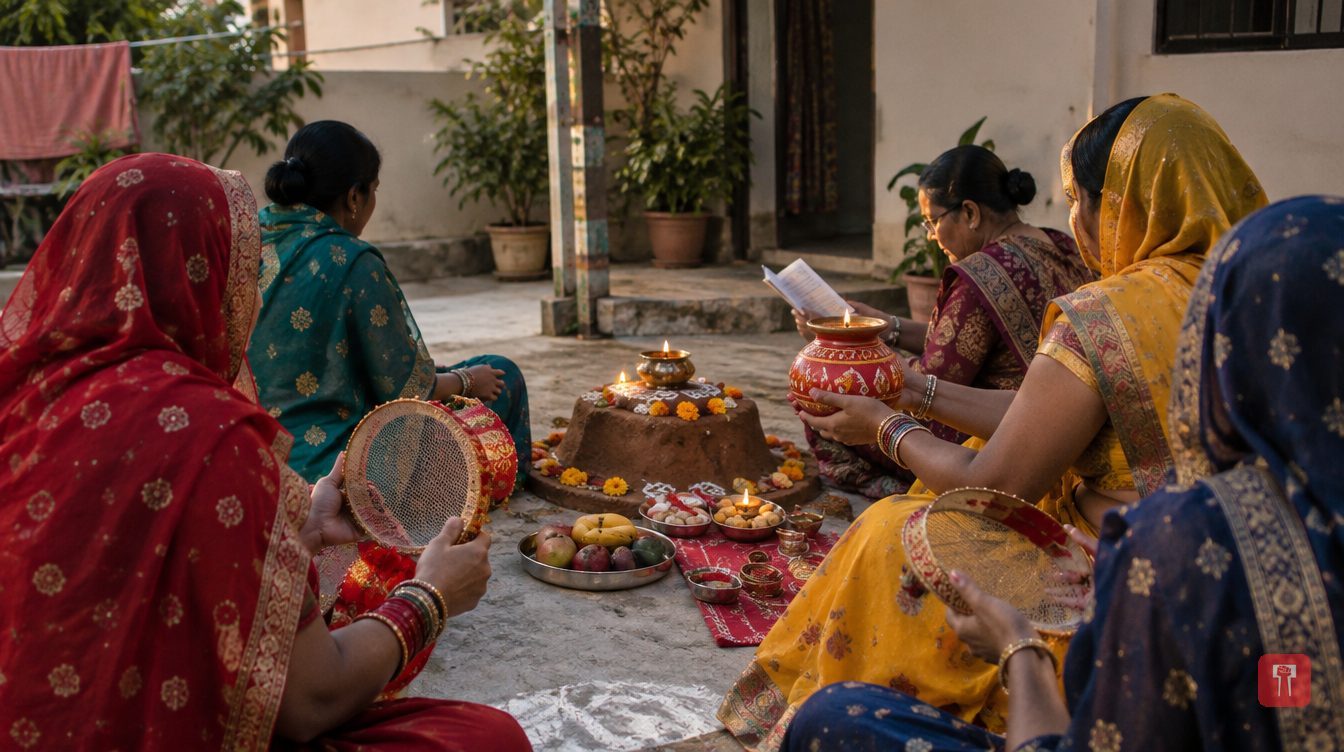
Preparations for the puja begin in the evening. A small altar is made with some clay, and the deities are seated on it. A karwa, a small earthen pot, is placed in front and filled with water, and is worshipped. Incense sticks and a lamp are lit, and kumkum, turmeric and sandalwood paste are applied.
Before the moon rises, the women sit together and listen to the story of the fast. When the moon appears, it is first viewed through a sieve and offered an arghya of water, and then the husband's face is seen. Only after this is the fast broken. After breaking the fast, the daughter-in-law bows to her mother-in-law, gives her sweets, fruit, dry fruits and some money, and takes her blessings. In many homes, items of marital adornment such as kumkum, bangles, bindi, a mirror and a comb are also given to the mother-in-law or an elder woman of the household. The practice varies slightly from state to state and home to home, but the purpose remains the same: prayer for the husband's long life.

Comments
No comments yet. Be the first.