

Pune air turns hazardous after Diwali fireworks, AQI hits 517 in Wanowrie and 417 in Kondhwa
 Images are not validated/verified
Overnight fireworks after Lakshmi Pujan pushed air quality to dangerous levels in several Pune neighbourhoods and suburbs by Monday morning.
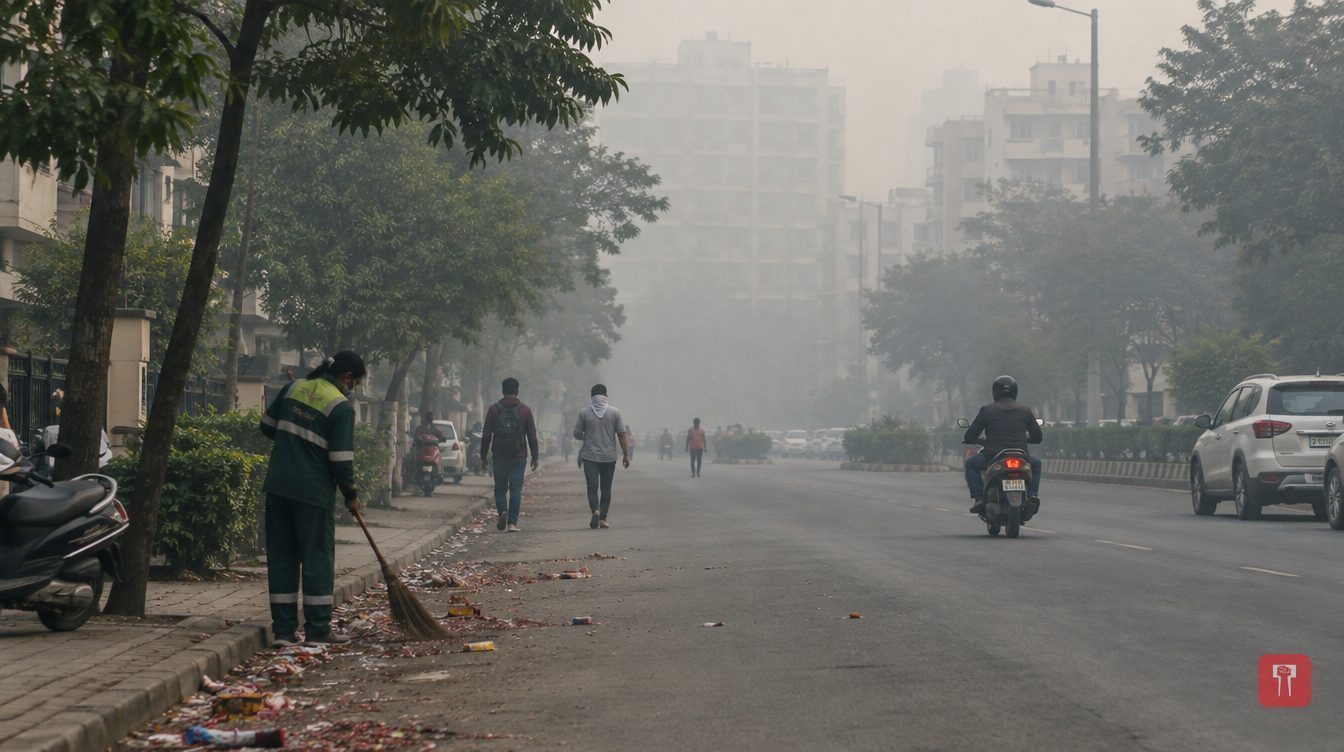
Pune woke on Monday morning under a thick blanket of pollution. Smoke from Diwali firecrackers pushed air quality in many neighbourhoods to hazardous levels. Pollution was relatively normal before the main celebrations began, but the air worsened considerably in the city and its suburbs after fireworks that continued through the night.
According to figures on an Air Quality Index (AQI) app, the city's average crossed 200, while several suburban areas recorded readings above 400. It is reported that in some areas the index went above 800 during the night. On Monday morning, Pune stood 34th among the world's most polluted cities on the platform.
The air deteriorated after large-scale fireworks following Lakshmi Pujan on Sunday evening. Between 8.30 pm and 9 pm, air quality remained mostly normal, but conditions changed as the celebrations picked up pace. Loud firecrackers, long strings of crackers and decorative fireworks continued in central Pune and its outskirts, and the smoke kept building. In many places firecrackers were still being set off after midnight, so smoke and fine particles kept accumulating in the air.
Monday morning's figures showed that pollution in Pune and Pimpri-Chinchwad was not uniform. Wanowrie recorded an AQI of 517, Kondhwa 417 and Katraj 360.
Levels remained high in other areas too. Shivajinagar recorded an AQI of 285, Sahakarnagar 275, Warje 292, Sinhagad Road 250 and Viman Nagar 212. On the Pimpri-Chinchwad side, Chinchwad recorded 305, Nigdi 250, Thergaon 270 and Hinjewadi 260.
The figures show that the impact spread well beyond the central parts of the city, affecting both residential and commercial neighbourhoods.
Normally, monsoon rain washes dust and particles out of the air, keeping it cleaner. Once the rainy season ends, dust levels begin to rise. Smoke from Diwali firecrackers adds another layer of pollution on top, and conditions worsen within a short time.
In the commonly used AQI classification, a level up to 50 is considered good and 51 to 100 satisfactory. A level between 101 and 200 is moderate, at which children and the elderly may have difficulty breathing. The range of 201 to 300 is considered poor, and readings above 300 fall in the very poor or severe category.
Reach readers on the ward they actually live in.
Advertise with Prime Time 24Reach readers on the ward they actually live in.
Advertise with Prime Time 24Reach readers on the ward they actually live in.
Advertise with Prime Time 24Choose primetime24.com as a preferred source on Google Google shows more stories from your preferred sources in Top Stories.
Reach readers on the ward they actually live in.
Advertise with Prime Time 24
Comments
No comments yet. Be the first.