

Maharashtra orders drinking water kept running in all schools and anganwadis
 Images are not validated/verified
The water supply and sanitation department has set 15 November 2026 as the last date for proposals to bring tribal hamlets without tap connections into the Jal Jeevan Mission.
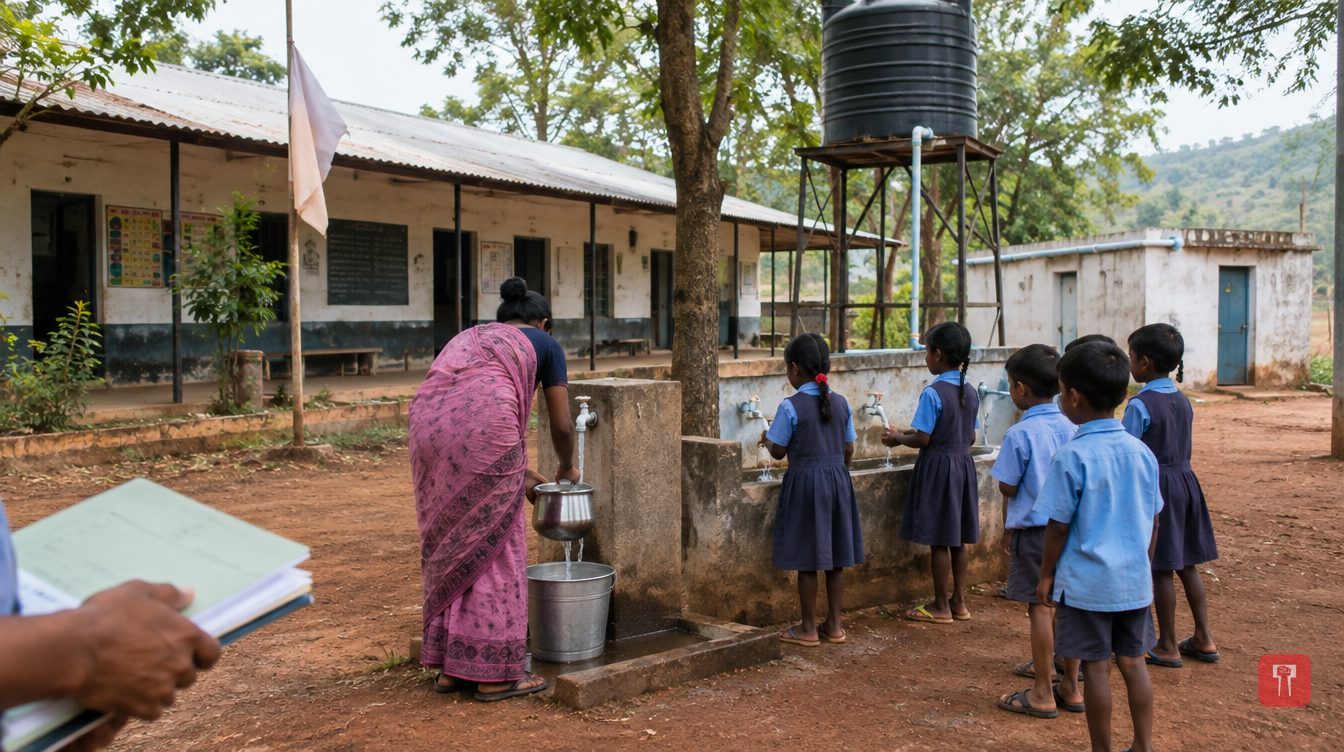
The Water Supply and Sanitation Department has issued directions to keep clean drinking water running in all schools and anganwadis in Maharashtra. The directions also cover hamlets and settlements in tribal-majority and remote areas that water has not yet reached. Under the Jal Jeevan Mission, schools and anganwadis have been told to keep up the water supply, water for toilets and handwashing facilities.
The last date for submitting proposals to bring tribal settlements that have so far been left without tap connections into the scheme has been fixed as 15 November 2026.
The information was given by Section Officer Anjali Bodke through a government circular. According to the circular, a total of 6,629 schemes for schools and anganwadis have been sanctioned in the state under the Jal Jeevan Mission. Work on 6,357 of them has been completed, while work on the remaining 272 is under way.
Chief executive officers of zilla parishads must confirm whether good-quality drinking water, water for toilets and handwashing facilities are functioning where work has been completed. Where work is incomplete, the directions are to make alternative arrangements until it is finished, such as giving a temporary tap connection from a nearby scheme, sending tankers or placing water tanks. Funds of the 15th Finance Commission are to be used for this.
Tribal settlements will be given priority in water supply schemes. Remote settlements under the Particularly Vulnerable Tribal Groups (PVTG) and the Dharti Aaba Janjatiya Gram Utkarsh Abhiyan (DAJGUA) will get particular preference. In the 16 districts covered under PVTG, there are 4,352 schemes. Of these, 2,187 have been completed and work on 2,165 is in progress. The schemes are to be completed by December 2028.
Directions have also been issued on water quality testing. In tribal-majority areas, drinking water sources and water received through tap connections must undergo one chemical test and two biological tests in a laboratory each year. Separately, biological tests are also to be carried out every month through trained women volunteers.
Proposals for deprived hamlets and settlements must give details of the population, the number of tap connections needed, the distribution system and additional funds required.
Reach readers on the ward they actually live in.
Advertise with Prime Time 24Reach readers on the ward they actually live in.
Advertise with Prime Time 24Reach readers on the ward they actually live in.
Advertise with Prime Time 24
Comments
No comments yet. Be the first.