

Why temple lamp towers stand before shrines: light, architecture and tradition
 Images are not validated/verified
The deepmal, or lamp tower, in front of a temple is a key part of Maharashtra's medieval and Maratha-era temple architecture, serving practical, spiritual and historical purposes.
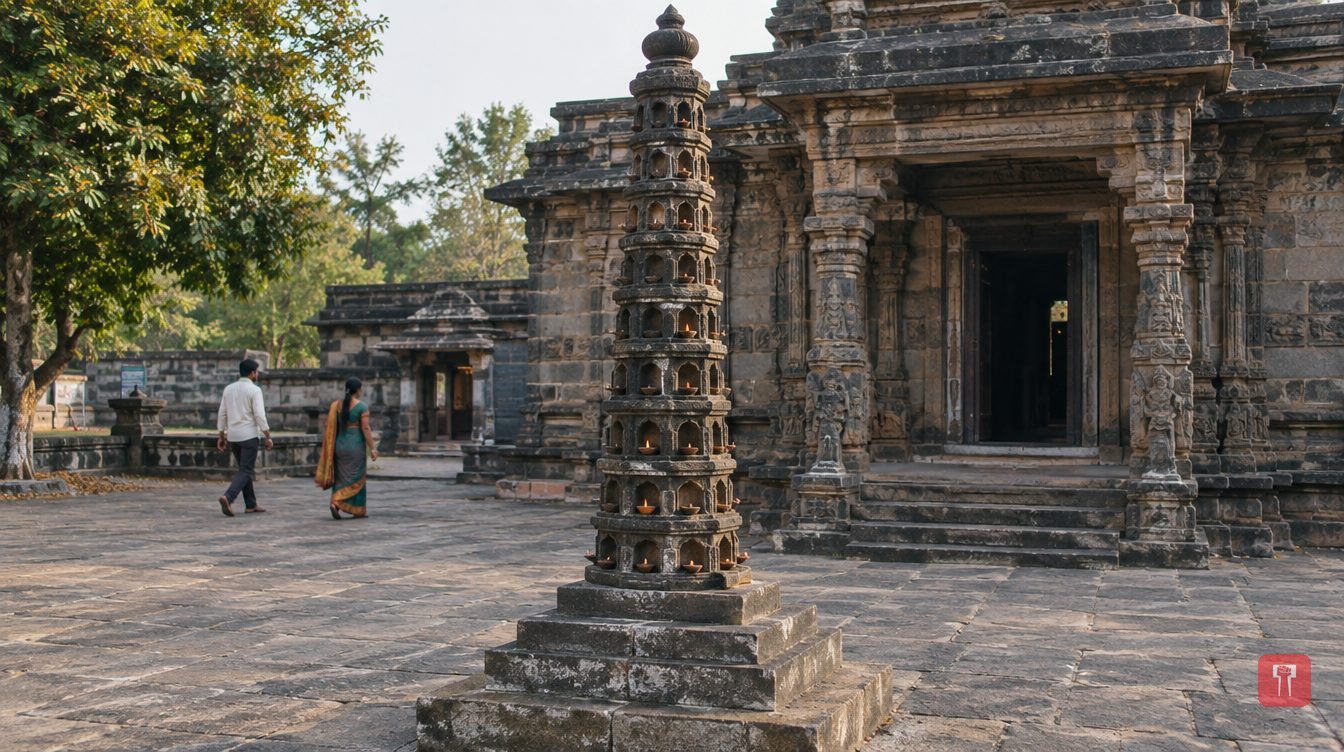
The deepmal, also called a deepstambh or lamp tower, standing in a temple courtyard or before its entrance is more than a decoration. Behind it lies a long thread of history, architecture and spirituality. In Maharashtra in particular, it is regarded as a very important and integral part of the temple architecture of the medieval and Maratha periods.
The first reason was light at night. In ancient and medieval times there was no electricity. These towers were raised so that lamps could be arranged in the courtyard and the temple complex stayed lit at night or during a deity's festival. Because the lamps burned at a height, travellers and devotees coming from afar could easily tell the direction of the temple even in the dark.
From a spiritual and religious point of view, the lamp, or fire, is considered very sacred and a sign of positivity in Hinduism. The deepmal narrows from the ground towards the sky. It symbolises moving from the darkness of human life, which is ignorance, towards light, which is knowledge. It embodies the idea expressed in "Tamso ma jyotirgamaya".
There is also a religious belief that lighting hundreds of lamps in this way before a temple destroys negative energy around it and creates a sattvik atmosphere.
In structure, a deepmal is a sturdy, tower-like construction of stone, brick and lime. It has a large stone platform at the base, and on it rises a round or polygonal column that tapers upwards in steps. Small stone niches, or carved projections resembling steps called "hands" (deepkalis), are made in sequence from bottom to top on the column so that oil lamps can be placed on them. At the very top of the column is a deep hollow, where flammable substances such as camphor, oud or guggul are put in to light a large flame. It is regarded as a fine example of the geometry and architecture of that era.
According to historical references, the deepmal was not limited to religious purposes. It was also seen as a mark of the splendour of the temple and the whole village. When kings, maharajas or jagirdars returned victorious from a battle, or when a vow of theirs was fulfilled, they erected a grand deepmal before the temple to express gratitude to the deity.
The deepmal is also a sight to behold during festivals. Huge deepmals can be seen at many well-known temples in Maharashtra, such as Khandoba at Jejuri, Yamai Devi at Aundh and Bhavani Mata at Tuljapur. On Kartik Purnima (Tripuri Purnima) or at a temple's annual fair, when all the lamps of the deepmal are lit together, a ritual called "deep prajwalan", the sight dazzles devotees.
The deepmal standing before a temple continues to bear witness to a rich cultural heritage, fine architecture and spiritual abundance.
Reach readers on the ward they actually live in.
Advertise with Prime Time 24Reach readers on the ward they actually live in.
Advertise with Prime Time 24Reach readers on the ward they actually live in.
Advertise with Prime Time 24Reach readers on the ward they actually live in.
Advertise with Prime Time 24
Comments
No comments yet. Be the first.