

Why shami and apta leaves are called gold on Dussehra: the tales of the Pandavas and Kautsa
Two traditional stories, one of the Pandavas and one of the sage Kautsa and King Raghu, are linked to shami worship and weapon worship on Dussehra.
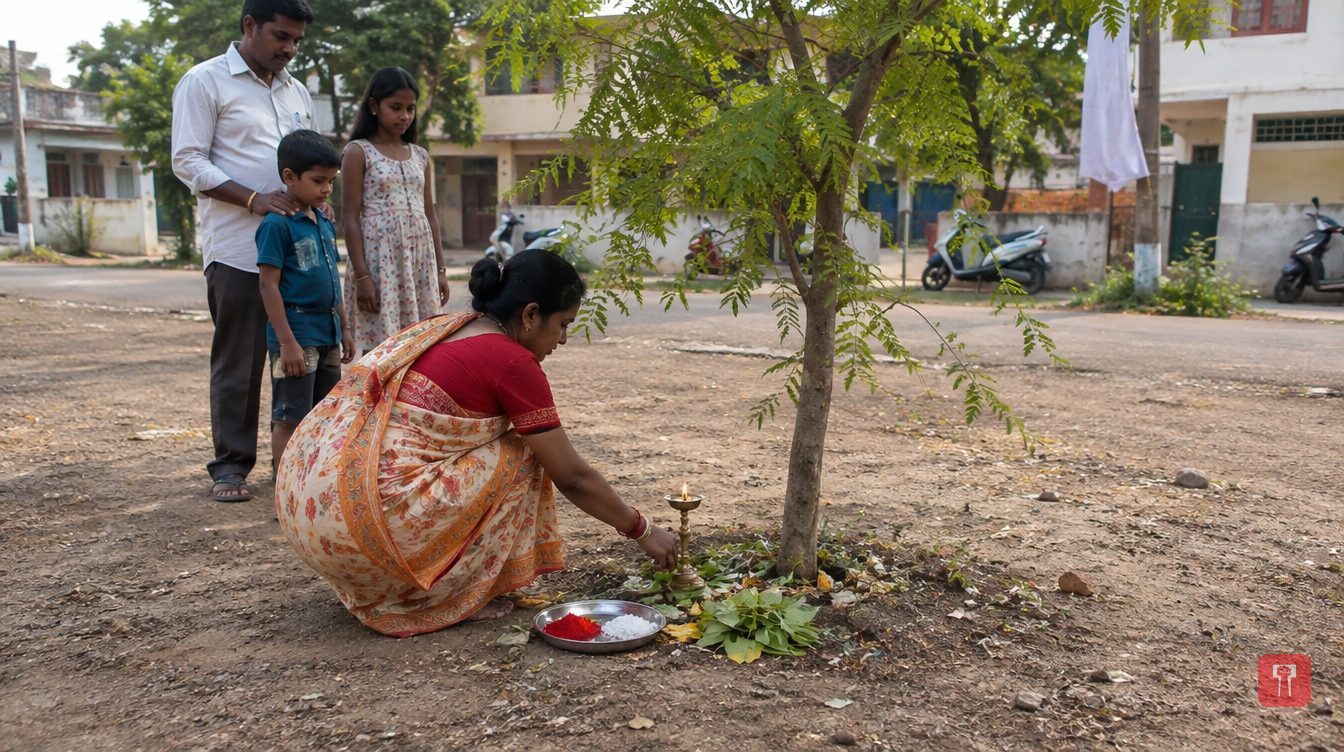 Images are not validated/verified
The tradition of worshipping the shami tree and weapons on Dussehra has been handed down over generations. Two stories are told in connection with it: one from the Pandavas of the Mahabharata, the other of the sage Kautsa and King Raghu.
Exile and a year of incognito living hold a special place in the Pandavas' lives in the Mahabharata. After losing at dice, they had to endure twelve years in exile, followed by a year of living incognito. Had their identity been revealed during that year, they would have had to go back into exile.
For this reason, the Pandavas lived in disguise in King Virata's kingdom of Matsya. Yudhishthira took the form of Kanka, Bhima of Ballava, Arjuna of Brihannala, Nakula of Granthika and Sahadeva of Tantipala. Draupadi, as Sairandhri, accepted service with the wife of King Virata.
According to the popular legend, before going into incognito living the Pandavas had safely placed their weapons on a shami tree. Arjuna's Gandiva bow and the other weapons were kept on this tree.
At the end of that year, the Kauravas attacked King Virata's cattle. Arjuna then cast off the guise of Brihannala and revealed his true identity. He took back the weapons kept on the shami tree and, with the help of Virata's prince Uttara, faced the Kaurava army.
The episode shows Arjuna's bravery, sense of duty and the thinking of using strength at the right moment. The tradition of weapon worship and shami worship on Vijayadashami is linked to this story of taking weapons back from the shami tree and readying for battle. However, the Mahabharata's account does not allow it to be said with certainty that the day the Pandavas' incognito period ended was the same as today's Vijayadashami.
The second story is that of Kautsa. In ancient times, education was imparted in gurukuls. Students lived in the guru's ashram and learnt various disciplines, and on completing their studies began the next phase of life with the guru's permission. There was also a tradition of giving gurudakshina to be freed of the debt owed to the guru.
According to the legend, a wise and humble student named Kautsa studied at the ashram of the sage Varatantu. Under the guru's guidance he learnt fourteen disciplines. On completing his studies, he bowed at the guru's feet and expressed a wish to give gurudakshina.
Varatantu at first refused to accept anything. He said Kautsa's knowledge, devotion and good conduct were themselves enough to satisfy him. Kautsa nevertheless remained firm.
Seeing the disciple's insistence, Varatantu finally asked him for gurudakshina of fourteen crore gold coins. In this popular story, one crore gold coins had been set for each of the fourteen disciplines. Kautsa, who held the guru's command sacred, resolved firmly to pay, but the question was where so many gold coins would come from.
Kautsa then thought of Raghu, the king of Ayodhya. Raghu was famed for his generosity, and no petitioner left his court disappointed. Kautsa reached Raghu's court, but the king's situation was different at that moment. He had recently performed the Vishwajit yagna and, following the tradition of giving away all wealth after the yagna, had donated all his riches. He therefore had no gold coins left to give Kautsa.
Even so, Raghu was unwilling to send away a petitioner who had come to his door empty-handed. He understood Kautsa's need and asked him to wait a while. The king resolved that he must help Kautsa. Though he had no wealth of his own, he was ready to raise the money through his valour and strength.
To keep his word, Raghu thought of taking gold coins from Kubera, regarded as the lord of wealth, and decided to prepare for war for this. Seeing Raghu's valour and firm resolve, Kubera avoided a clash and rained gold coins on Ayodhya. The story mentions the gold coins showering on apta and shami trees. In this way Raghu obtained the money needed for Kautsa's gurudakshina.
