

Why Kumkumarchan is performed for the Goddess during Navratri, and who can do it
Kumkumarchan, offering vermilion to the Goddess while chanting her names or mantras, is a key rite of Devi worship, especially during Navratri.
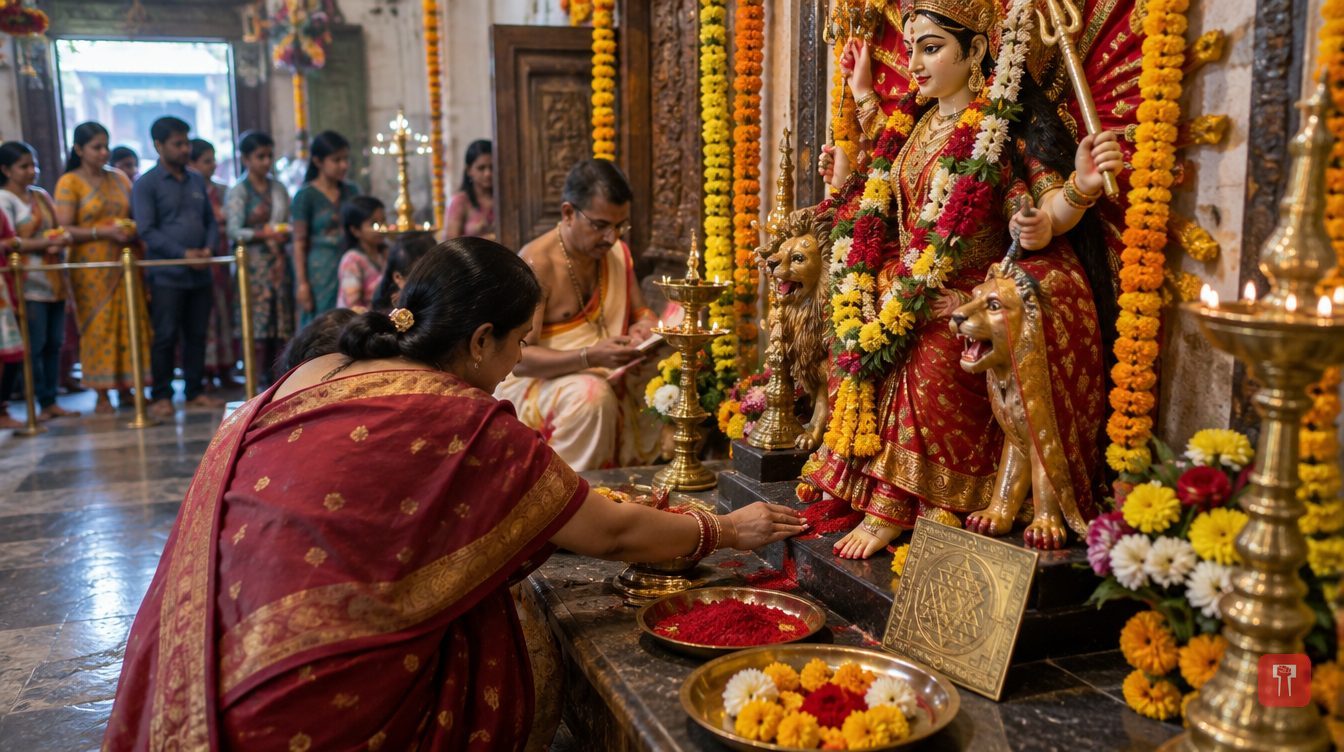 Images are not validated/verified
Kumkumarchan is regarded as an important religious rite in the worship of the Goddess. In many places it is performed during Navratri, on Lalita Panchami, on Fridays and on full-moon days. Kumkum (vermilion) is considered a symbol of good fortune, auspiciousness and power.
Worship of the Goddess holds special importance in Hinduism. The veneration of Adishakti involves different pujas, abhishekas, mantra chanting, recitation of hymns and religious rites. Kumkumarchan is one of the important ones. It is performed especially during Navratri at temples of Goddess Durga, Mahalakshmi, Tulja Bhavani and Lalita Devi, and in many homes.
While offering kumkum to the Goddess, devotees remember her divine power. They perform kumkumarchan with the faith that they will receive her grace, that there will be happiness and peace in the family, and that they will get the strength to face life's difficulties.
Kumkumarchan is the rite in which kumkum is offered to an idol, image or Shri Yantra of the Goddess while remembering her name or chanting mantras. The Goddess's namavali, the Ashtottara Shatanamavali, the Sahasranamavali, the Lalita Sahasranama or a Devi mantra prescribed by tradition is recited. Kumkum is offered to the Goddess with the utterance of each name.
In some traditions kumkum is offered from the feet of the Goddess to the forehead, while in some places the custom is to offer it only at the feet. In some forms of worship, kumkumarchan is also performed on the Shri Yantra. Both mantra chanting and the offering of kumkum are important in the rite. Its main spirit is to concentrate the mind while remembering the Goddess's name and to express devotion to her.
In Indian religious and cultural tradition, kumkum is regarded as an auspicious mark. It is linked with the good fortune of married women. Kumkum is also used in worship of deities, religious ceremonies and auspicious occasions. The Goddess is a form of Adishakti, so the colour red is given special importance in her worship. Red is considered a symbol of power, consciousness, strength and auspiciousness. Offering kumkum to the Goddess is a way of showing respect to her form as Shakti, according to religious belief.
Navratri is considered an especially important time for kumkumarchan. During this period different forms of Adishakti are worshipped, and kumkumarchan is organised at the Goddess's temples and in homes. It is part of worship during Shardiya Navratri and Chaitra Navratri. Apart from Lalita Panchami, Ashtami, Navami, Fridays and full-moon days, the rite can also be performed on other days according to family custom, household tradition and the deity being worshipped.
Being married is generally not a necessary condition for kumkumarchan. A woman or man who wishes to worship the Goddess can perform the rite according to the tradition and form of worship followed at home. In many families, married women perform kumkumarchan for the prosperity, good fortune and well-being of the family. In many places it is customary to worship the Goddess and offer kumkum during Navratri or on Fridays.
Unmarried girls, or kumarikas, can also worship the Goddess and perform kumkumarchan according to their family's religious tradition. The Goddess is regarded as the mother of all, so it cannot generally be said that the rite is only for married women.
It cannot be said with certainty that there is any universally accepted Hindu religious rule that widows should not perform kumkumarchan. Different communities, sects and families may follow different practices in this regard.
Men can also worship the Goddess. In some traditions men offer kumkum while remembering the Goddess's name or perform kumkumarchan on the Shri Yantra. However, certain rites, sects or temples may have fixed rules. In such cases, the guidance of that tradition should be followed.
Cleanliness, devotion and concentration are given importance in kumkumarchan. At home the rite can be performed in a simple way. The tradition is to recite the Goddess's namavali or a mantra, and the mantra can be chosen according to the deity worshipped and the household's form of worship. The following mantra is recited for general worship of the Goddess: Om Dum Durgayai Namah.
Kumkum can also be offered while reciting the Goddess's Ashtottara Shatanamavali, the Lalita Sahasranama or the namavali of one's own kuladevata (family deity). A person who has received initiation into a specific mantra should worship according to the mantra given by the guru. There is no universally accepted rule that every person must chant one particular mantra.
Information on subjects such as religion, astrology and Vastu is meant only for readers' information. Experts should be consulted before trying any practice related to it.
