

Why a breast lump is biopsied and what happens to the sample in the laboratory
 Images are not validated/verified
A pathologist at Metropolis Healthcare explains when a breast biopsy is advised, how it is done and how the tissue is tested to guide treatment.
It is natural for women to worry when they feel a lump in the breast or when a mammogram shows something unusual. The first question that comes to mind is whether it is cancer. Dr Kunjal Leela, head of department and consultant (surgical pathology) at Metropolis Healthcare Limited, has explained the biopsy in detail.
According to Dr Leela, a doctor's examination and imaging tests give some important pointers, but often it is the biopsy that gives a clear answer. A mammogram can show a suspicious shadow or change in the breast. A biopsy shows what it is, what its nature is and what treatment is needed. Without a biopsy, she says, one is only guessing.
She cited GLOBOCAN 2024 figures, according to which India records an estimated 2,37,231 new breast cancer cases every year, or 15.2 per cent of all new cancer cases in the country. In India the cancer is seen more often between the ages of 40 and 50 and is found nearly ten years earlier than in Western countries. She also says that, because of fear or a lack of regular check-ups, nearly half of women reach a doctor at the third or fourth stage.
Dr Leela says a biopsy is advised when an imaging report comes back as BIRADS 4 or 5, meaning cancer is suspected. A biopsy may also be needed when a new lump persists for a long time, there is blood-stained discharge from the nipple, the skin of the breast thickens or looks pulled inward (dimpling), or suspicious lumps are felt in the armpit.
A core needle biopsy is done in most cases, under local anaesthesia and with the help of ultrasound. Three to four small tissue samples are taken from the lump. The procedure takes about 15 minutes, no stitches are needed and the patient can go home the same day. In certain situations a vacuum-assisted or surgical biopsy may have to be done. Dr Leela clarified that a biopsy does not cause cancer to spread.
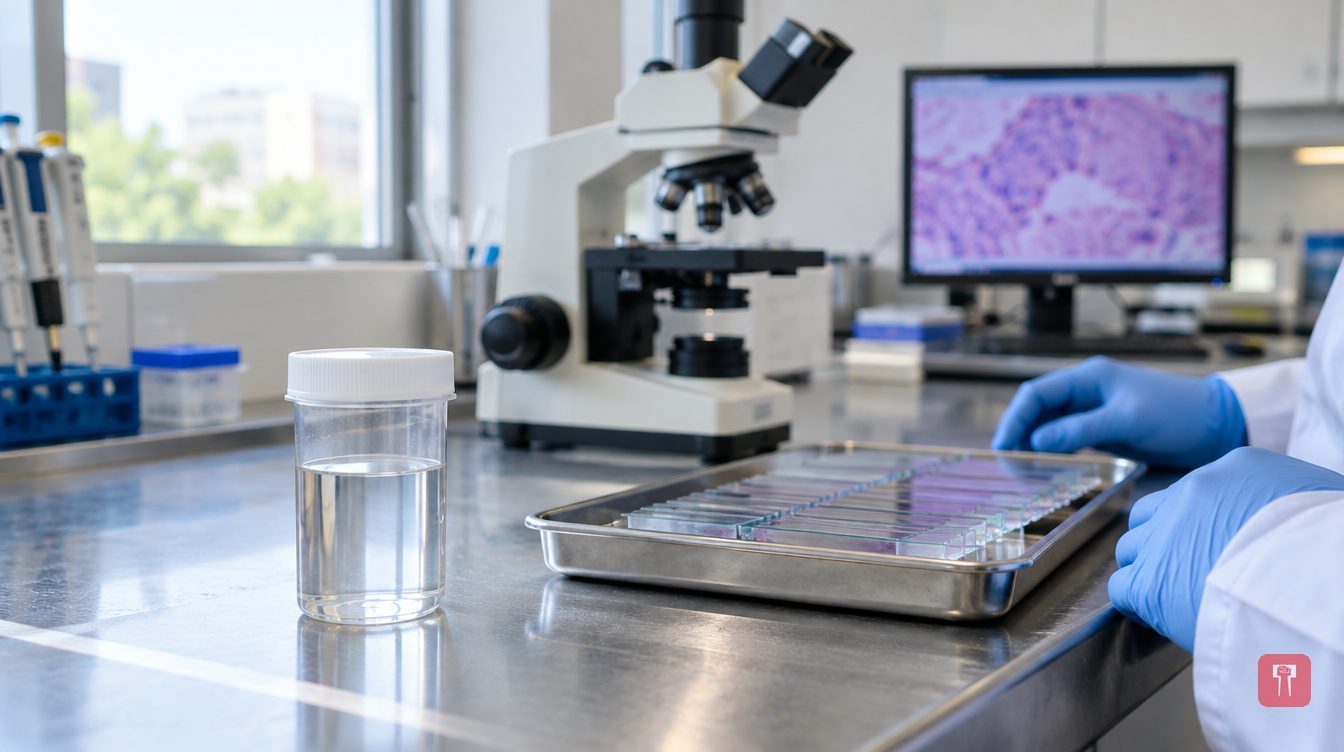
Once taken, the sample is put in formalin immediately and sent to the laboratory, where the pathologist plays a key role. The tissue is processed and examined by histopathology. This shows whether the tissue is normal, whether there are changes that raise the risk in future, or whether there are actual cancer cells. If there is cancer, its type and grade, that is, how aggressive it may be, are also assessed. Sometimes special tests called immunohistochemistry (IHC) are needed.
The IHC tests, ER, PgR, HER2neu and Ki-67, show the factors behind the growth of the cancer and how fast the cells are growing. According to Dr Leela, 60 to 70 per cent of breast cancer patients are ER/PgR positive. They may benefit from hormonal treatment, and in some cases chemotherapy can be avoided. In 20 to 25 per cent of patients HER2neu is positive, and they can be treated with the targeted injection Trastuzumab. Ki-67 is a marker that shows how fast cells divide. Doing these tests together at the outset (reflex testing) rather than one after another is recommended, because it saves time and allows treatment to start sooner.
In selected cases, molecular or genomic tests are also done. Gene tests in the early stages of cancer give a score showing the likelihood of recurrence. She says that if the score is low, tablets alone without chemotherapy may be safe, while if it is high, chemotherapy may help. In advanced or triple-negative cases, BRCA1/2, PIK3CA and PD-L1 are also tested, which helps decide whether PARP inhibitors or immunotherapy can be given.
Finally, the final pathology report combines the findings of the microscopic examination and the other tests. The team of doctors then considers the reports, imaging and the patient's medical condition together to plan further treatment. Dr Leela says a small sample taken in just 15 minutes can set the direction of treatment for many years. A biopsy is not a sign that something bad has happened, she says, but a step towards clear information about the illness.
Reach readers on the ward they actually live in.
Advertise with Prime Time 24Reach readers on the ward they actually live in.
Advertise with Prime Time 24Reach readers on the ward they actually live in.
Advertise with Prime Time 24
Comments
No comments yet. Be the first.