

Soviet Union tested Tsar Bomba, the world's largest bomb, on this day in 1961
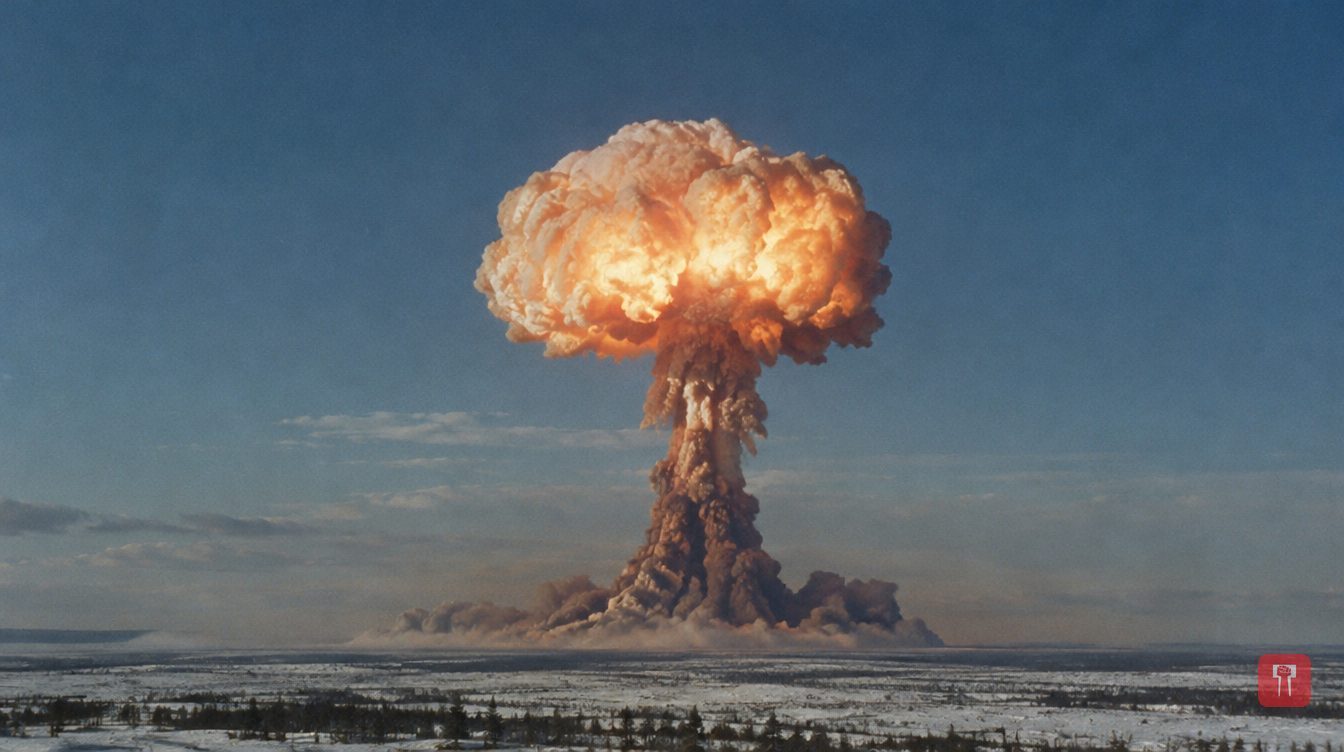 Images are not validated/verified
The Soviet Union detonated the most powerful hydrogen bomb ever tested on October 30, 1961, breaking window glass up to 900 km away.
October 30, 1961 is recorded in history for a test that took destruction to a new extreme. On this day the Soviet Union (today's Russia) tested the most powerful hydrogen bomb in the world's history. The bomb is known as Tsar Bomba. Soviet leader Nikita Khrushchev had the test carried out to show the United States and Western countries his country's military strength.
A secret plan initially set the yield of this massive bomb at 100 megatonnes. But a 100-megatonne blast would have spread radioactive fallout through the air that would have been dangerous for the entire Northern Hemisphere, including Soviet soil. Sensing the danger, Soviet scientists quickly changed the bomb's design and cut the yield to 50 megatonnes. Even so, it remains the largest and most destructive of all the bombs humans have tested on Earth.
The initial codename of this highly secret project was Ivan. Later, when the world learnt of it, historians and the public began calling it Tsar Bomba, which in Russian means king of bombs. It was a thermonuclear hydrogen bomb, and its blast was equivalent to about 50 million tonnes of TNT.
The size of the bomb was also unlike that of ordinary weapons. It weighed about 27 tonnes and was roughly 8 metres long. A Soviet military Tu-95 aircraft had to be heavily modified to carry it. The bomb did not fit fully inside the aircraft, so the underside of the plane had to be left open. On the day of the test it was dropped from a height of about 10 km and detonated about 4 km above the ground.
Within seconds of the blast, a fireball 8 km wide formed. The giant mushroom cloud rose to more than 60 km, reaching the stratosphere. The light was so intense that it was clearly visible from hundreds of kilometres away, and people felt its heat up to a radius of 270 km. The shockwave from the blast circled the Earth three times. Official records show window panes in houses and buildings broken 900 km from the centre. Anyone close to it would have been killed within a second.
The aircraft that dropped the bomb had very little time to reach a safe distance. To shield it from the blast wave, a special and very large parachute was attached to the bomb. Even so, the jolt was so powerful that the aircraft wobbled for a few moments. The pilot skilfully brought it under control, and the crew had a narrow escape.
The bomb was not actually built for use in war. It was a declaration of the Soviet Union's political and military power. Its size and weight were so great that using it in a real war would have been extremely difficult. An aircraft carrying such a bomb would easily have appeared on enemy radar and become an easy target. For this reason the Soviet Union never took production of the bomb forward.
The test gave the world a deep sense of the devastation of nuclear weapons. Anger spread against it in the United States, Britain and other Western countries. Leaders around the world felt that further such tests could endanger the Earth's atmosphere and human life. Amid this pressure and the global demand for peace, the United States, the Soviet Union and Britain signed the Partial Test Ban Treaty (PTBT) in 1963. Under the treaty, nuclear tests of every kind in the atmosphere, in outer space and underwater were legally banned.
Reach readers on the ward they actually live in.
Advertise with Prime Time 24Reach readers on the ward they actually live in.
Advertise with Prime Time 24Reach readers on the ward they actually live in.
Advertise with Prime Time 24
Comments
No comments yet. Be the first.