

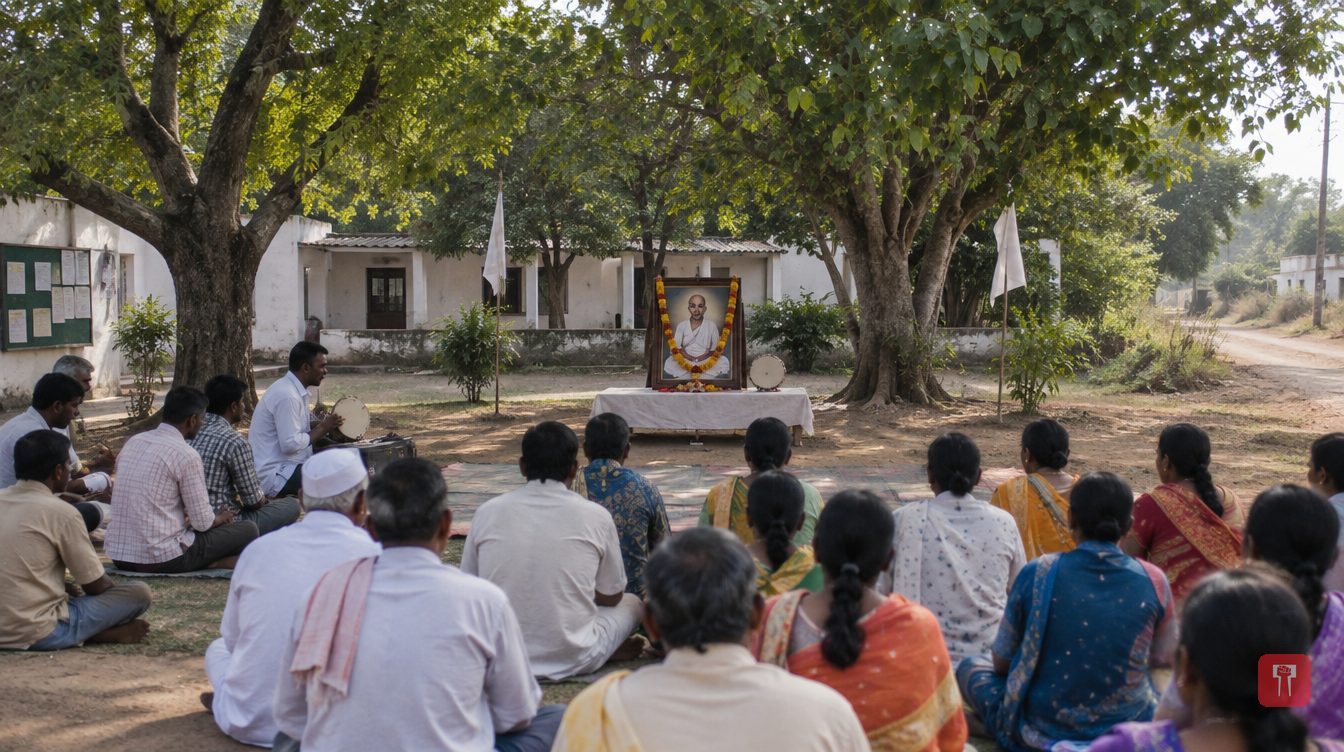
Rashtrasant Tukdoji Maharaj remembered as the saint who tied spiritual strength to nation-building
 Images are not validated/verified
On his death anniversary, Rashtrasant Tukdoji Maharaj is recalled for bhajans, the Gramgeeta and relief work that took India's saints into village development and national service.
The Indian saintly tradition has upheld the values of social awakening, equality and humanity along with spirituality. Rashtrasant Tukdoji Maharaj, who gave this tradition a direction towards modern nation-building, was an extraordinary personality of the twentieth century. He made society realise that winning freedom was not the final aim of nation-building. The real responsibility lay in making free India founded on equality, self-reliant, united and prosperous. His work therefore did not remain confined to the saintly tradition; it became part of the building of a new India.
Paying tribute to him on his death anniversary, it seems that society and its community of saints should follow the ideal he set. For the renewal of India, it seems necessary in every era that the country's righteous forces come together.
After Independence, India faced the challenges of social inequality, discontent between religions, illiteracy, rural poverty, caste divisions and national unity. In these circumstances, the then President, Dr Rajendra Prasad, put forward the view that saints, who influence the minds of society, should take an active part in nation-building. Rashtrasant Tukdoji Maharaj took up the task of carrying this view across the country. His khanjiri bhajans and ideas of patriotism at Rashtrapati Bhavan took his work to the national level.
The essence of his work was that the influence of saints should not stay limited to religious faith but should serve public education, social change and service to the nation. His efforts to bring saints from across the country together for broader national interest reached a turning point in 1956. The Bharat Sadhu Samaj was founded in Delhi with the participation of dharmacharyas and saints from different akhadas, states and religious seats. According to recorded accounts of the life philosophy linked to Gurukunj Ashram, Rashtrasant played an important role in founding the body and was unanimously elected its first president.
His national work did not begin after Independence. During the freedom struggle, he awakened the public through bhajans and kirtans. During the Quit India Movement of 1942, his patriotic compositions inspired people with the desire for freedom. In the Chimur, Ashti and Yavali areas, his words kindled the spark of patriotism. Rousing songs such as the lines of the bhajan "Aate Hain Nath Hamare", "Jhaad-jhankhaad shastra banenge! Bhakt banenge sena, patthar saare bomb banenge, naav lagegi kinare", drew people in rural areas into the movement. The British government arrested him and he also had to serve time in jail.
He used folk language, folk music and effective means of village-to-village contact to awaken national consciousness. In his view, freedom meant not only liberation from foreign rule but also from injustice, ignorance and inequality in society.
It was Rashtrasant's firm conviction that India is a country of villages and that no kind of progress of the country is possible without the progress of villages. With this thinking he wrote the Gramgeeta. It is a vision of village development that joins cleanliness, education, dignity of labour, cooperation, freedom from addiction, morality, self-reliance and people's participation. "Gaon hai vishwa ka naksha, gaon se desh ki pariksha" (the village is the map of the world; the nation is tested through the village) is a line that shows the direction of his thinking. His work shows that village development is not limited to building roads, water supply and buildings, but is a process of changing the thinking, conduct and mutual relations of villagers.
Through Gurukunj Ashram, established in 1935, he promoted social service, community prayer and constructive work. Through the Akhil Bharatiya Shri Gurudev Seva Mandal, he took the idea of village upliftment to large numbers of people. A key message of his work was that villagers should take responsibility for their own development and achieve collective progress through shramdaan, voluntary labour.
Nation-building means not only development schemes but also rushing to help fellow citizens in times of crisis. During the Bengal famine, in the backdrop of the 1962 Chinese attack, after the Koyna earthquake and during the 1965 Pakistani attack, Rashtrasant set an ideal of service to the nation through relief work and public awakening. His work erased the gap between spirituality and action. Building brotherhood in Indian society beyond caste, religion, sect and language was the basic thread of his idea of nation-building. Through community prayer he tried to bring all sections of society together. This same popular bhajan of his is the university song of Rashtrasant Tukdoji Maharaj Nagpur University, Nagpur.
By taking part in the World Religions Council and world peace councils held in Japan in 1955, he carried the message of humanity and universal brotherhood beyond the country. His idea of nation-building was not limited to India's borders; it was linked to the broader values of world peace. He accompanied Sant Dnyaneshwar's Pasayadan, with its spirit of brotherhood, on his khanjiri. In Japan too, he raised the slogan of universal brotherhood and did the global work of bringing together the good impulses of the world.
Rashtrasant awakened the public through bhajans, built the strength of social service through organisation, and presented the idea of village development through the Gramgeeta. Bringing the strength of saints into constructive national work, making the common man an active partner in development, and building the nation on social unity were the hallmarks of his work. Today the concept of a developed India gives importance to village development, citizens' participation, social unity and self-reliance. Rashtrasant had stressed all these values through his work several decades ago. Remembering him on his death anniversary, it is necessary to put his ideas into real practice rather than limit them to praise.
A strong foundation of a new India can be laid only on the strength of a society bound by brotherhood, self-reliant villages and citizens devoted to service; this remains the inspiring message of his life's work today. On his death anniversary, a humble tribute to him.
Reach readers on the ward they actually live in.
Advertise with Prime Time 24Reach readers on the ward they actually live in.
Advertise with Prime Time 24Reach readers on the ward they actually live in.
Advertise with Prime Time 24
Comments
No comments yet. Be the first.