

Modi inaugurates Pune's Hinjewadi-Shivajinagar Pink Line metro; 17 stations open to riders on November 4
 Images are not validated/verified
Prime Minister Narendra Modi inaugurated Pune Metro's 23-km Line 3 by video on Tuesday; passenger services begin on November 4 with fares of Rs 12 to Rs 62.
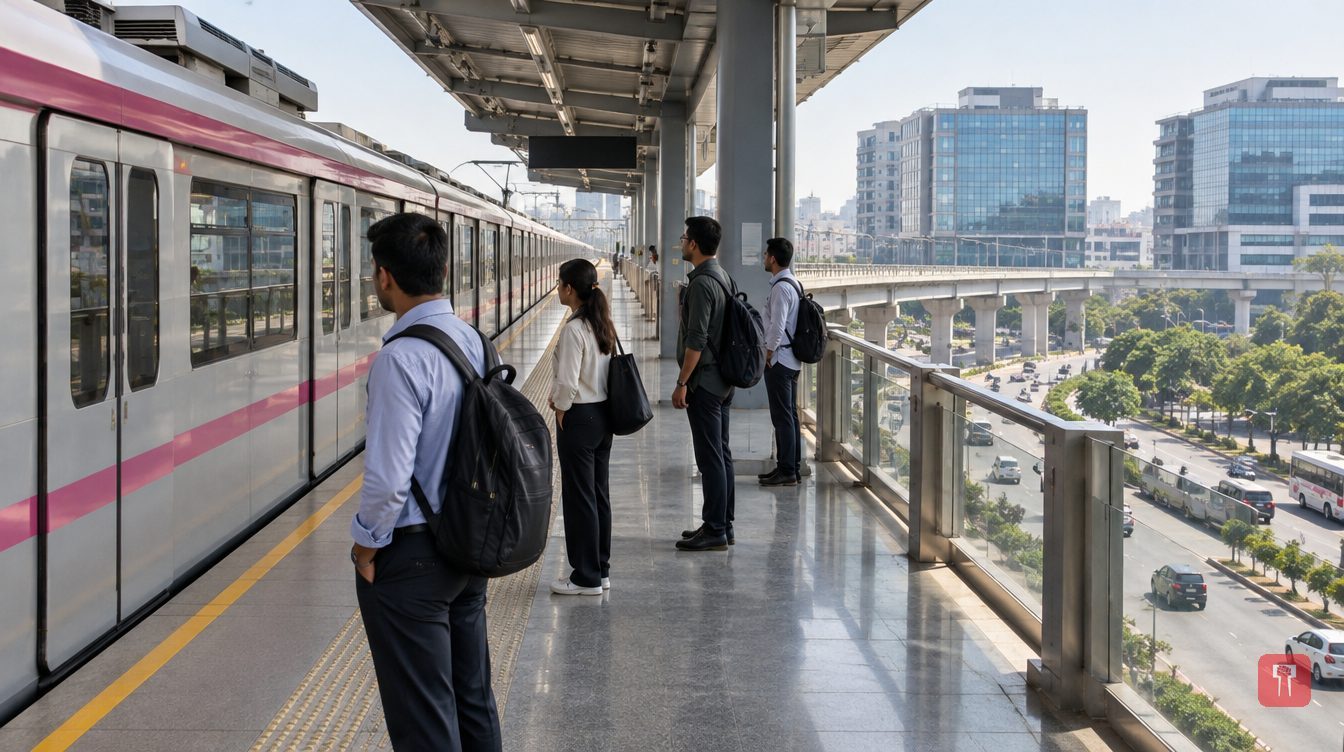
Prime Minister Narendra Modi on Tuesday inaugurated Pune Metro Line 3, the Pink Line, by video link. The line is meant to ease traffic on the road to the Hinjewadi IT park and to link the older and newer parts of the city. Passengers can board from 6 am on Wednesday, November 4. The ceremony was scheduled for 10.30 am at the badminton hall of the Shri Shiv Chhatrapati Sports Complex at Mhalunge-Balewadi. Chief Minister Devendra Fadnavis was due to attend. Earlier accounts of the guest list named Deputy Chief Minister Sunetra Pawar, and some also named Deputy Chief Minister Eknath Shinde.
The line is also called the Puneri Metro. It runs for 23.203 km, fully elevated, from Maan-Hinjewadi to Shivajinagar, and it cost about Rs 8,313 crore. Built as a public-private partnership on the DBFOT model under the Centre's National Metro Rail Policy 2017, it is described as the country's first metro project of this kind. The company behind it is Pune IT City Metro Rail Limited, a venture of TRIL Urban Transport Private Limited and Siemens Project Ventures GmbH. The Railways' Research Designs and Standards Organisation has vetted every part of the project, and the full route holds the safety certificates required from the Commissioner of Railway Safety.
In his address, Mr Modi spoke of how the country's metro network has grown. Operational routes totalled 248 km before 2014, he said, and now stand at 1,200 km. He added that he had had the chance to lay the foundation stone for the first phase of Pune Metro 10 years ago. Another account says the foundation stone for this particular line was laid by Mr Modi in November 2018. Work was then expected to take five years, but it was halted by Covid. A March 2025 deadline was also missed, and dates slipped six to eight times in all. The metro is opening about nine years on. Most metros admit riders two or three hours after the inauguration, but here the gap is a full day. Mr Modi said the new line would give the city's big IT hub better connectivity.
The Pune Metropolitan Region Development Authority (PMRDA) gave the details at a press conference at its headquarters in Akurdi on October 31. Commissioner Dr Abhijit Choudhary led it. Additional Metropolitan Commissioner K. Manjulakshmi, Pune IT City Metro Rail Limited chief executive Anilkumar Saini and Chief Engineer (Special Projects) Rinaj Pathan were with him.
The first train leaves Maan at 6 am. In the rush hours, 7.30 am to 9.30 am and 4 pm to 7 pm, a train will come every 6 minutes. At other times the gap is 12 minutes. The last train from Maan towards District Court departs at 10.30 pm. The last from District Court back to Maan leaves at 11.40 pm. The operator has 22 train sets ready. Officials expect 2 lakh to 2.5 lakh passengers a day. A full run takes roughly 45 minutes. IT workers now spend one and a half to two hours on the road to Hinjewadi, so the saving could be at least an hour a day.
Fares are higher than on the existing Mahametro lines. On the Pimpri-Chinchwad Municipal Corporation (PCMC) to Swargate and Vanaz to Ramwadi routes, tickets cost Rs 10 to Rs 35. On the new line the range is Rs 12 to Rs 62, so the lowest fare is Rs 2 higher and the highest Rs 27 higher. By distance, the charges are Rs 12 up to 2 km, Rs 25 for 2 to 4 km, Rs 37 for 4 to 8 km, Rs 49 for 12 to 18 km and Rs 62 beyond 18 km. For the 8 to 12 km band the filings disagree: one gives Rs 45 and another Rs 43. In the 2 to 8 km slabs, the new line costs about Rs 5 to Rs 12 more than Mahametro. A trip from District Court to Hinjewadi Phase 3, the Megapolis Circle, costs the full Rs 62. For comparison, the Mann-Shivajinagar stretch is 23.2 km, PCMC to Swargate is 16.6 km and Vanaz to Ramwadi is 14.6 km. The commissioner himself acknowledged the premium. The higher fare is attributed to the PPP model and rising capital costs. It will add to the burden on IT staff and other daily commuters.
Tickets will be sold at station counters and by QR code. They will also be available on WhatsApp, which removes the need to queue. The line's facilities are to be added to the Mahametro app, and riders will be able to use the NCMC card. A joint app covering all three lines has been built. A single ticket valid across all three Pune metro routes is to follow in the coming days.
Only 17 of the 23 stations open at first, because work on the other six is unfinished. Even so, a rider can still travel without a break between Maan and District Court. Stations 13 and 14 are due for completion by the end of November. Stations 15, 16, 20 and 22 will open in phases by January 2027.
Ten of the open stations will have both staircases working. They are Hinjewadi Phase-1 and Wakad Chowk, Aundh and Sakal Nagar, the R.K. Laxman Museum stop, MITCON Balewadi, the sports complex station at Mhalunge and Savitribai Phule Pune University. The list also includes Hinjewadi Phase-2 Circle-2 and the one named for Shri Shivchhatrapati Shivaji Maharaj Chowk. Seven will start with one staircase: Maan, the Maan-MIDC Circle Phase-2 stop, Maan Bus Depot, Hinjewadi Phase-2 Circle-1, Padmabhushan Chowk, College of Agriculture and the District and Sessions Court.
District Court is the interchange with Mahametro's Line 1 and Line 2. It makes onward trips easier for riders on the Pimpri-Chinchwad to Swargate and Vanaz to Ramwadi routes.
The coaches are made by Alstom, are air-conditioned, and have points for charging phones and laptops. The trains run on a 750-volt DC third-rail system with CBTC signalling.
All trains will be driven by about 100 women pilots. About half of the station staff will be women, including controllers, ticketing staff and attendants. One account says women will make up more than half of the station controllers and other staff. For passenger safety, 350 personnel of the Maharashtra State Security Corporation are posted at the stations.
The aim is to join the Hinjewadi IT Park with the main commercial and administrative areas of Pune. Outside the stations, PMPML buses, autorickshaws, Ola and Uber cabs and e-bikes will be available, with separate pick-up and drop points under construction. The project also provides parking for two-wheelers and four-wheelers, cycle tracks, footpaths, pedestrian crossings and foot overbridges. Traffic should ease in Hinjewadi, Wakad, Baner, Balewadi, Aundh, Mhalunge, Ganeshkhind Road and Shivajinagar.
On the environmental side, the project has 7.60 MW of solar capacity, which is to meet 30 per cent of its power needs. GGBS technology used in construction has avoided 28,000 tonnes of carbon emissions.
Dr Choudhary said: "The Puneri Metro will prove to be a lifeline connecting a fast-growing IT hub like Hinjewadi with the central part of the city. This service will substantially reduce the daily traffic congestion in the Hinjewadi, Baner, Aundh and Shivajinagar areas. We estimate that about two to two and a half lakh people will use this metro every day."
Reach readers on the ward they actually live in.
Advertise with Prime Time 24Reach readers on the ward they actually live in.
Advertise with Prime Time 24Reach readers on the ward they actually live in.
Advertise with Prime Time 24
Comments
No comments yet. Be the first.