

Pune Metro Line 3 to open on November 3, with passenger service from November 4
 Images are not validated/verified
Prime Minister Narendra Modi will inaugurate the Maan-Hinjewadi to Shivajinagar line by video conference, and the first train will run at 6 am on November 4.
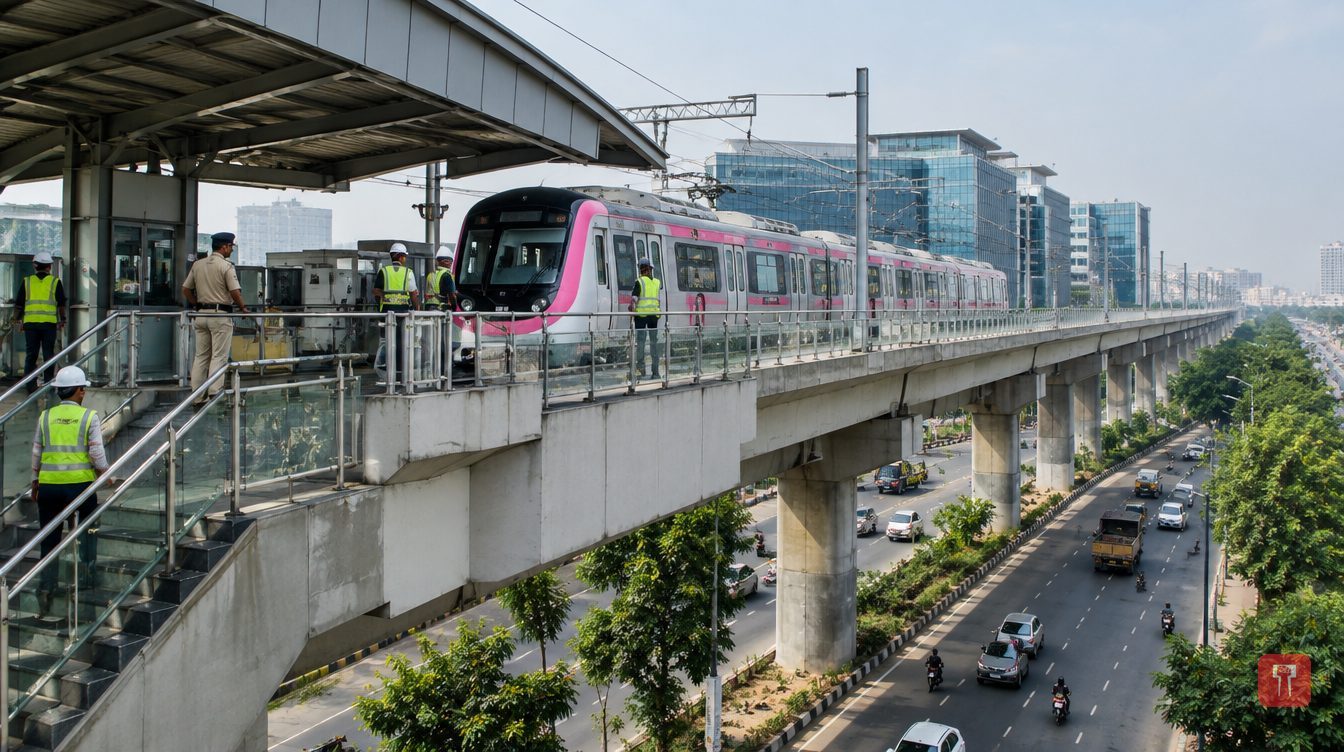
Pune Metro Line 3, the route from Maan-Hinjewadi to Shivajinagar, will open on November 3, 2026. Prime Minister Narendra Modi will inaugurate it by video conference. Chief Minister Devendra Fadnavis, Deputy Chief Minister Eknath Shinde and Sunetra Ajit Pawar will be present. The ceremony will be held at 10.30 am in the badminton hall of the Shri Shivchhatrapati Sports Complex in Mhalunge-Balewadi. Service for the general public will begin at 6 am on November 4, 2026.
The details were given at a press conference on Saturday (October 31) at the Pune Metropolitan Region Development Authority (PMRDA) headquarters in Akurdi. Present were PMRDA Metropolitan Commissioner Dr Abhijit Chaudhari, Additional Metropolitan Commissioner K. Manjulakshmi, Pune IT City Metro Rail Limited (PITCMRL) Chief Executive Officer Anilkumar Saini and PMRDA Chief Engineer (Special Projects) Rinaz Pathan.
Dr Chaudhari said Line 3 is fully elevated and 23.203 km long. It is also called the "Puneri Metro" and the "Pink Line". The route starts at Maan, passes Hinjewadi's Rajiv Gandhi Infotech Park and runs to Shivajinagar, a major administrative and business centre of Pune. The estimated cost of the project, including land acquisition and the cost of shifting utilities, is Rs 8,313 crore. Built on the DBFOT basis under a PPP model under the Centre's National Metro Rail Policy 2017, it is the country's first metro project of its kind. Under the concession agreement with PMRDA, it is operated by Pune IT City Metro Rail Limited. This special purpose company is a partnership of TRIL Urban Transport Private Limited and Siemens Project Ventures GmbH.
Of the 23 stations in all, 17 will open to passengers from November 3. At seven of them, one staircase will be in operation. These are station no. 1 (Maan), 2 (Maan MIDC Circle Phase-2), 3 (Maan Bus Depot), 5 (Hinjewadi Phase-2 Circle-1), 6 (Padmabhushan Chowk), 21 (College of Agriculture) and 23 (District and Sessions Court). At the other ten stations both staircases will be open. These are nos. 4, 7, 8, 9, 10, 11, 12, 17, 18 and 19, that is, Hinjewadi Phase-2 Circle-2, Shri Shivchhatrapati Shivaji Maharaj Chowk (Hinjewadi), Hinjewadi Phase-1, Wakad Chowk, Shri Shivchhatrapati Sports Complex (Mhalunge), Mitcon (Balewadi), R.K. Laxman Museum (Balewadi), Aundh, Sakalnagar and Savitribai Phule Pune University. Of the remaining six stations, work on nos. 13 and 14 is in its final stage and will be complete by the end of November 2026. The four stations numbered 15, 16, 20 and 22, along with their staircases, will be completed and opened in phases by January 2027.
Multimodal integration is under way to make the onward journey easier after passengers leave the metro. Separate pick-up and drop-off points are being built outside the stations for PMPML buses, autorickshaws, app-based taxis such as Ola and Uber, and e-bikes. Two-wheeler and four-wheeler parking is also being provided near the stations. Pedestrians and cyclists have been considered too, with separate cycle tracks, wider footpaths, road-crossing arrangements and foot overbridges being built. Traffic congestion, especially in the Hinjewadi area, is expected to ease.
The entire route has been inspected by the Research Designs and Standards Organisation (RDSO). The first section of 12.60 km, from Maan (PMR-1) to R.K. Laxman Museum, Balewadi (PMR-12), received final safety approval from the Commissioner of Metro Rail Safety (CMRS) on July 23, 2026. The section with the other five stations received the approval on September 23, 2026. A total of 350 security guards of the Maharashtra State Security Corporation (MSSC) are deployed to guard the stations. A modern passenger information system and ticketing arrangement have been put in place to help passengers plan journeys, find their way inside stations and buy tickets easily. A combined app is also ready for people travelling on Maha Metro's existing lines and the new Line 3.
According to Dr Chaudhari, 7.60 MW of solar power capacity has been installed in the project, of which 6.10 MW will be generated at the metro stations and 1.50 MW at the car depot. This will meet about 30 per cent of the project's total power requirement. All Line 3 trains will be run by about 100 women train pilots. Women will make up about 50 per cent of total station staff, including station controllers, ticketing staff and station attendants. Dr Chaudhari said this reflects a commitment to women's empowerment, gender equality and the growing participation of women in modern transport. He expected the daily crowds at Hinjewadi IT Park, Aundh, Baner, Balewadi, Mhalunge, Ganeshkhind Road and Shivajinagar to thin out, and said about two to two and a half lakh people a day would use this metro.
Anilkumar Saini said the first metro will leave at 6 am from November 4. The last metro from Maan station towards the District Court will leave at 10.30 pm. The last metro from District Court station towards Maan will leave at 11.40 pm. Trains will run every six minutes at peak hours and every 12 minutes at other times. At the District Court (Shivajinagar) station, Line 3 is linked to Maha Metro's Line 1 (Pimpri-Chinchwad to Swargate) and Line 2 (Vanaz to Ramwadi). The Alstom air-conditioned trains have mobile and laptop charging facilities. They use CBTC signalling and a 750-volt DC third rail system. Saini said Pune's growth is tied to its IT and business environment, and that seamless connectivity is essential for this pace. Line 3 has been built to connect fast-growing IT hubs such as Maan-Hinjewadi with the central parts of the city, so the daily commute will be faster, more convenient and more effective.
Rinaz Pathan said the use of ground granulated blast furnace slag (GGBS) in construction avoided about 28,000 tonnes of carbon dioxide emissions. Two thousand tonnes of steel and 60 crore litres of water were also saved. In place of trees affected by the project, 5,500 new trees have been planted, and 750 trees have been successfully transplanted, with a survival rate of 80 per cent. An integrated two-level flyover has been built at Vidyapeeth Chowk on Ganeshkhind Road. The Aundh-to-Shivajinagar bridge opened on August 20, 2025. After work was completed on the Shivajinagar-Baner and Baner-Shivajinagar directions, traffic has been running on them since March 8, 2026. Work on the Pashan ramp is still in progress and is planned to be completed by the end of December 2026.
Pathan also said the Pune Municipal Corporation (PMC) has created parking near metro stations for people's convenience and to reduce traffic jams. In Balewadi, about 30,000 sq ft of parking will be available in the Amar Tech Park premises near the PMR-11 station. In Baner, parking has been readied on 21,000 sq ft in the ABZ premises near the PMR-14 station. According to her, this will bring relief to motorists and make traffic in the area smoother.
Reach readers on the ward they actually live in.
Advertise with Prime Time 24Reach readers on the ward they actually live in.
Advertise with Prime Time 24Reach readers on the ward they actually live in.
Advertise with Prime Time 24
Comments
No comments yet. Be the first.