

Orford Ness: Suffolk's former secret radar and nuclear test site is now a nature reserve
Once the site of secret aircraft, radar and atomic weapons experiments, Orford Ness in Suffolk is now a nature reserve managed by the National Trust.
 Images are not validated/verified
On the Suffolk coast in eastern England lies Orford Ness, a stretch of about 2,000 acres. The desolate area is covered with sea, salt marsh and shingle. Through the First and Second World Wars and the Cold War, it was the site of some of Britain's most secret operations. Today it is quiet and nature has reclaimed it, but there was a time when experiments on aircraft, radar systems and nuclear weapons were carried out here in complete secrecy.
In medieval times the area was generally used by local farmers to graze sheep, goats and cattle. Stone walls were built to hold back the sea. But the location was of great importance to Britain's security. Suffolk's beaches and deep inlets meant there was always a threat of attack from outside. Because of this strategic importance, the British War Department bought the land in 1913, closed it completely to the public and turned it into a heavily guarded enclosure.
Between 1913 and 1916, the marshy area known as King's Marsh was drained and the first military airfield was built here. The first British aircraft landed here in 1915, and for the next four decades only military experiments were conducted. At this test centre, research was carried out on aircraft performance, the effect of air-launched weapons and improving aiming calculations.
The Bomb Ballistics Building, built in 1933, was the main centre of this research. Researchers used special cameras and instruments to find out how bombs dropped from aircraft travel through the air. In 1935, Sir Robert Watson-Watt and his team also set up an ionospheric research centre here. This was in fact a secret base for the development of radar technology, which was vital for air defence.
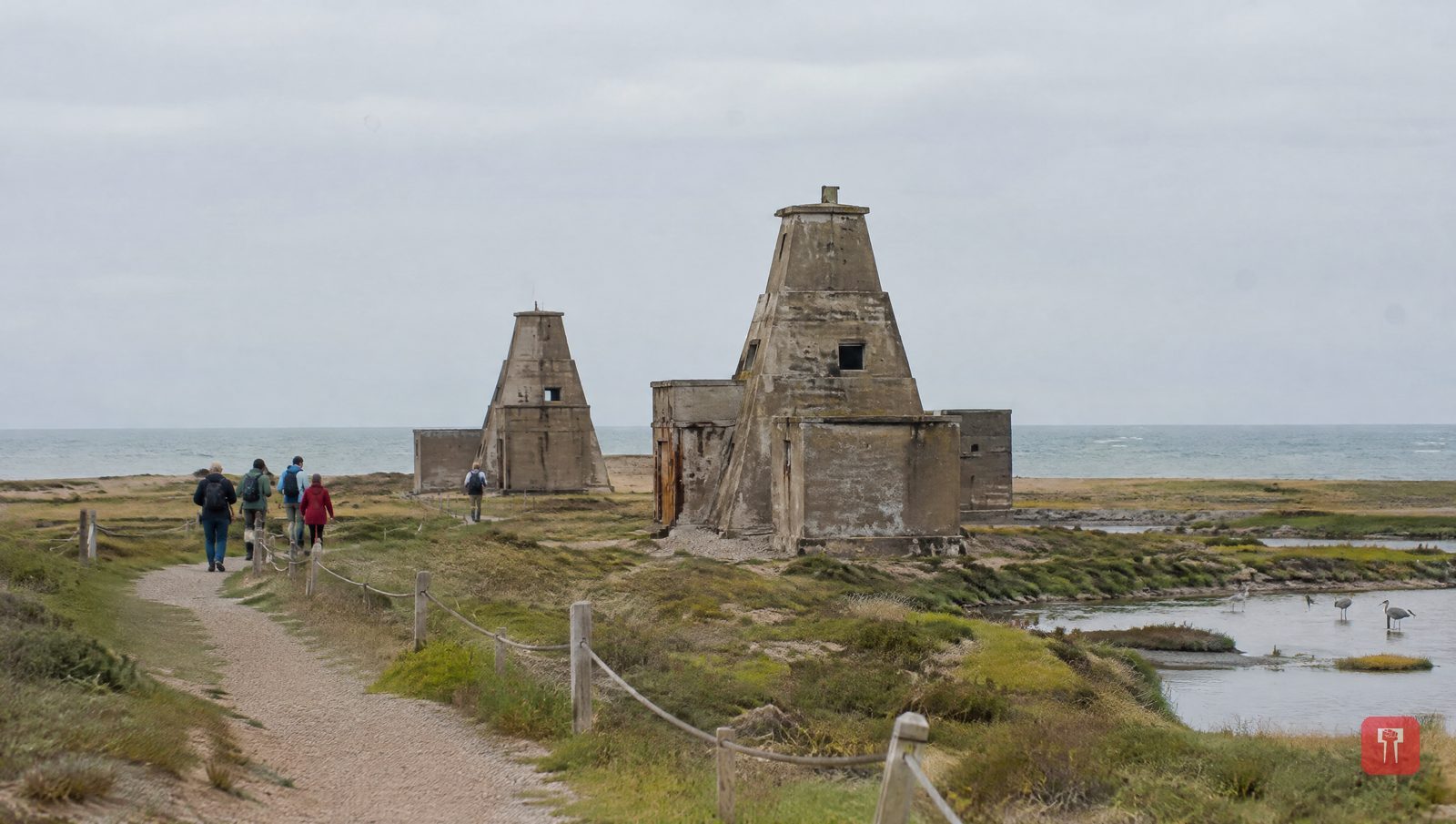
After the Second World War, during the Cold War, Orford Ness was used for even more sensitive and secret work. The Atomic Weapons Research Establishment (AWRE) built special laboratories here to test the various components of Britain's nuclear bomb. Locally they are called the Pagodas.
The huge concrete remains of these buildings can still be seen on the coast. They were designed in a distinctive way to withstand the shock of a possible accidental explosion and to release the energy of the blast safely. Tests were conducted here between the 1950s and 1970s to check how the internal parts of a nuclear bomb withstood vibration, the effect of being dropped from a height, and the ability to bear extreme pressure.
Military activity gradually ended in the 1970s, and in 1993 the National Trust, an organisation concerned with environmental and historic conservation, took charge of the 2,000-acre site. After human intervention stopped entirely, nature re-established itself on this deserted land strewn with military remains.
Orford Ness is now an internationally important nature reserve. Of all the rare habitats of vegetated shingle in Europe, 20 per cent are found at Orford Ness alone. Very delicate plants and species thrive on the stony ground deposited by the sea over centuries. The old airfield has turned into green grassland, where waterbirds, Chinese water deer, rabbits and several kinds of rare animals roam unafraid.
For now, the National Trust looks after this sensitive natural area while also giving visitors a limited chance to understand its history. Special paths have been marked out for tourists so that the delicate plants and the nests of breeding birds are not damaged.
It is a remarkable experience to hear birdsong and see deer leaping on land where plans for tests of world-shaking nuclear weapons were once made. Orford Ness tells a unique story of humanity's appetite for war and the return of nature.
