

Nobel Prize in Chemistry goes to Henri Kagan and Kenso Soai for solving mirror-image molecule puzzle
The two scientists were honoured for solving a puzzle more than 100 years old: how to make only the wanted one of two mirror-image molecular forms.
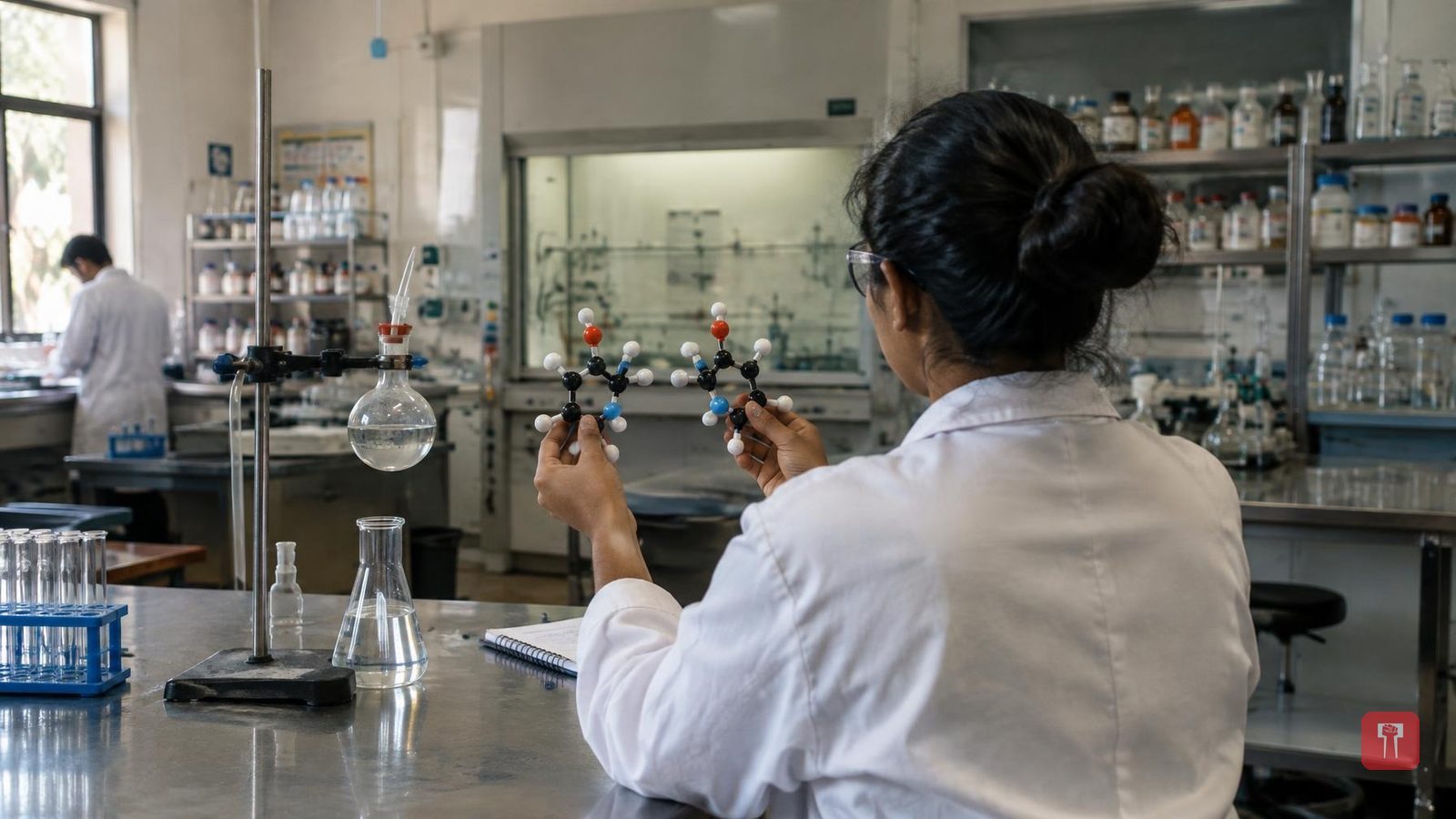 Images are not validated/verified
The 2026 Nobel Prize in Chemistry has been awarded to Henri B. Kagan and Kenso Soai. The Royal Swedish Academy of Sciences announced the names of the two scientists on the social media platform X. The two have given chemistry a new direction by discovering unexpected and revolutionary principles in organic synthesis.
Kagan and Soai solved a puzzle in chemistry that had stayed unresolved for more than 100 years. The question was how, during a chemical reaction, to make only one of two distinct molecules that are mirror images of each other, that is, only the form that is wanted. The two showed through their experiments that this could be done. The discovery is not confined to theory on paper; it will prove highly useful for human health and for making medicines.
Members of the Nobel committee explained it to the layperson with the example of our two hands. The hands look alike, but the left hand does not fit properly over the right, nor the right over the left. They are mirror images of each other. In chemistry, such molecules are called chiral molecules. When scientists make such molecules in a laboratory or factory, both forms, left and right, are produced in equal amounts as a rule of nature. This often hindered the main process, because scientists needed only one particular form.
Explaining why the problem matters so much, experts said one form of a drug can be highly effective against a disease of the body, while the mirror-image form of the same molecule can be harmful to the body or cause side effects. Making only the beneficial molecule and leaving out the harmful form was therefore the biggest challenge before chemists in drug-making.
This is not a problem of man-made drugs alone; the very make-up of our body rests on the same principle. For instance, amino acids can have two mirror-image forms, but our body uses only one particular form of them to build proteins. Understanding this secret of nature and reproducing it in the laboratory was vital for science.
In 1986, Henri B. Kagan found a distinctive route to solving the problem. He devised a new way of controlling a chemical reaction, known as non-linear effects. This made it possible to produce the desired form of the two possible ones in large quantities. Scientists making drugs, fragrances, food flavours and new industrial materials gained greatly from it.
Japan's Kenso Soai then took the research further. He discovered a process based on autocatalysis, or self-catalysis. In it, the first molecule that forms itself acts as the catalyst and helps quickly make more of the same molecules that are needed. These two discoveries have changed the very definition of organic synthesis.
This year's Nobel laureates will be honoured at a grand ceremony in Stockholm, the capital of Sweden, in December. The winners will receive the Nobel medal, an official diploma and prize money of about Rs 115 million (11 million Swedish kronor).
The 2026 Nobel announcements began on October 6. Earlier on Tuesday, the Nobel Prize in Physics was announced for Belgian scientist Francis Halzen for research on extremely powerful neutrinos that reach the Earth from space. Congratulations are pouring in from the scientific community around the world for Kagan and Soai.
