

Navratri: Ardhanarishvara form of Shiva and Parvati stresses unity of male and female principles
During Navratri, remembering the Ardhanarishvara form is seen as a way to understand the complementary bond between Shiva and Shakti.
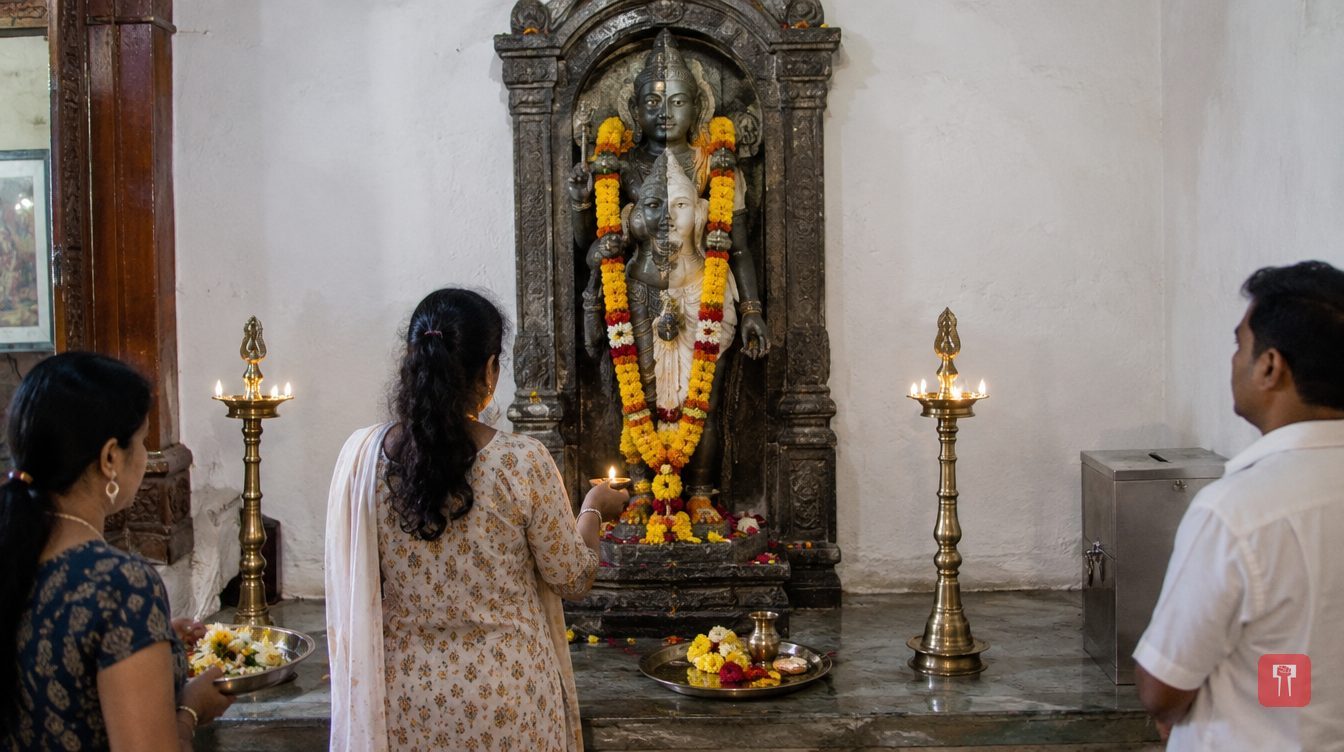 Images are not validated/verified
In the Hindu tradition, Navratri is a major festival of worship of Adishakti, devotion and spiritual practice. Over these nine days, different forms of the goddesses Durga, Lakshmi and Saraswati are worshipped. Amid the worship of Shakti, remembering the Ardhanarishvara form, a symbol of the oneness of Lord Shiva and Goddess Parvati, also holds special meaning.
Ardhanarishvara is not merely a divine form showing the oneness of Shiva and Shakti. It is also a profound philosophy, which conveys that the feminine and masculine principles in creation complement each other.
Ardhanarishvara is the name of the unified form of Lord Shiva and Goddess Parvati. In this form, the right half of the image is usually shown as Shiva and the left half as Parvati. The Shiva half displays matted locks, a trident, rudraksha and the attributes of the masculine form. The Parvati half shows feminine beauty, ornaments and the attributes of the Shakti form.
The form conveys a deeper point. Shiva and Shakti are not two separate principles, entirely distinct from each other. For the existence of creation, the two complement each other. In Shaiva philosophy, Shiva is regarded as the symbol of consciousness and Shakti as that of dynamic energy. Shiva is the awareness of existence, and Shakti is the energy that drives that existence. Through their oneness, the principles of creation, sustenance and change can be understood.
Navratri is a festival of worship of the goddess's power. While worshipping the different forms of Shakti, it is also necessary to understand her inseparable bond with Shiva. The Ardhanarishvara form tells us that without Shakti the work of Shiva does not manifest, and without the Shiva principle the existence of Shakti cannot be understood. The relationship between the two is not one of superior and lesser, but of oneness and mutual complementarity.
During the nine days of Navratri, the devotee worships different forms of the goddess. The spiritual meaning of this worship is not limited to outward ritual. Increasing one's inner virtues, overcoming the vices of the mind, and bringing discernment, compassion, patience and balance into life are also an important part of this practice.
On Mahanavami, the ninth day of Navratri, Goddess Siddhidatri is worshipped. This is the ninth of the Navdurgas, and the goddess is regarded as the power that grants siddhis. According to some mythological accounts, by the grace of Goddess Siddhidatri, Lord Shiva received various siddhis, and half of his body appeared in the form of the goddess. It is said that this is how Shiva's Ardhanarishvara form became well known. The essence of this account is the indivisible oneness of Shiva and Shakti. The message is that the goddess is not merely Shiva's companion but the Adishakti who sets the work of creation in motion.
However, the Ardhanarishvara form is not connected only to Mahanavami. This form is an eternal symbol of the oneness of Shiva and Shakti. Remembering it during Navratri helps in understanding the broader spiritual principle behind the worship of the goddess.
The most important feature of Ardhanarishvara is that the feminine and masculine principles are given equal standing. In Indian philosophy, different aspects of creation are explained through concepts such as Purusha and Prakriti, consciousness and energy, stillness and dynamism. Their meaning is not limited to the biological distinction between men and women. They offer a symbolic view of the different aspects of the existence of the universe. In the Ardhanarishvara form, both principles are given place in a single divine form, meaning that women and men are not rivals but complements.
The answer to why Shiva and Shakti are shown in one form lies in the concept of the non-duality (advaita) of Shiva and Shakti. Advaita means oneness beyond distinction at the fundamental level. Lord Shiva is regarded as the symbol of consciousness and Goddess Parvati as the power that expresses that consciousness. It is from Shakti that movement, change and creation arise in the world.
It cannot be said that a particular rite is required everywhere to remember Ardhanarishvara during Navratri. Methods of worship can vary according to local tradition, family custom and sect. Devotees may worship Lord Shiva and Goddess Parvati together at home or in a temple. Lighting a lamp before an image of Shiva and Parvati, praying, reflecting on the oneness of Shiva and Shakti, and praying for love, mutual respect and harmony in the family can be the spirit of this worship. More than any particular rite, faith, purity of intent and the wish to understand the philosophy matter.
