

Nashik-Trimbakeshwar Simhastha Kumbh Mela begins, President Murmu to hoist flag
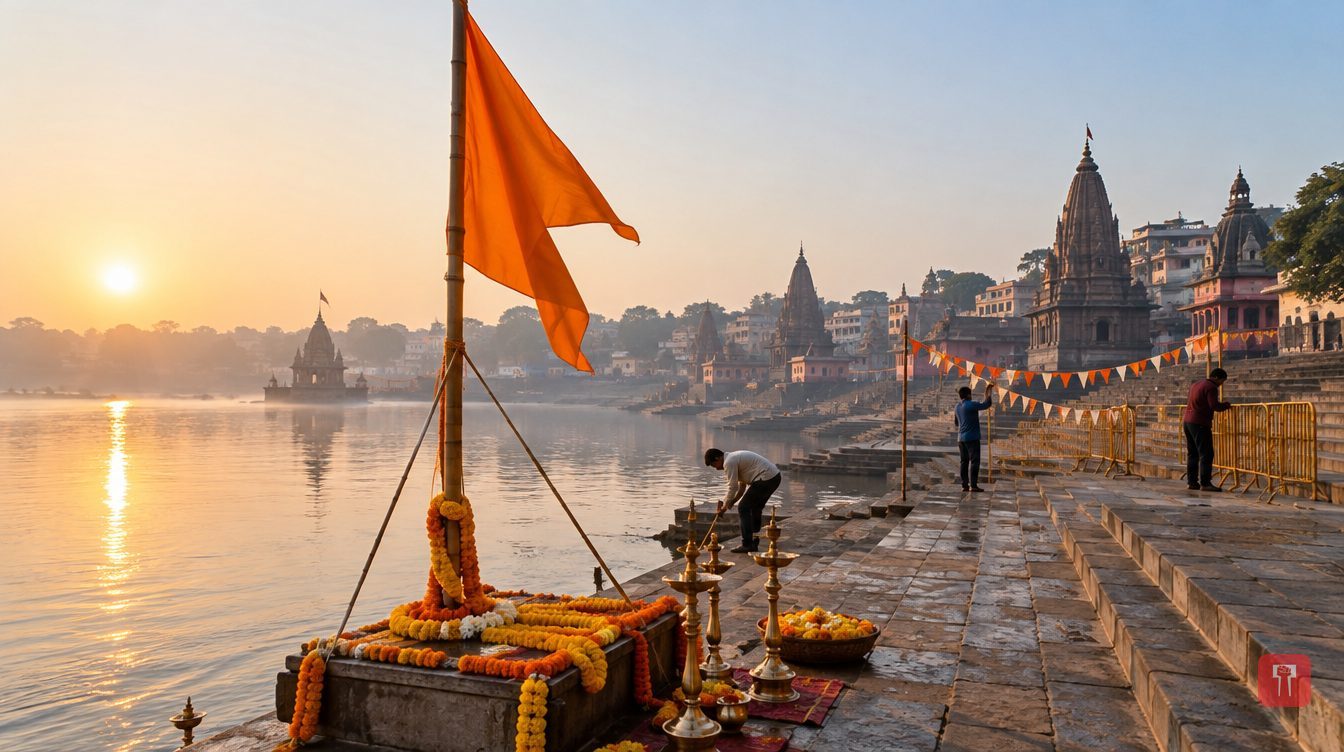 Images are not validated/verified
The Simhastha Kumbh Mela begins today in Nashik and Trimbakeshwar. It starts on 31 October 2026 and will run until 24 July 2028. The inauguration will be marked by a flag-hoisting ceremony, to be performed by President Droupadi Murmu at 12.02 pm at Ramkund in Nashik and Kushavart Tirth in Trimbakeshwar.
According to the Hindu almanac, the Simhastha Kumbh Mela is held in Nashik and Trimbakeshwar when the Sun and the Moon enter Cancer (Kark rashi) and Jupiter (Guru) enters Leo (Singh rashi). During the event, which lasts about 21 months, lakhs of devotees from India and abroad come to bathe in the Godavari. Hindus hold a deep belief that during this period the water of the rivers does not remain ordinary water but becomes nectar, and that a shahi snan taken at that time brings merit. Akhadas of the Shaiva and Vaishnava traditions will take part in the Mela.
Though the Mela formally begins in October 2026, the main religious rites and the biggest crowds will come in August and September 2027. The key dates are as follows. The Nagar Pradakshina, a sacred circumambulation of Nashik city, will be held on 29 July 2027. The first Amrit Snan (shahi snan) will be held on 2 August 2027, on Ashadha Somvati Amavasya. The second and main Amrit Snan will be held on 31 August 2027, on Shravan Amavasya. The third Amrit Snan, on Bhadrapad Ekadashi, will be held over two days: on 11 September 2027 in Nashik only, for the Vaishnava akhadas, and on 12 September 2027 in Trimbakeshwar only, for the Shaiva akhadas. The Mela will formally end on 24 July 2028 with the dhwajavataran, the lowering of the flag.
To receive crores of devotees and sadhus, the Maharashtra government has approved a development plan costing more than Rs 24,225 crore. Under a tradition dating to the Peshwa era, Shaiva sadhus will bathe at Kushavart Tirth in Trimbakeshwar, while Vaishnava akhadas and mahants will bathe at Ramkund and in the Tapovan area of Nashik. A large Sadhu Gram is being built at Tapovan for their stay.
To handle the growing crowds on the Godavari, new, safe and wider ghats have been built in both towns. A special drive has also been run to clean the riverbed. Ring roads connecting the city on all sides are ready for traffic, and special parking zones and holding areas have been set up for crowded days.
A website called Kumbh Mela Portal has been launched to inform devotees. Heli-tourism, or helicopter rides, is also planned for tourists who come outside the crowded days. For safety and health, large temporary hospitals, round-the-clock ambulances, fire brigade services and thousands of CCTV cameras to monitor the entire area have been put in place.
Kumbh means a pot or pitcher. According to legend, when the gods and demons churned the ocean in the Satya Yuga, 14 gems emerged, the last of which was the pot of nectar. The gods and demons fought over it for 12 days and 12 nights, said to equal 12 years of the human world. In the tussle, some drops of nectar fell at four sacred places on earth: Prayagraj (the confluence of the Ganga, Yamuna and Saraswati), Haridwar (the Ganga), Ujjain (the Shipra) and Nashik-Trimbakeshwar (the Godavari). For this reason the Kumbh Mela is held at these four places in turn every 12 years.
The Nashik Mela is called Simhastha because Jupiter (Guru) enters Leo (Singh rashi) during it. The Mela is divided between two places, Nashik and Trimbakeshwar, where sadhus of the Shaiva (worshippers of Lord Shiva) and Vaishnava (worshippers of Lord Vishnu) sects perform religious rites separately. It is believed that a dip in the river under a particular astronomical planetary position, that is, on the days of shahi snan, washes away all sins, frees one from disease and brings moksha, release from the cycle of birth and death. UNESCO has recognised the Kumbh Mela as an Intangible Cultural Heritage of Humanity.
Reach readers on the ward they actually live in.
Advertise with Prime Time 24Reach readers on the ward they actually live in.
Advertise with Prime Time 24Reach readers on the ward they actually live in.
Advertise with Prime Time 24
Comments
No comments yet. Be the first.