

Mumbai and Nagpur record worst air in Maharashtra after Diwali; Pune, Nashik AQI above 100
 Images are not validated/verified
Mumbai (162) and Nagpur (160) top the state's real-time AQI ranking after Diwali, with Mira-Bhayander third at 159 and Thane at 151.
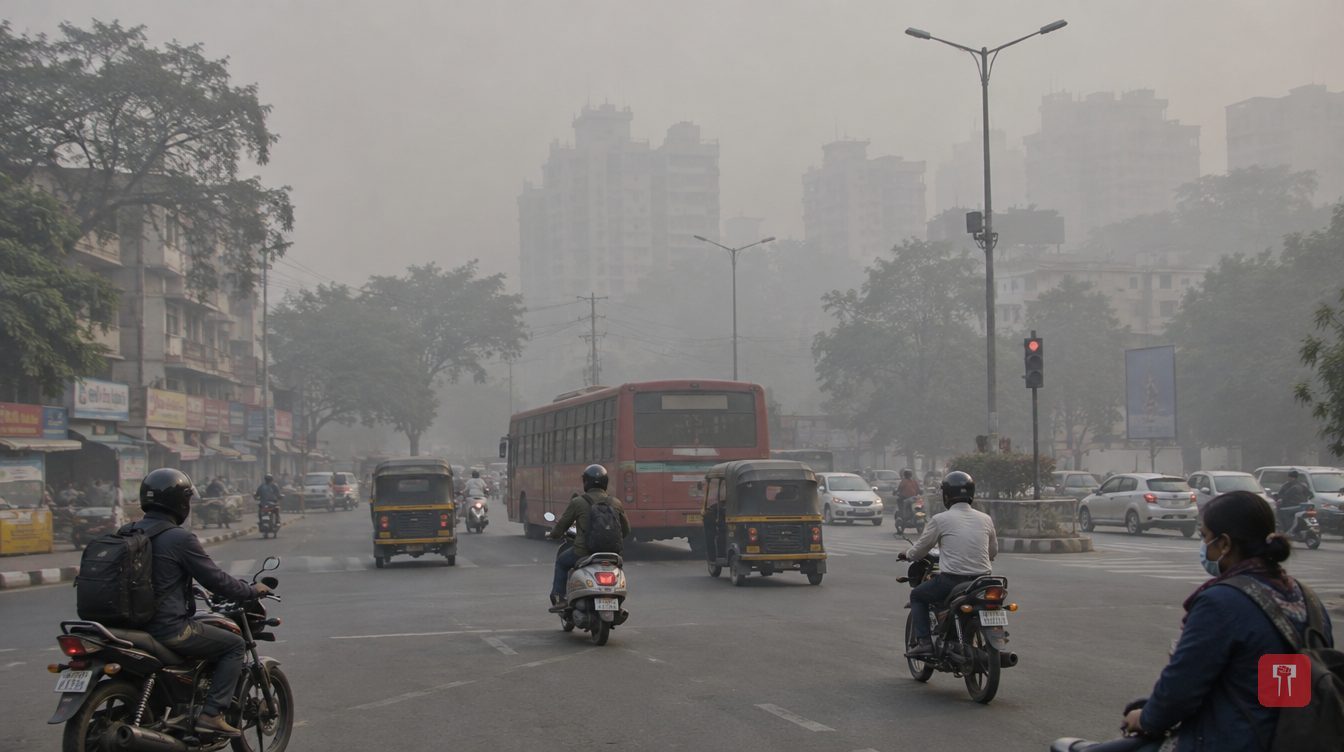
Diwali fireworks may have stopped, but the effect of firecracker smoke is still visible in the air of several Maharashtra cities. Pollution levels remain high in Mumbai, Nagpur, Mira-Bhayander and Thane.
In the real-time AQI ranking, Mumbai is first among the state's most polluted cities with 162. Nagpur is second with an AQI of 160 and Mira-Bhayander third with 159. Thane recorded an AQI of 151. Mumbai and Nagpur are separated by only 2 points, and Mira-Bhayander is also very close to both. Several cities in the Mumbai Metropolitan Region are thus facing the same challenge.
The air in some other cities was comparatively clean. Dhule and Jalgaon are at the top of that list with an AQI of 81. Mahad has an AQI of 84, while Belapur and Malegaon recorded 96. Pune, Nashik and Chhatrapati Sambhajinagar are also on the list, but all three have an AQI above 100.
At 9 am on the day after Diwali, Mumbai's average CPCB AQI was 171. On the day after Diwali last year it was 134, which makes this year's figure about 28 per cent higher. At eight monitoring stations in Mumbai, the AQI went past 200. Bandra East recorded 265, Bandra-Kurla Complex 232, Sewri 229 and Deonar 228. The figure was 221 in Ghatkopar and 215 in Chembur.
Nagpur's situation was also worrying. At 9 pm on November 8, its AQI had reached 217. At the same time, Pimpri-Chinchwad recorded an AQI of 197, Nashik 177, Pune 161, Navi Mumbai 150 and Mumbai 130.
Large quantities of firecrackers are burnt during Diwali, and their smoke and fine particles dissolve into the air. PM2.5 and PM10 are the main ones. PM2.5 particles are extremely small and can travel deep into the lungs with the breath. On the day after Diwali, CPCB stations in Mumbai had recorded PM2.5 as the main pollutant.
When the wind is slow, pollutant particles cannot disperse. In cold and given weather conditions, they can stay close to the ground. Existing traffic fumes and dust from construction sites and roads in Mumbai, Pune and Nagpur also worsen the air. In Pune, the rise in pollution on Diwali evening was attributed to firecracker smoke along with slow winds and low night temperatures.
A few hours of fireworks can affect the air, but it would not be right to put all the blame on firecrackers. Vehicle fumes, construction work, factory emissions and the weather also play a part. Continuous monitoring of the air and measures to curb pollution are therefore necessary.
A rise in AQI can affect children, the elderly, pregnant women and people with asthma or heart disease more. When the AQI is very bad, avoid exercising outdoors in the morning and late at night, and wear a well-fitting N95 mask when going out. See a doctor in case of breathlessness, cough or chest tightness.
Reach readers on the ward they actually live in.
Advertise with Prime Time 24Reach readers on the ward they actually live in.
Advertise with Prime Time 24Reach readers on the ward they actually live in.
Advertise with Prime Time 24Choose primetime24.com as a preferred source on Google Google shows more stories from your preferred sources in Top Stories.
Reach readers on the ward they actually live in.
Advertise with Prime Time 24
Comments
No comments yet. Be the first.