

Indian and British researchers build tiny supercapacitor that stores more energy under light
Researchers from India and the UK have developed a micro-supercapacitor whose energy-storage capacity rises when exposed to light, aimed at small electronic devices.
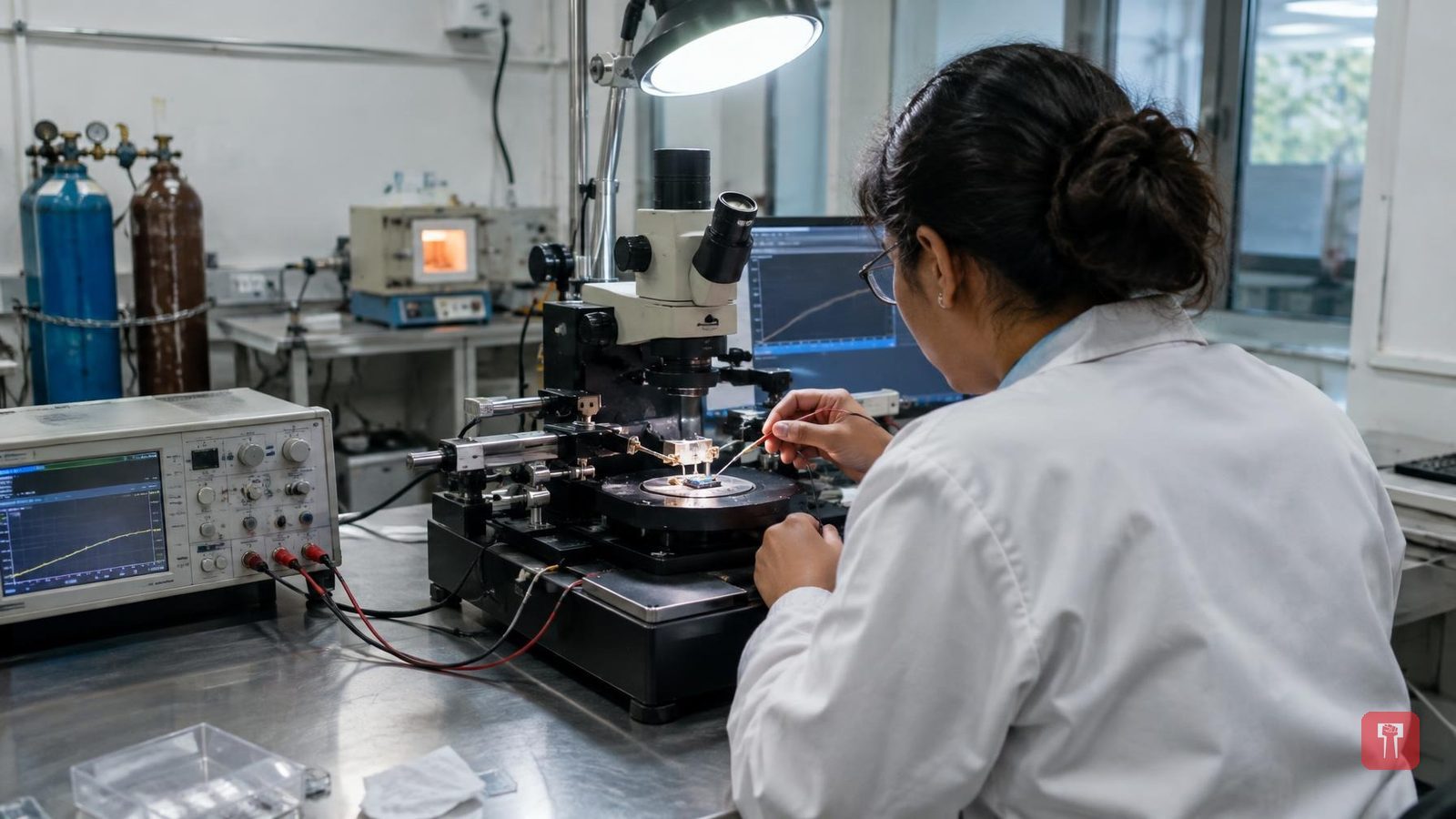 Images are not validated/verified
Indian and British researchers have taken an important step towards more effective, faster-charging and longer-lasting energy storage for small electronic devices. They have developed a micro-supercapacitor that increases its capacity to store energy when exposed to light.
Researchers from the Indian Institute of Science, IIT Bombay, Indraprastha Institute of Information Technology Delhi and University College London took part in the work. Experiments showed that the device's performance improves considerably when light falls on it.
Mobile devices, smartwatches, medical sensors and wearable electronics are steadily getting smaller, so the devices that power them must also be small and efficient. Conventional micro-supercapacitors have certain limits in energy storage capacity and performance. To overcome these, the researchers used a special titanium-based material.
They treated nanoparticles of titanium sesquioxide in a controlled mixture of hydrogen and argon gases at a temperature of 400 degrees Celsius. This hydrogenation process improved the properties of the material.
From this material, the researchers made a flat micro-supercapacitor that can be mounted on a chip. In experiments, the device recorded a specific capacitance of 13.5 millifarads per square centimetre. According to the research report, this is about seven times that of carbon-based micro-supercapacitors.
The durability of the device was also tested. After 5,000 continuous charge-discharge cycles, it retained about 88 per cent of its initial capacitance. The technology can be considered useful for small devices that have to be charged and discharged repeatedly.
In future, the technology could be used in smart clothing, small medical sensors, Internet of Things devices and micro-electronic systems. The ability to boost energy storage with the help of light could help make these devices more effective.
However, before commercial use, its long-term stability, manufacturing cost and performance in real-world conditions need to be examined.
