

IIT Bombay study shows graphene could detect tiny quantum changes in light
Researchers at IIT Bombay have proposed a theoretical method that uses graphene to pick up subtle quantum fluctuations in light, with possible uses in future sensors.
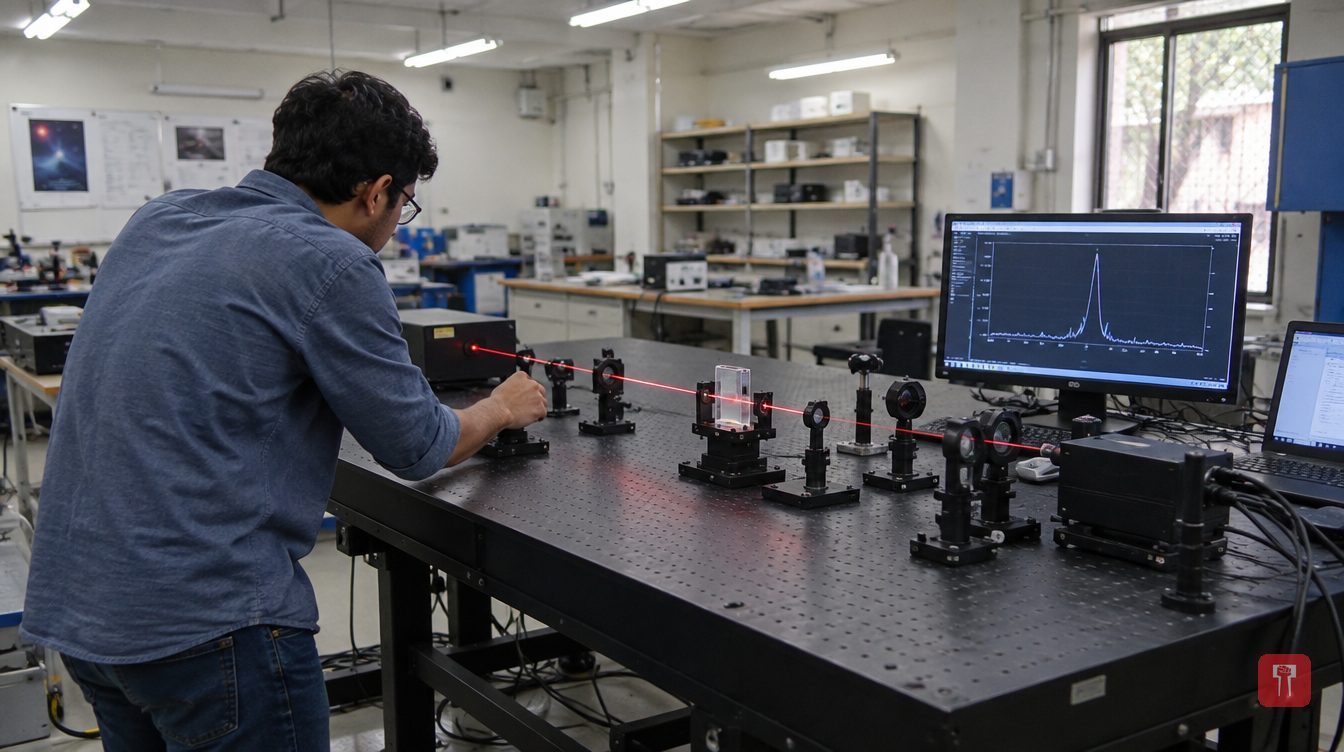 Images are not validated/verified
Measuring a small change in a room's temperature or a fluctuation in the current flowing through a machine is often difficult. Light poses the same problem: changes at a very small scale are not easy to detect directly.
What if the real changes could be worked out by studying the light those changes produce? Researchers at IIT Bombay have put forward a new theoretical route for this. Their work shows the possibility of detecting subtle quantum changes in light using graphene, a special material.
The research was carried out by Kartik Prabhu and Prof Gopal Dixit of the physics department at IIT Bombay. Their study has been published in Physical Review Letters, a journal of the American Physical Society.
Light has very fine uncertainties and fluctuations, known as quantum fluctuations, which ordinary instruments cannot easily capture. The researchers shone a special kind of quantum light on graphene and examined how light of a higher frequency is generated from it. Through theoretical analysis, they showed that this newly generated light can carry signs of the subtle changes in the original light.
The significance of the work is that it could later be used to build sensor systems that measure very small changes with greater precision. Such technology could make it more effective for scientists to understand fine properties of light in experiments, study the extremely fast motion of electrons and monitor chemical processes in materials. Research on atomic clocks, quantum technology and highly sensitive measurement systems is also likely to benefit in the future.
However, it cannot be concluded from this research that medical tests or everyday devices will immediately become more accurate. For now, it is only a theoretical study. More research is needed to confirm it in actual experiments and to develop the technology. Even so, the study could prove an important step towards measuring the invisible, subtle changes in light.
