

IB, LoC and LAC explained as ITBP chief flags face-off with Chinese troops in Arunachal
Amid tension on the Arunachal Pradesh border, here is how India's International Border, Line of Control and Line of Actual Control differ in law, history and policing.
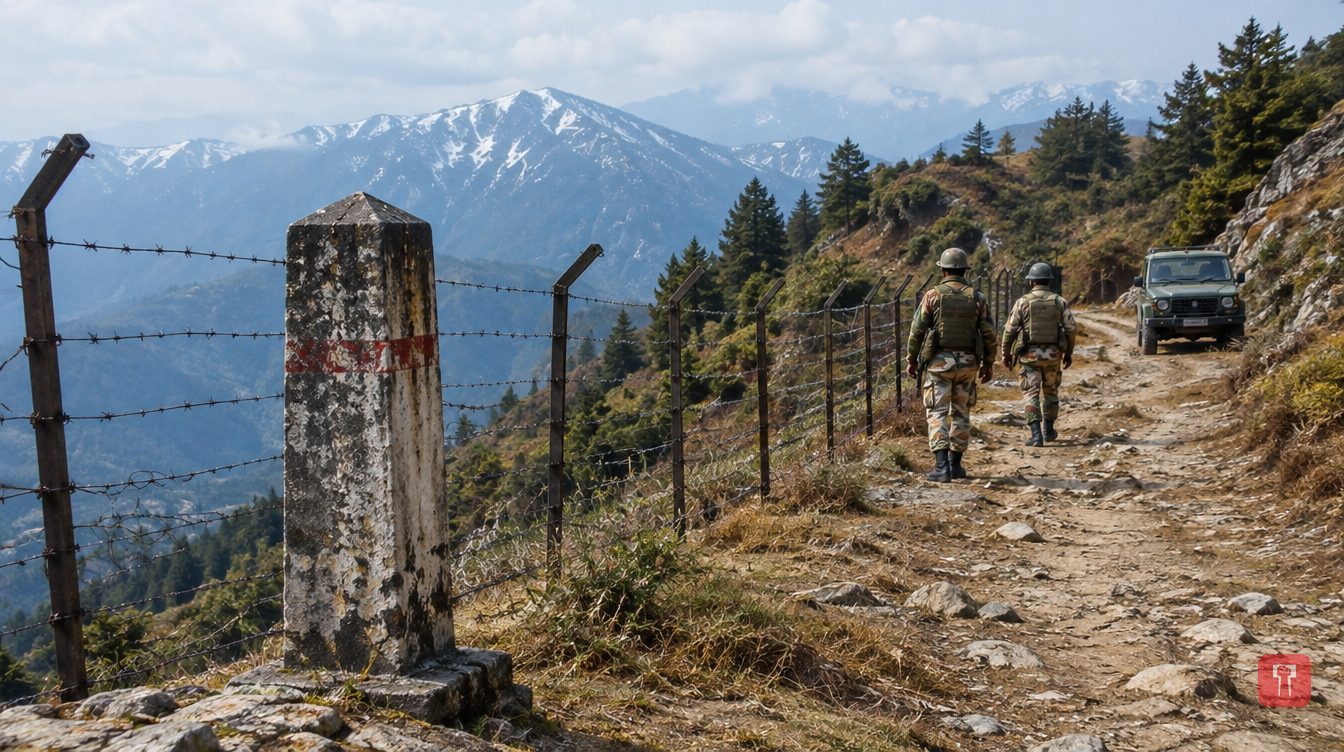 Images are not validated/verified
Guarding India's borders is counted among the toughest tasks in the world. The terms International Border (IB), Line of Control (LoC) and Line of Actual Control (LAC) are often read and heard in newspapers, on news channels and online. To the common man they are simply the country's frontiers. In military and diplomatic terms, however, the three are very different. Each has its own history, legal recognition, security forces and kind of confrontation.
Indo-Tibetan Border Police (ITBP) Director General Shatrujeet Kapoor recently spoke about the situation on the India-China border in Arunachal Pradesh at an event in Alwar, Rajasthan. He said clearly that a face-off has arisen between Indian and Chinese soldiers on the LAC in Arunachal Pradesh. Such tension at several places on the LAC is nothing new, but it makes the technical differences between the three borders worth understanding once again.
First, the International Border. This is a line that two countries fix by agreement, through maps and joint surveys. Under international law it is fully valid. The International Border between India and Pakistan along Gujarat, Rajasthan, Punjab and the Jammu area was fixed at the time of Partition in 1947. India's borders with Bangladesh, Nepal, Bhutan and Myanmar are also called international borders.
On the ground, the International Border is easy to identify. Border pillars, fencing and lights mark it, so people and troops on both sides know exactly where it runs. These borders are mostly watched by paramilitary forces. The Border Security Force (BSF) is deployed on the Pakistan and Bangladesh borders, while the Sashastra Seema Bal (SSB) is deployed on the Nepal and Bhutan borders.
Next, the Line of Control. It is not an officially recognised border at the international level. It is a temporary military line between India and Pakistan in Jammu and Kashmir, about 740 km long. After the 1947-48 India-Pakistan war, a ceasefire line was drawn through United Nations mediation, where the control of the two armies stopped. After the 1971 war, the line was named the Line of Control in the 1972 Shimla Agreement.
On the LoC, the armies of both sides stand face to face. The area is extremely sensitive, and regular firing, infiltration attempts and ceasefire violations are seen there. The Indian Army guards the line directly. At the northern end of the LoC, in the Siachen Glacier area, there is another line of about 110 km, called the Actual Ground Position Line (AGPL).
Third is the LAC, a border line about 3,488 km long between India and China. It is the most complex and disputed issue between the two countries, because they have never jointly accepted the line on a single map. The LAC has three major sectors. The western sector is part of Ladakh, where China has illegally occupied a large stretch of Aksai Chin. The middle sector is the border with Himachal Pradesh and Uttarakhand, considered comparatively calm. The eastern sector covers Sikkim and Arunachal Pradesh, where India treats the 1914 McMahon Line as the official border, but China does not accept it and claims the whole of Arunachal Pradesh.
The main cause of friction is that the two countries perceive the LAC differently. The point where the LAC ends according to India lies elsewhere according to China. Because of these overlapping claims, soldiers of the two countries come face to face while patrolling their own areas, and disputes arise. This is the main reason behind the clashes in Arunachal Pradesh that ITBP Director General Kapoor mentioned. The ITBP and the Indian Army share responsibility for guarding the LAC.
In brief, the International Border is with countries such as Pakistan, Bangladesh and Nepal and is recognised under international agreements. It has clear pillars and fencing, and the BSF and SSB are deployed there. The LoC is with Pakistan (Jammu and Kashmir region), is a military line of control under the Shimla Agreement, is fenced in parts, is very tightly guarded and is held by the Indian Army. The LAC is with China, where each country has its own separate claim, there are no fences or pillars, and security rests with the ITBP and the Indian Army.

Comments
No comments yet. Be the first.