

India, China agree on eight points at Doval-Wang Yi talks in Beijing; final boundary settlement still pending
National Security Adviser Ajit Doval and Chinese Foreign Minister Wang Yi agreed on eight issues at the 25th Special Representatives meeting, but demarcation remains unsettled.
 Images are not validated/verified
The boundary question between India and China is not merely a matter of drawing a line on a map. It has become the centre of a strategic tussle between Asia's two big powers. The Special Representatives of the two countries have been holding talks for over two decades to find a solution.
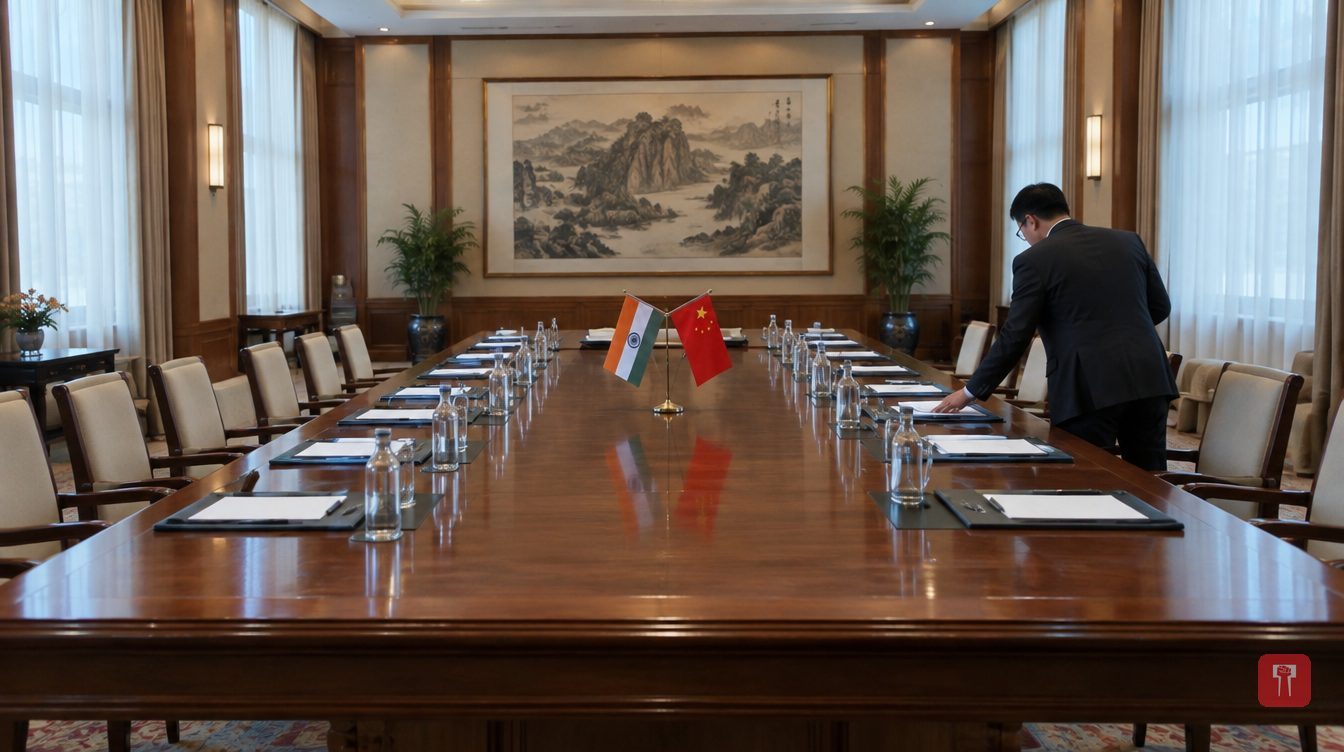
On August 25, 2026, National Security Adviser Ajit Doval and Chinese Foreign Minister Wang Yi held the 25th important meeting in Beijing. Agreement was reached on eight key issues. Even so, the final demarcation of the boundary on the ground and the claims over disputed areas remain unsettled.
Meanwhile, Indo-Tibetan Border Police (ITBP) Director General Shatrughan Kapoor (Shatrujeet Kapoor) has briefed on recent clashes between Indian and Chinese soldiers on the Arunachal Pradesh border and the ongoing tension. There is thus a wide gap between the understanding reached at the diplomatic level and the military reality on the Line of Actual Control (LAC).
The roots of the dispute lie in the 1962 war and the events that followed. On December 8, 2011, the Government of India told the Rajya Sabha officially that China was illegally occupying about 38,000 square km of Indian land in Jammu and Kashmir (Aksai Chin).
Under the boundary agreement between Pakistan and China on March 2, 1963, Pakistan also handed over 5,180 square km of land in Pakistan-occupied Kashmir (PoK) to China. India has held from the start that this agreement is wholly illegal. In the eastern sector, China claims the whole of Arunachal Pradesh and describes about 90,000 square km as its own.
In 2003, the two countries set up the Special Representatives (SR) mechanism to seek a lasting political solution to the boundary question. After initial rounds of talks, on April 11, 2005, they signed a landmark agreement on political parameters and guiding principles for settling the boundary dispute.
The aim of that agreement was to find a solution acceptable to both sides that is fair and reasonable. In the 21 years between 2003 and 2026, the Special Representatives have held 25 meetings. Even so, no final agreement has yet been reached on the entire 3,488-km boundary that could end the dispute for good.
At the 25th meeting in Beijing, the two countries agreed on the following eight points to stabilise relations. First, maintaining peace and stability on the LAC and working towards restoring relations between the two countries. Second, speeding up the process of finding a mutually acceptable solution on the basis of the 2005 guiding principles. Third, moving talks forward by fixing the scope and terms of reference of two working groups on demarcation and boundary management.
Fourth, establishing immediate contact through military and diplomatic channels whenever tension arises on the border. Fifth, starting two new hotlines in the eastern and central sectors for direct military-level talks, and two new meeting points for military commanders. Sixth, reopening three border trade centres that had been shut and increasing the number of Indian pilgrims for the Kailash Mansarovar Yatra.
Seventh, holding an expert group meeting in September to share hydrological data on rivers that flow across the border. Eighth, holding the 26th meeting of the Special Representatives in India next year, in 2027.
Trust between the two countries broke down completely after the violent clash in Ladakh's Galwan Valley in June 2020. Citing security, India banned more than 59 Chinese apps including TikTok, tightened investment rules and halted direct flights.
In October 2024, agreement was reached on disengagement in eastern Ladakh. Talks between Prime Minister Narendra Modi and President Xi Jinping followed. In 2025, direct flights resumed and the Prime Minister attended the SCO council meeting in China.
Notably, despite the tension on the border, bilateral trade between India and China rose 12 per cent in 2025 to a record $155.6 billion. This shows that the economic dependence of the two countries has largely moved apart from border politics.
Reaching an understanding at the diplomatic level and the final demarcation of the boundary on the ground are two entirely different things. The hotlines and meeting points now being set up may help avoid military clashes caused by misunderstanding. However, the two countries have not yet made clear from which area the demarcation process will begin, or what timeline it will follow.
The coming meetings of the expert groups and the 26th meeting to be held in India in 2027 will be extremely important in deciding the future course of the boundary dispute.

Comments
No comments yet. Be the first.