

ITBP chief says Indian and Chinese troops are face to face at several points on Arunachal LAC
ITBP Director General Shatrujeet Kapoor confirmed that troops of both countries have been in a face-off in Arunachal Pradesh since July, and outlined drone and bunker plans.
 Images are not validated/verified
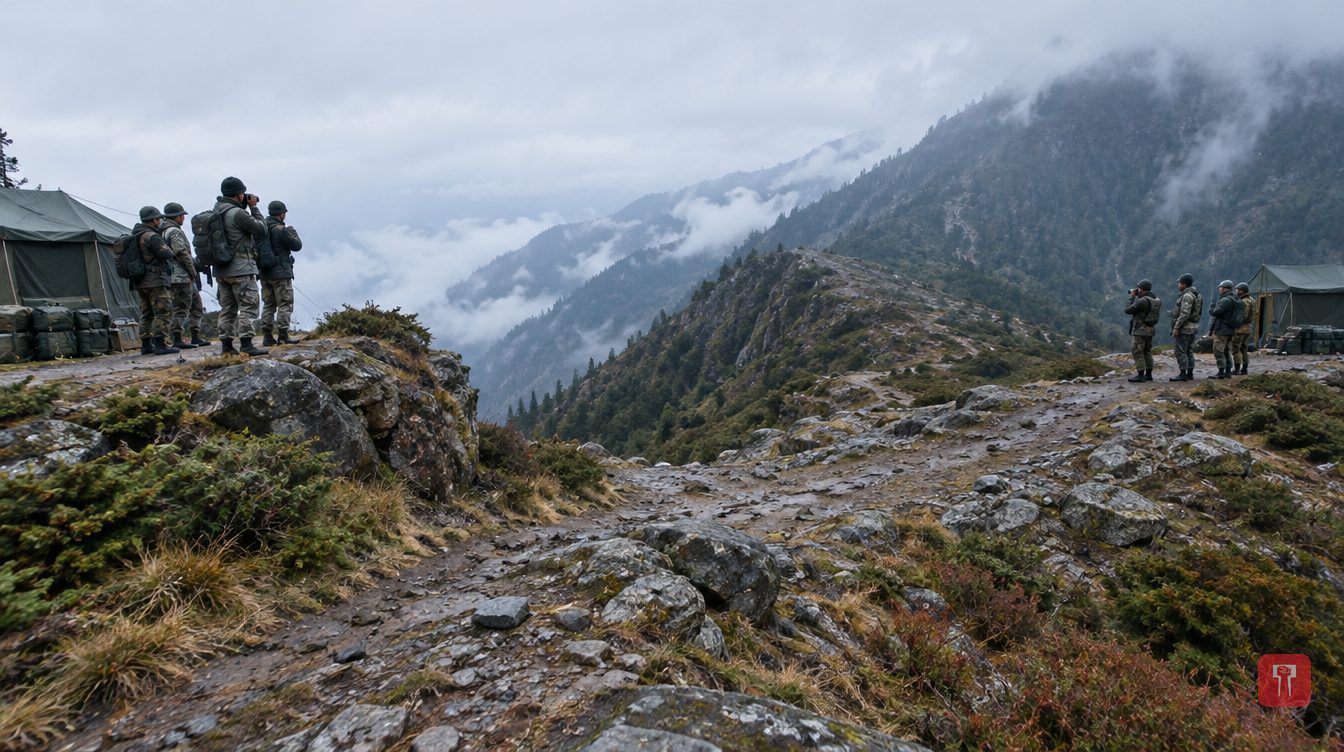
Indian and Chinese troops are standing face to face at several points on the Line of Actual Control (LAC) in Arunachal Pradesh, the Director General of the Indo-Tibetan Border Police (ITBP), Shatrujeet Kapoor, has said. He described the situation at an event in Alwar, Rajasthan, and said that tension on the northeastern frontier has been building since July and that the face-off has not ended.
Kapoor was speaking at the annual awards function of the Central Training College (CTC) in Alwar, the 'Himveer Samman Samaroh'. He praised the force and said its newly raised 'Shaurya Commando' unit had performed with great courage during the Arunachal stand-off. The ITBP, he said, will soon have a full battalion of these commandos, since work at extreme altitudes is where the force is strongest.
Government sources have given a more detailed account of the stand-off. Since the end of July, soldiers of the two sides have been confronting each other in the Asafila area, near the Maja company operating base of the Taksing circle in Upper Subansiri district. The two sides first met during a routine patrol in July. After an initial dispute both pulled back, but a few days later soldiers of China's People's Liberation Army (PLA) returned in large numbers. By India's reading of the LAC, they are 6 to 7 km inside Indian territory and have pitched tents on a high ridge. India has since reinforced its own deployment on the border substantially.
Diplomacy has run alongside the stand-off. Chinese President Xi Jinping was in India for the 18th BRICS summit from September 11 to 13. Since July the two countries have held three high-level border meetings. The 36th meeting of the WMCC took place on August 6, and the 25th round of Special Representatives (SR) talks was held in Beijing on August 26, with National Security Adviser (NSA) Ajit Doval attending for India. On September 6 a corps commander-level meeting for the eastern sector was held for the first time at Wacha-Damai in Arunachal. After the Galwan Valley clash of June 2020, such meetings were mostly held at Chushul-Moldo in eastern Ladakh. Because of the weather, long-range patrols go out regularly in Arunachal between June and October.
Why the LAC produces such confrontations is a matter of how the line is understood. The LAC is about 3,488 km long and runs between India and China, and the two countries have never agreed on it jointly on a single map. A point where the line ends according to India lies elsewhere according to China, so patrols from both sides meet in the same stretch of ground and disputes follow. This is the root of the Arunachal clashes Kapoor referred to. The ITBP and the Indian Army share the task of guarding the line.
The LAC has three sectors. The western sector lies in Ladakh, where India says China has illegally occupied a large stretch of Aksai Chin. The middle sector, along Himachal Pradesh and Uttarakhand, is seen as comparatively quiet. The eastern sector covers Sikkim and Arunachal Pradesh. India treats the 1914 McMahon Line as the border there, China rejects it and claims the whole of Arunachal Pradesh.
The LAC differs from India's other frontiers. The International Border is a line fixed by agreement between two countries, through maps and joint surveys, and it is fully valid under international law. India's border with Pakistan along Gujarat, Rajasthan, Punjab and the Jammu area was settled at Partition in 1947, and the borders with Bangladesh, Nepal, Bhutan and Myanmar are also international borders. They are marked by pillars, fencing and lights, and are mostly watched by paramilitary forces: the Border Security Force (BSF) on the Pakistan and Bangladesh borders and the Sashastra Seema Bal (SSB) on the Nepal and Bhutan borders.
The Line of Control (LoC), about 740 km long, is not an officially recognised international border. It is a temporary military line between India and Pakistan in Jammu and Kashmir. It began as a ceasefire line drawn with United Nations mediation after the 1947-48 war, and was named the Line of Control in the 1972 Shimla Agreement after the 1971 war. The armies of both sides stand directly opposite each other there, and firing, infiltration attempts and ceasefire violations are regularly seen. The Indian Army guards it directly. At its northern end, in the Siachen Glacier area, a further line of about 110 km is called the Actual Ground Position Line (AGPL).
On the ITBP itself, Kapoor said the force began as a 'mountain guerrilla force' and was handed the duty of guarding the China border in 2004. Without losing that original identity, he said, it is now building a 'high-altitude mountain fighting force' distinct from the Army.
Kapoor, who retires on October 31, put the modernisation of the force at the centre of his remarks. The ITBP's weapons are about 50 years old, he said, and replacing them is vital. China has spent heavily on upgrading its weapons and infrastructure, so it is hard to keep pace with it by old methods.
He gave particular weight to drones. "Even small countries can challenge a big power on the strength of drones. We have seen how Ukraine has held back a superpower like Russia, where 10,000 to 15,000 Russian soldiers have been killed. Iran challenged the United States with drones despite having no navy."
The ITBP has therefore decided to move towards drones and anti-drone systems. Of the Rs 400 crore it received for modernisation, 70 per cent has already gone on drones. Every frontier battalion now has a drone platoon, training of drone pilots has started, and the force has begun building drones itself. A second modernisation plan worth Rs 3,500 crore to Rs 4,000 crore is under way, and Rs 1,000 crore of it has been set aside for drone technology alone.
Kapoor also said the nature of modern warfare has changed. The force has decided that over the next 3 years it will build as many underground shelters on the China border as there are shelters above ground.

Comments
No comments yet. Be the first.