

Hyundai Bayon vs Honda Elevate facelift: engine, boot space, features and price compared
 Images are not validated/verified
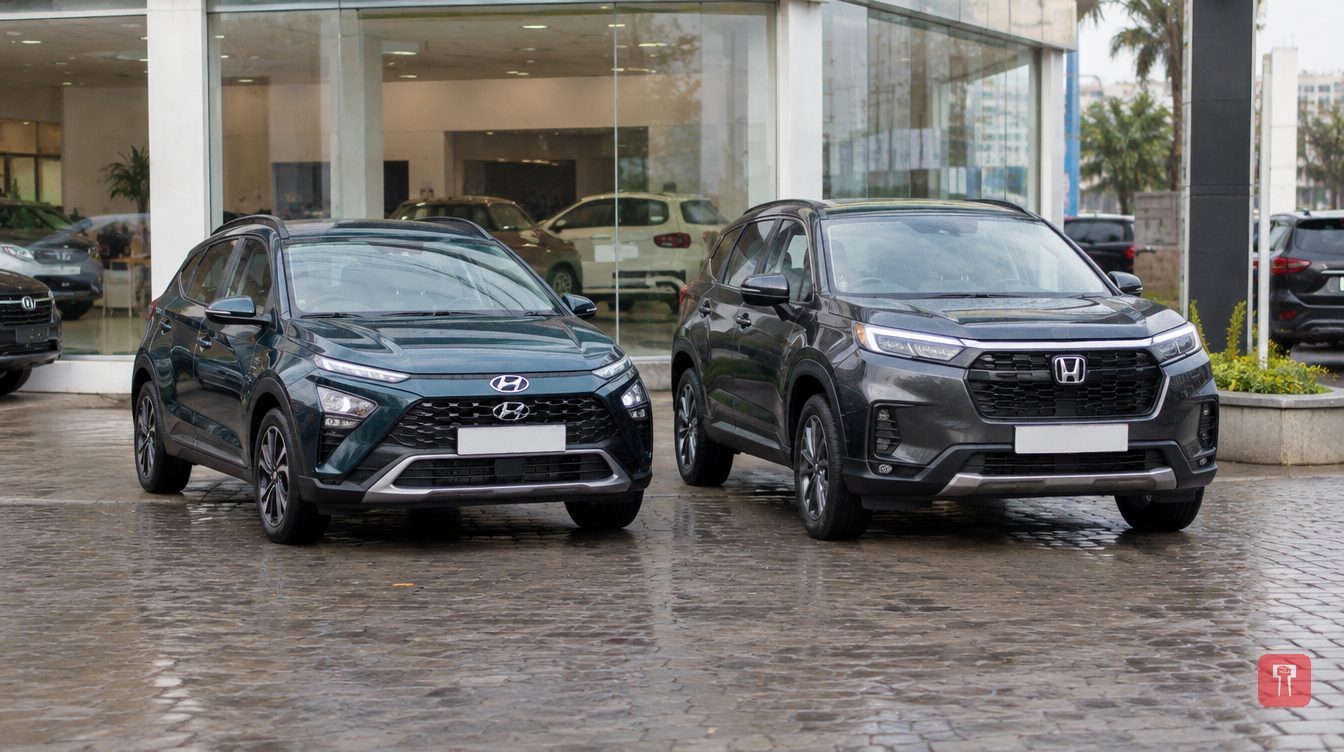
Hyundai is readying the Bayon as a rival to the Honda Elevate facelift launched on October 6, with the Elevate more powerful and bigger and the Bayon ahead on boot space and features.
Demand for SUVs in the Indian car market is rising fast, and a direct contest is now taking shape between two strong models. Before bringing in a new-generation Creta, Hyundai is preparing to enter the 'D SUV' segment with two models. The Hyundai Bayon is the second of these and will later replace the base and lower variants of the current Creta. It will face a stiff challenge from the Honda Elevate facelift, launched on October 6.
On engines, both cars have a 1.5-litre naturally aspirated petrol engine, with a choice of a 6-speed manual or a CVT automatic gearbox. The Bayon's engine makes 113 bhp of power and 143 Nm of torque, while the Elevate's makes 119 bhp and 145 Nm. The Elevate is thus slightly more powerful than the Bayon.
The picture differs on CNG. The pre-facelift Elevate had a dealer-level CNG kit fitted with the company's approval, available with the 6-speed manual. Honda has not announced an authorised CNG option for the new Elevate facelift. Hyundai, on the other hand, has officially confirmed that the CNG version of the Bayon will reach the market in January 2027. Its setup will be similar to the Kia Carens Clavis CNG, whose engine produces 95 bhp and 123 Nm and is offered only with a 6-speed manual.
In size, the Honda Elevate is slightly bigger than the Hyundai Bayon. The Bayon is 4.24 metres long with a 2.60-metre wheelbase, while the Elevate is 4.32 metres long with a 2.65-metre wheelbase. The picture reverses on boot space: despite being smaller, the Bayon offers a large 505-litre boot, against 458 litres in the Elevate.
The top variants of both cars have largely similar features. These include LED lighting, climate control with rear AC vents, Level 2 ADAS, TPMS, a 360-degree camera with blind spot monitor, connected car technology, ventilated front seats and USB-C fast-charging ports. Even so, the Bayon's ADAS system offers more functions than the Elevate's. The Bayon also gets a fully digital instrument cluster and a rear seat that reclines in two positions.
The price difference between the top variants of the Bayon and the Elevate is only Rs 19,000. Buyers willing to spend Rs 6,000 more can opt for the Elevate ZX+ Dark variant. A special edition of the Hyundai Bayon is likely in the coming months, which could either close this price gap with the Elevate ZX+ Dark or widen it further.
In Mumbai, the on-road price of the Hyundai Bayon starts at Rs 11.72 lakh and that of the Honda Elevate at Rs 14.14 lakh.
Overall, the Honda Elevate is bigger and slightly more powerful, while the Hyundai Bayon offers more modern features, and a company-fitted CNG option is also due soon.
Reach readers on the ward they actually live in.
Advertise with Prime Time 24Reach readers on the ward they actually live in.
Advertise with Prime Time 24Reach readers on the ward they actually live in.
Advertise with Prime Time 24Choose primetime24.com as a preferred source on Google Google shows more stories from your preferred sources in Top Stories.
Reach readers on the ward they actually live in.
Advertise with Prime Time 24
Comments
No comments yet. Be the first.