

Hyundai Bayon vs Creta: how price, features and engines compare
Hyundai has launched the Bayon SUV in India, positioned just below the Creta; the two share many features but differ in price, size, screens and engine options.
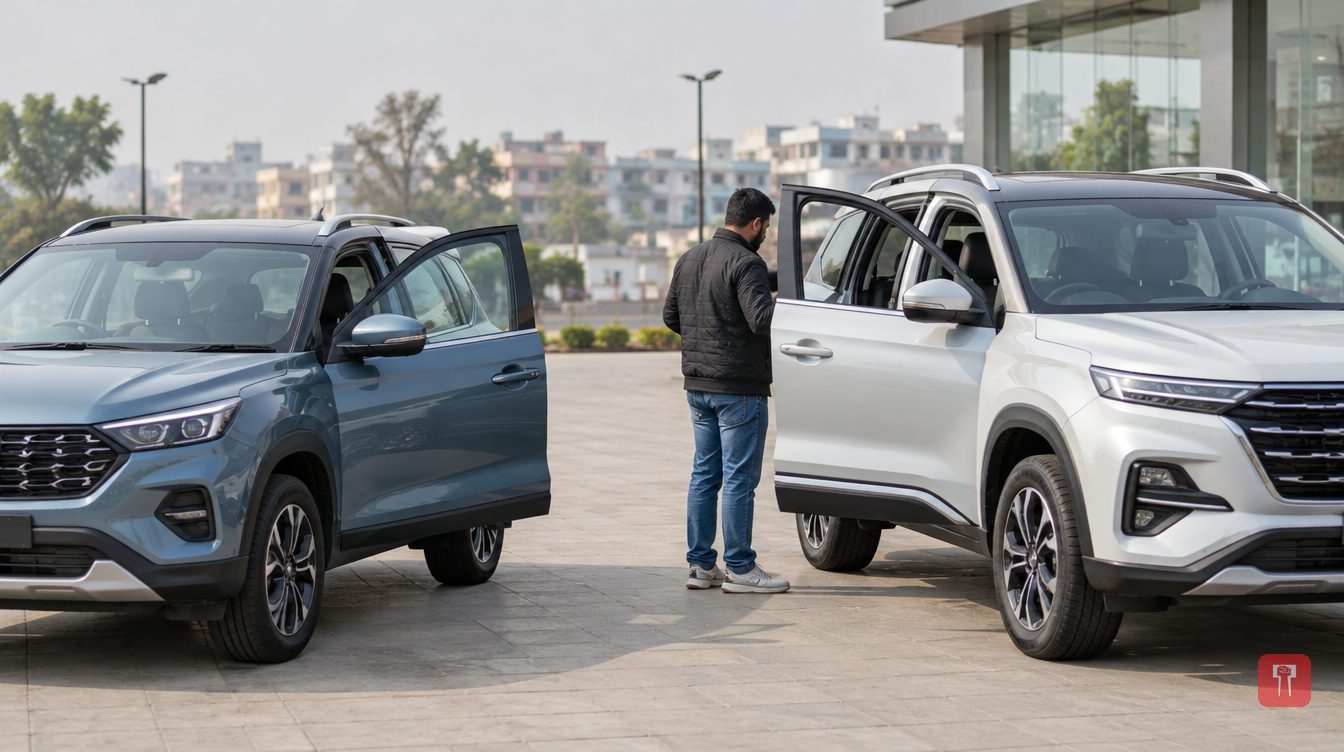 Images are not validated/verified
Hyundai has officially launched its new SUV, the Hyundai Bayon, in the Indian market. It is positioned slightly below the popular Hyundai Creta. The two cars share many features, and both offer a 1.5-litre naturally aspirated petrol engine. There are, however, major differences in design, size, features, price and engine variants.
On price, the Bayon's ex-showroom price starts at Rs 9.99 lakh and goes up to Rs 18 lakh. The Creta starts at Rs 10.91 lakh and goes up to Rs 20.46 lakh. The Bayon is thus Rs 92,000 cheaper in the entry variant, and the gap is Rs 2.46 lakh in the top variants. For buyers who want a Hyundai SUV but do not have the Creta's budget, the Bayon could be a good option.
The Bayon has a sporty, modern look. At the front it has a split headlamp setup, slim LED daytime running lights and low-set main headlamps. Black and silver bumper cladding, petal-shaped alloy wheels and pronounced wheel arches give it a distinct identity. At the rear it has connected-style tail-lamps, a roof spoiler and a dual-tone bumper.
The Creta is the bigger car. The Bayon is 4,245 mm long against the Creta's 4,330 mm, making it 85 mm shorter. The Bayon is 1,570 mm tall and the Creta 1,635 mm, a difference of 65 mm. In width, however, the Bayon (1,810 mm) is 20 mm wider than the Creta (1,790 mm). The Bayon's wheelbase is 2,600 mm and the Creta's 2,610 mm, 10 mm less.
The Bayon comes in Titanium Black, Classic Blue, Atlas White, Fiery Red, Golden Bronze and Ecotronic Grey. Classic Blue and Fiery Red are likely to appeal to young buyers. The Creta is offered in premium shades: Robust Emerald Pearl, Starry Night, Titan Grey, Titan Grey Matte, Atlas White, Titanium Black and Titanium Black Matte.
Safety features are the same in both. Both cars get six airbags, a 360-degree camera, ESC, TPMS, rain-sensing wipers and Level-2 ADAS. Both also have a panoramic sunroof.
The Bayon leads on screens, with a 12.3-inch touchscreen infotainment system and a 12.3-inch digital driver display. Wireless Apple CarPlay and Android Auto come as standard. The Creta has 10.25-inch screens and needs an adapter for wireless connectivity. The Creta, however, has 18-inch alloy wheels against the Bayon's 17-inch. The Creta's dual-zone climate control lets the driver and the front passenger set different temperatures, while the Bayon has single-zone climate control.
The biggest difference is in the engines. The Bayon has only the 1.5-litre naturally aspirated petrol engine, which produces 115 PS of power and 144 Nm of torque. The Creta's naturally aspirated petrol variant delivers the same power and torque. Both have a 6-speed manual and a CVT automatic gearbox. The Creta additionally has a 1.5-litre turbo-petrol engine producing 160 PS and 253 Nm, paired with a 7-speed DCT gearbox, and a 1.5-litre diesel engine producing 116 PS and 250 Nm, with 6-speed manual and 6-speed automatic options. The Creta is clearly ahead in the variety of engines and transmissions.
Which one to pick? The Bayon is worth considering for a lower starting price, large digital screens, wireless smartphone connectivity and a 1.5-litre petrol engine. The Creta offers more choice for those who want a bigger size, 18-inch alloy wheels, dual-zone climate control and a turbo-petrol or diesel engine. Buyers should not look only at the starting price, but at which features, which engine and which variant fit their budget. It is advisable to see both cars in person and compare them before deciding.

Comments
No comments yet. Be the first.