

Air India flying academy at Amravati's Belora airport gets DGCA approval; all 34 aircraft arrive
 Images are not validated/verified
The Air India flying training organisation at Belora airport is about 95 per cent complete, and training is planned to begin within a month with 180 trainees.
The Air India Flying Academy (flying training organisation, or FTO) being built in Amravati has reached its final stage. About 95 per cent of the work on the project at Belora airport is complete. The project, seen as giving a new direction to the country's aviation sector and as important for the development of Vidarbha, is now close to starting.
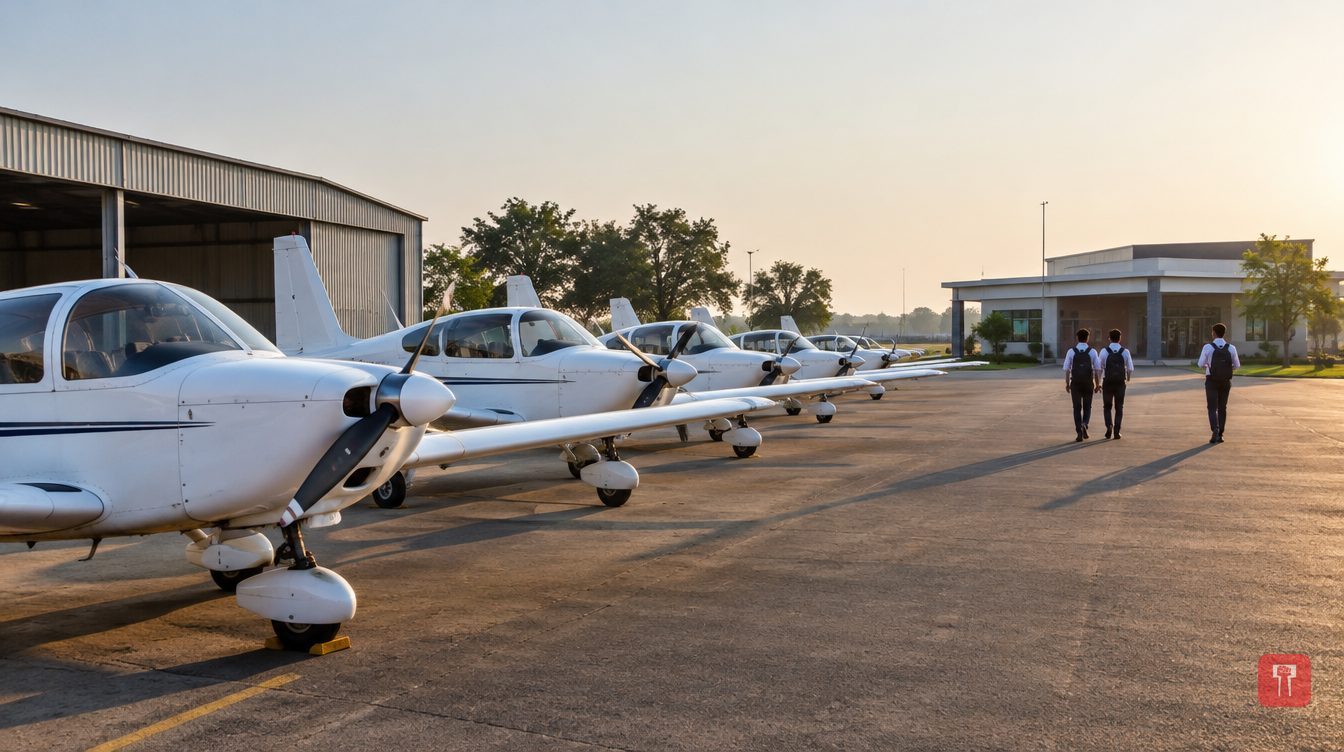
All 34 aircraft required for pilot training have arrived at Belora airport. They include 31 single-engine 'Piper Archer' aircraft and three twin-engine 'Diamond DA 42 NG' aircraft. The DGCA has now also given its official approval, clearing the way for training to begin.
The centre is being set up jointly by the Maharashtra Airport Development Company and Air India, which is owned by the Tata Group. It has been described as the largest pilot training centre in South Asia. It will give the country's aspiring pilots a chance to receive world-class training in Maharashtra itself.
Once the administrative and operational procedures are completed, actual training is planned to begin within the next month. A total of 180 trainees will be taken in the first batch.
The course for a commercial pilot licence will run for 18 months. During this period, each trainee must complete 200 hours of flight training on actual aircraft. This includes 185 hours on single-engine aircraft, and flight training will also be given on multi-engine aircraft.
Experts say Amravati's weather is favourable for flying. The conditions could be good for flying training on at least 300 days a year. For this reason, Amravati is expected to emerge as an important centre for pilot training.
The training centre's campus spreads over 10 acres. A hostel and a dining facility have been built for trainees. It also has modern classrooms, briefing rooms and hangars, and separate arrangements for the maintenance and repair of aircraft.
Three flight simulators have also been installed for practice before actual flying, two single-engine and one multi-engine. To maintain the standard of training, a ratio of only six trainees per flight instructor has been fixed.
Reach readers on the ward they actually live in.
Advertise with Prime Time 24Reach readers on the ward they actually live in.
Advertise with Prime Time 24Reach readers on the ward they actually live in.
Advertise with Prime Time 24
Comments
No comments yet. Be the first.