

Pune spent Rs 275 crore on clean air, yet SPM hits seven-year high as mist fountains lie dead
 Images are not validated/verified
Pune's annual SPM average rose to 101 micrograms per cubic metre in 2025-26, the highest in seven years, even as NCAP dust-control equipment lies idle.
The Air Quality Index (AQI) in Pune reached about 427.39 on Sunday evening, putting the city in the "severe" category. Smoke from Diwali firecrackers, dust from construction and road dust kicked up again by traffic have been cited as the causes of the smog. Meanwhile, the pollution-control machines of the Pune Municipal Corporation (PMC) are lying idle. Activists say spending that does not stop pollution at the source is a waste of public money, and they are demanding an immediate audit.
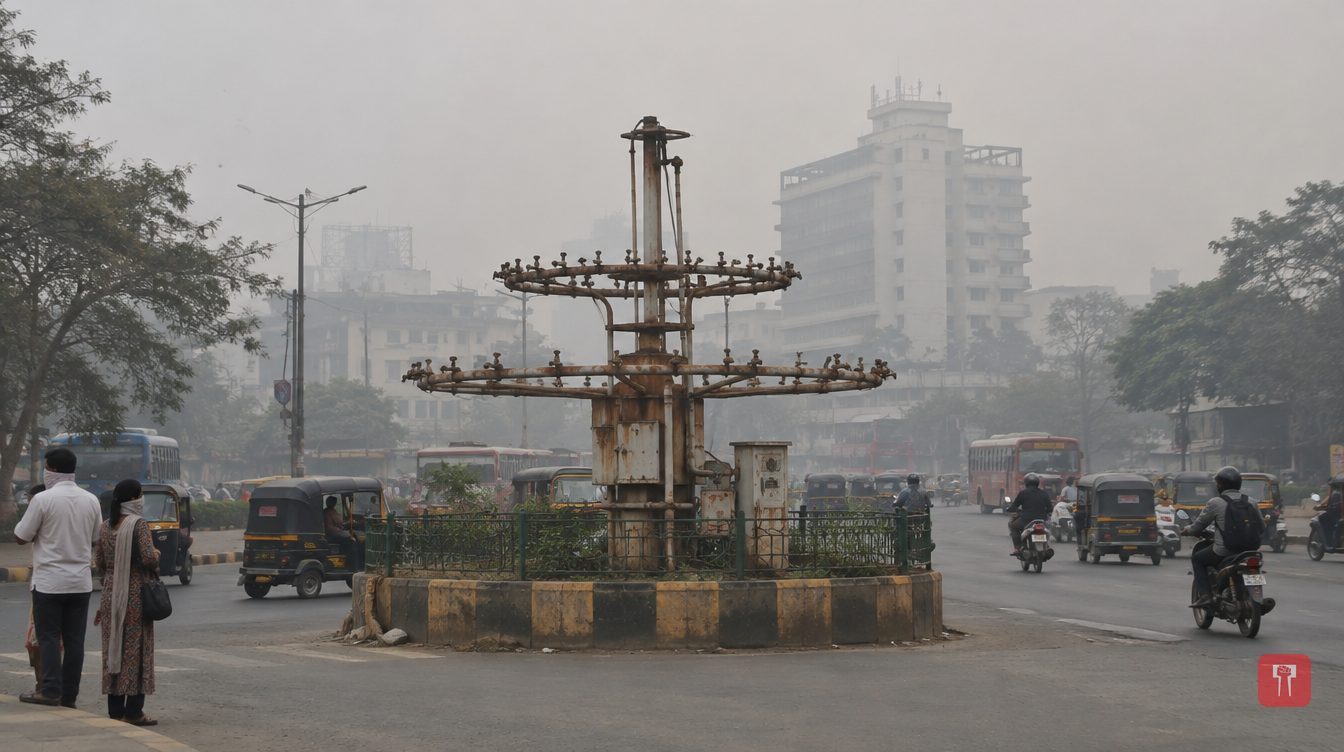
Under the National Clean Air Programme (NCAP), mist fountains were installed at ten major traffic hubs in the city. At places such as RTO Chowk on Sangamwadi Road, Baner and Bremen Chowk in Aundh, they had been billed as a major measure against vehicle fumes and road dust. Today the fountains are dry, rusted and shut. At RTO Chowk and Aundh, people are forced to breathe dust clouds beside this defunct equipment.
The condition of the main roads is similar. Mobile fog cannon machines were bought with 15th Finance Commission grants for routes such as Karve Road, Satara Road, Solapur Road and Sinhagad Road. It is alleged that despite heavy spending on purchase and maintenance, the machines rarely run on the roads and are mostly kept in municipal sheds. People are suffering throat irritation and breathing trouble.
According to data on the PRANA portal, the Centre's platform for monitoring NCAP implementation, Pune received Rs 418.45 crore and spent Rs 275.28 crore over seven years, about 66 per cent. Information obtained under the Right to Information (RTI) Act shows the money went on road infrastructure, public transport, crematoria and waste management.
The RTI data mention the building or improvement of 121.4 km of roads and repair of 19 km of footpaths. Two mechanical road sweepers and 19 sprinklers were acquired to control road dust. 36 electric buses were put on the roads and 65 charging stations installed. Ten waste collection centres were set up, of which six are dry waste centres and four are for construction and demolition waste. 381 tonnes of solid waste were collected and transported, 15 new crematorium facilities were built (including PNG and electric ones, with seven cremation sites replaced), and 36 awareness programmes were held.
Even so, SPM remains a major concern. SPM refers to particles of 10 micrometres or smaller, which can enter the airways and worsen respiratory, lung and heart disease. In 2025-26 the city's annual average was 101 micrograms per cubic metre, the highest in seven years and above the national limit of 60. The annual average for PM 2.5 was 48 in 2019 and 34.2 in 2026. The SPM average was 81 in 2019-20, 69 in 2020-21, 85 in 2021-22, 96 in 2022-23, 98 in 2023-24 and 96 in 2024-25.
Dr Rakesh Kumar, president of the Society for Indoor Environment, said the figures show a shift from combustion-related pollution to dust. "BS-VI vehicles, cleaner fuels and electric buses, along with a reduction in open burning, may have helped bring SPM down. City expansion, metro works, road widening, concretisation and construction keep generating coarse dust. Pune's efforts to reduce SPM are commendable, but it is essential to continue them," he said. He described the 2022 figure as a data quality concern, because of differences in monitoring locations, methods and data collection. In his view, existing measures such as sprinklers and cleaning machines do not appear effective. "The focus should be on construction practices, operation and maintenance, and location-specific measures. Water sprinkling and mechanical sweeping alone are not enough," he said.
Sharmila Deo, a member of Pune Air Action Hub, said expenditure figures alone do not show whether measures are working. "The cost of each measure and its actual implementation and impact should be examined. Spending on technologies such as mist fountains and fog cannons, for which there is no scientific evidence, is a clear example of wasted money. Mechanical road cleaning should not be considered a success merely because machines were bought or installed," she said. According to Deo, any assessment should include the roads covered, frequency of cleaning, running hours of the machines, methods of collecting and disposing of dust, and evidence of reduced resuspension of road dust. Since vehicle exhaust is a major contributor in Pune's emissions inventory, she said: "Priority should go to reducing dependence on private vehicles and strengthening buses and the metro. Spending should mainly go to controlling pollution at the source."
NCAP was launched in January 2019 and aims to improve air quality in 131 non-attainment cities.
Reach readers on the ward they actually live in.
Advertise with Prime Time 24Reach readers on the ward they actually live in.
Advertise with Prime Time 24Reach readers on the ward they actually live in.
Advertise with Prime Time 24Choose primetime24.com as a preferred source on Google Google shows more stories from your preferred sources in Top Stories.
Reach readers on the ward they actually live in.
Advertise with Prime Time 24
Comments
No comments yet. Be the first.