

Pune airport holds annual bomb threat mock drill with dummy bombs at check-in and cargo
Pune airport, with the CISF and other agencies, ran its annual drill to test readiness and coordination for a bomb threat.
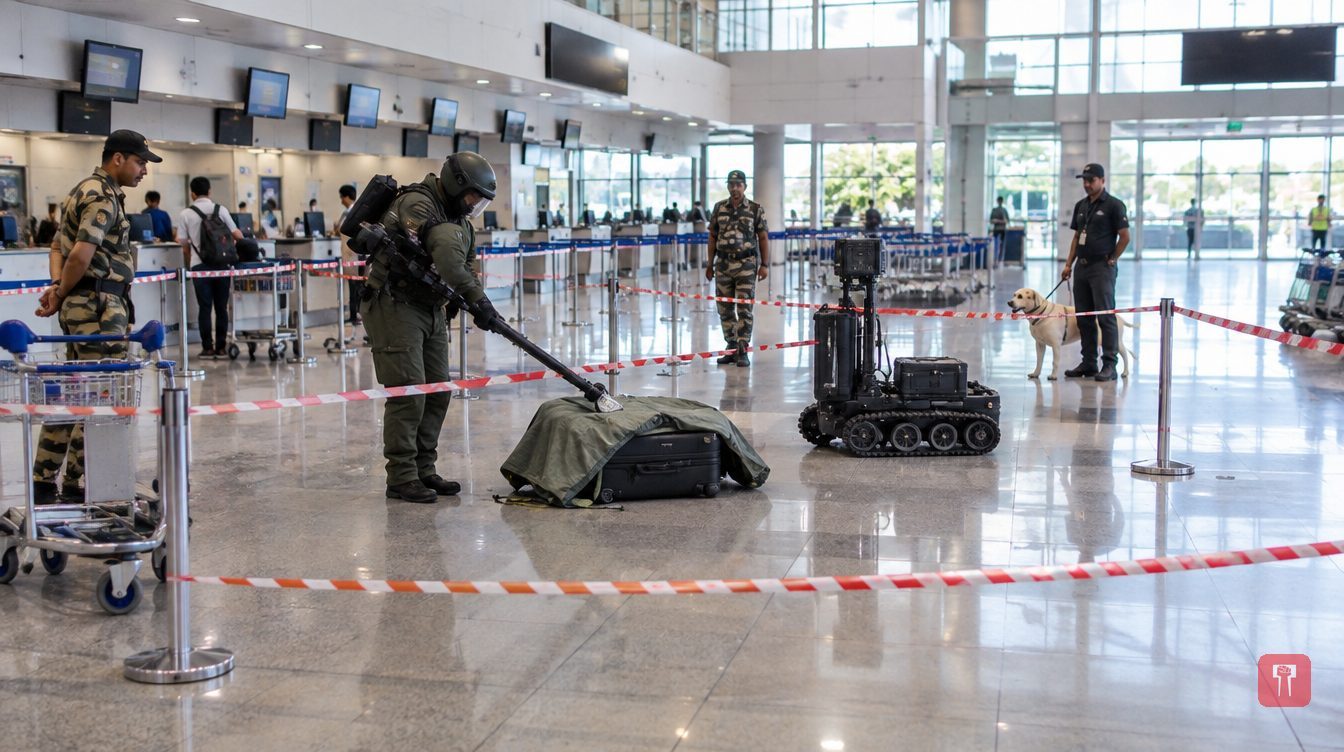 Images are not validated/verified
The annual mock drill to deal with a bomb threat was held at Pune airport. The Pune airport of the Airports Authority of India (AAI) carried out the exercise together with the Central Industrial Security Force (CISF) and other agencies concerned. The drill was held under the Bomb Threat Contingency Plan (BTCP). Its aim was to test preparedness for emergencies and to strengthen coordination between agencies during a bomb threat.
The exercise began at 11 am with a tabletop exercise in the conference hall of the AAI administrative building. A hypothetical threat situation was discussed, the role and responsibility of each agency was explained, and ways of keeping in contact with one another were settled.
The live mock drill began in the terminal building at 11.30 am. In the set scenario, an unknown person told IndiGo's Pune manager that an unattended bag was lying in the check-in area, suspected to hold a dummy improvised explosive device (IED). The manager immediately informed the CISF's Security Operational Control Room. The control room at once alerted the Quick Reaction Team (QRT) and also informed the duty post concerned. Passengers, staff and concessionaires in the affected area were moved to a designated safe place.
As part of the exercise, the suspect bag was covered with a blast inhibitor and the whole area was cordoned off. The bag was then checked in several stages: first a visual inspection, then the dog squad, an explosive vapour detector (EVD), a second check by the dog squad, a non-linear junction detector (NLJD), an electronic stethoscope and a handheld real time viewing system (RTVS). As per the set procedure, the presence of the hypothetical IED was treated as confirmed, a meeting of the Bomb Threat Assessment Committee (BTAC) was called and a specific threat was declared.
The Bomb Detection and Disposal Squad (BDDS) then handled the suspect bag with a telescopic manipulator and placed it in a suspect luggage containment vessel (SLCV). After the hypothetical Render Safe Procedure (RSP) was completed successfully, the threat bag was taken for further action to the designated Safe Disposal Area (SDA), that is, the cooling pit.
Apart from the terminal building, a dummy IED was also placed near India Post in the cargo area as part of the hypothetical threat. The state BDDS team successfully caught it. This showed its preparedness and ability to deal with security threats in the airport's cargo area.
The exercise was meant to test the operational readiness of the agencies involved. It was also meant to ensure that each agency is clear about its role and responsibility, and to check how effective the coordination and mutual contact between agencies is in a hypothetical situation such as a bomb threat anywhere in the airport premises.
Representatives of the CISF, the Indian Air Force, Pune Police, the State Disaster Response Force (SDRF), fire services, customs, immigration, health department officials, airlines and other airport stakeholders took part in the drill.
Such mock exercises are an important part of an airport's emergency preparedness. They improve operational readiness, strengthen coordination between agencies and ensure an effective, joint response in security situations.

Comments
No comments yet. Be the first.