

Hinjewadi metro set to open, but commuters face dust, unfinished footpaths and jams
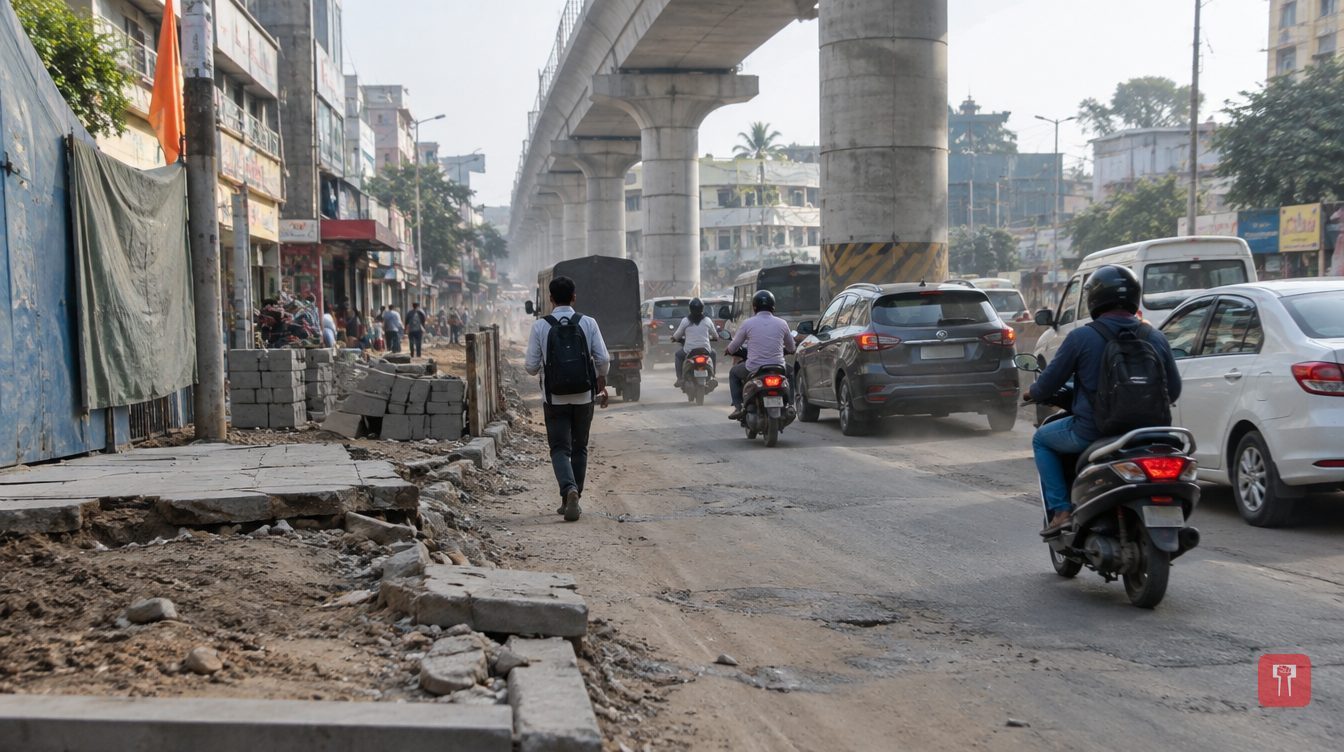 Images are not validated/verified
Ahead of the 3 November start of Pune Metro Line 3's first section, commuters say the Baner-Hinjewadi route is still marked by dust, potholes and incomplete pedestrian facilities.
The first operational section of Pune Metro Line 3 is due to open on 3 November. The line is being built by the Pune Metropolitan Region Development Authority (PMRDA), and work is under its supervision. Thousands of IT employees, students and local residents who travel daily between Baner, Balewadi and Hinjewadi hope for a better commute. Commuters say, however, that after years of construction the route to Hinjewadi is still full of dust, unfinished footpaths, traffic jams and broken roads.
The biggest complaint is about incomplete footpaths, especially on the Baner stretch. In many places footpaths have not been completed or are closed because of construction, so pedestrians have to walk on the road. The situation is worse near speed breakers, where the footpath meets the road awkwardly and vehicles keep passing close by.
Zenil Shah, an IT employee who travels to and from Hinjewadi daily, said: "Every evening I walk from Baner to my office shuttle, and in many places there is no proper footpath at all. I have to keep a constant watch on the vehicles, because construction has taken over the space for walking."
Urban planners also see this as a result of how the project has been carried out. Aditya Chavande, an architect and urban designer who is a senior programme associate at Parisar, said the metro agency builds facilities around its stations, but the stretches in between also need to be redesigned. He said: "If new footpaths and access facilities are built near the station and the rest of the road stays on the old plan, the two parts do not match. The municipal corporation should complete the stretches in between; it is not right to just connect the new metro structure to the old road and leave it at that."
A layer of dust has settled on many roads, especially where civil work is still under way. Two-wheeler riders and cyclists are the worst affected. They say the dust reduces visibility and makes the daily commute difficult. Potholes and broken surfaces slow vehicles down, and queues form at peak hours. Many commuters say jams are no longer limited to rush hour, because traffic often crawls through stretches narrowed by construction. Commuter Naresh Sahu said: "The road is uneven in many places and everyone has to move carefully around the potholes, so traffic slows down. A stretch that should take 20 minutes often takes much longer."
Several metro pillars have also become choke points, especially where they stand near shops. Shopkeepers on Baner Road say some pillars have reduced the actual width of the road, and traffic worsens at school hours. This is most visible near private schools, where in the afternoon the vehicles of parents picking up children get stuck in long lines trying to pass around the pillars. One shopkeeper, whose shop faces such a narrow bend, said: "As soon as school lets out, the road becomes tight near some pillars and vehicles pile up. Customers hesitate to stop, because there is no space left." According to traders, long construction over the past few years has reduced customer footfall, and they hope access will become easier once the road is built after the work is finished.
Chavande said these problems point to a deeper design flaw. In his view, if the road is built as an integrated corridor, the space for moving traffic should remain uniform. If the width near a station is two or three lanes, the stretches in between should be built to match. Otherwise, at every station vehicles move from a wide section into a narrow one and jams occur repeatedly. He also said the metro structure is now permanent. In his words: "Its pillars cannot be removed for another round of road widening. So the road will have to be redesigned to suit the existing structure. Increasing the total width does not automatically increase the space usable by vehicles, because the space taken by the metro structure stays the same."
The Maan station is expected to start service, but part of the station is still incomplete. Work on the stairs on one side is continuing, so commuters worry whether the finishing will be completed before service begins. Commuters are waiting for the metro to start, but want passenger facilities to be fully functional from day one. Commuter Riya Hirani said: "We will certainly benefit from the metro, but people also need safe access to the station. When passengers start using it, the station and the area around it should be fully ready."
According to Chavande, the real root is a lack of coordination among agencies. He said: "The problem is that development is not integrated. The metro builds its structure, the municipal corporation looks after the road, but these works are not always planned together. Until the road along the entire metro corridor is redesigned for the new structure, these problems will persist. For this, all the agencies that own the road will have to work together." He also cautioned that it would not be right to blame only the metro. In his view, the metro's job is to build stations and provide the infrastructure needed to reach them, while connecting that development to the rest of the road is the municipal corporation's job. The metro may have made mistakes in some places, but instead of attributing every obstruction entirely to it, each location should be examined carefully.
As an example, he cited Ganeshkhind Road. There, the metro was planned for a 36-metre-wide road, while a later road-widening proposal raised the width to 45 metres. Chavande said this created a difference between the metro's plan and the new road plan. In his view, the concern was that it was a makeshift plan, because the road was being widened without a clear, coordinated plan for how the road under the metro would function.
Officials say road restoration work has begun across the corridor. According to them, repairs to the roads under the metro corridor are expected to be completed in the next 10 days. Priority is being given to the stations that will be operational from 3 November, and officials have assured that the roads under these stations will be fully repaired before passengers use the metro. The work includes repairing the road surface and restoring stretches damaged by construction.
Chavande believes repairs alone will not be enough. He said: "The metro agencies (Maha Metro and PMRDA Metro) should clearly communicate their development plans to the municipal corporation, and the municipal corporation should incorporate them into the road design. Work should be done across the whole corridor, including the stretches between stations. That means traffic lanes, footpaths, cycling facilities, passenger drop-off spots and auto-rickshaw facilities should be planned together, so that the metro structure does not obstruct movement." He also said the remaining road space should be designed for pedestrians, cyclists and wheelchair users.
Despite the years of hardship, many commuters are confident that once the entire corridor is operational, the journey from Shivajinagar to Hinjewadi will take considerably less time. For now, daily commuters still have to deal with dusty roads, incomplete pedestrian infrastructure, jams and ongoing construction. Elina Patil, a Baner resident, said: "Everyone understands that big infrastructure projects take time. But after putting up with construction for so long, people now want the finishing work completed quickly, so that the benefits of the metro finally outweigh the hardships."
Reach readers on the ward they actually live in.
Advertise with Prime Time 24Reach readers on the ward they actually live in.
Advertise with Prime Time 24Reach readers on the ward they actually live in.
Advertise with Prime Time 24
Comments
No comments yet. Be the first.