

Cycling's share of Pune trips falls from 45% in the 1980s to 3% in 2025-26
 Images are not validated/verified
A study led by Additional Commissioner of Police Manoj Patil finds two-wheelers now account for 37% of daily trips in Pune, as cycling has become less safe.
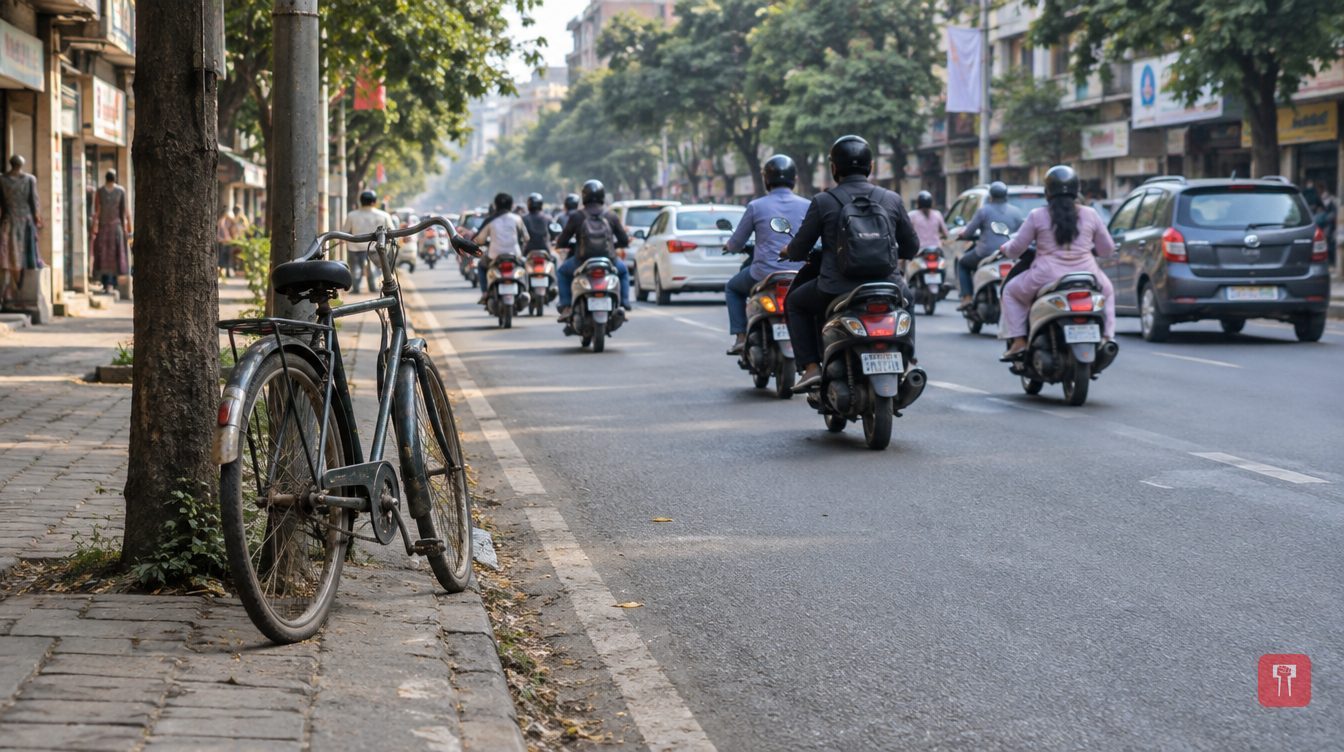
Pune was once known as a city of cyclists, but that has changed. Bicycles accounted for 45 per cent of daily trips in the city in the 1980s, and only 3 per cent in 2025-26. Two-wheelers have meanwhile become the biggest mode of travel, making 37 per cent of daily trips. The figures show the city has grown more dependent on motor vehicles and that safety for cyclists has worsened.
The findings come from a study of bicycle and motor vehicle use in the city, carried out by Additional Commissioner of Police Manoj Patil and his team. It records the major changes in how people travel over the past four decades.
According to the data, about 80 per cent of daily trips in Pune in the 1980s were made by bicycle or on foot, with cycling at 45 per cent and walking at 35 per cent. By 1995, the share of cycling had dropped to 37.2 per cent, while walking stood at 32.3 per cent. The decline continued, and the 2008 Comprehensive Mobility Plan (CMP) survey recorded only 11 per cent of trips by bicycle. The latest figures put the share for 2025-26 at just 3 per cent.
Patil attributed the decline to the city's geographical spread, longer travel distances and growing traffic. He said that as residential areas spread towards the outskirts, people moved to two-wheelers to save time. As the number of vehicles rose, cycling also became increasingly unsafe.
"Very few people cycle to work now, as they did in the 1980s and 1990s," Patil said. "As the city expanded and residential areas moved away from the centre, people took to two-wheelers to get there faster. Besides, cycling has become unsafe because of factors such as fast and careless driving by motorists. Only a few roads have safe arrangements for cyclists."
The rising share of two-wheelers shows the same shift. Their share was around 10 per cent in the 1980s and rose to 38 per cent in 2008. In 2025-26 it stands at 37 per cent. Car use has also risen sharply. Cars accounted for less than 1 per cent of trips in the 1980s, against 10.25 per cent in 2025-26.
The share of walking has also fallen, from 35 per cent in the 1980s to 23.5 per cent in 2025-26. Public transport use has remained almost unchanged. It accounted for 11 per cent of daily trips in 2025-26, against 8 per cent in the 1980s.
Reach readers on the ward they actually live in.
Advertise with Prime Time 24Reach readers on the ward they actually live in.
Advertise with Prime Time 24Reach readers on the ward they actually live in.
Advertise with Prime Time 24Choose primetime24.com as a preferred source on Google Google shows more stories from your preferred sources in Top Stories.
Reach readers on the ward they actually live in.
Advertise with Prime Time 24
Comments
No comments yet. Be the first.