

BMC issues 28-point dust rules for Mumbai building sites, deploys 76 surprise-inspection squads
The Brihanmumbai Municipal Corporation has issued guidelines for construction and demolition sites; violators face show-cause notices, stop-work orders or sealing.
 Images are not validated/verified
The Brihanmumbai Municipal Corporation (BMC) has issued 28-point guidelines to curb air pollution at construction and demolition sites in Mumbai. Seventy-six ward-level mitigation squads have been deployed for surprise inspections. Violators may be served a show-cause notice, a stop-work order, or their site may be sealed.
The measures are part of the BMC's Winter Air Pollution Mitigation and Enforcement Action Plan 2026. The plan focuses on construction dust, road pollution, vehicle emissions, illegal dumping of waste and open burning.
According to the BMC, Mumbai recorded 231 days in the 'good' and 'satisfactory' Air Quality Index (AQI) categories up to October 22, 2026. The figure was 218 days in 2025, 216 in 2024 and 185 in 2023. Data from the Union Environment Ministry's PRANA portal also shows that PM10 levels in the city fell by about 48 per cent between 2017-18 and 2025-26.
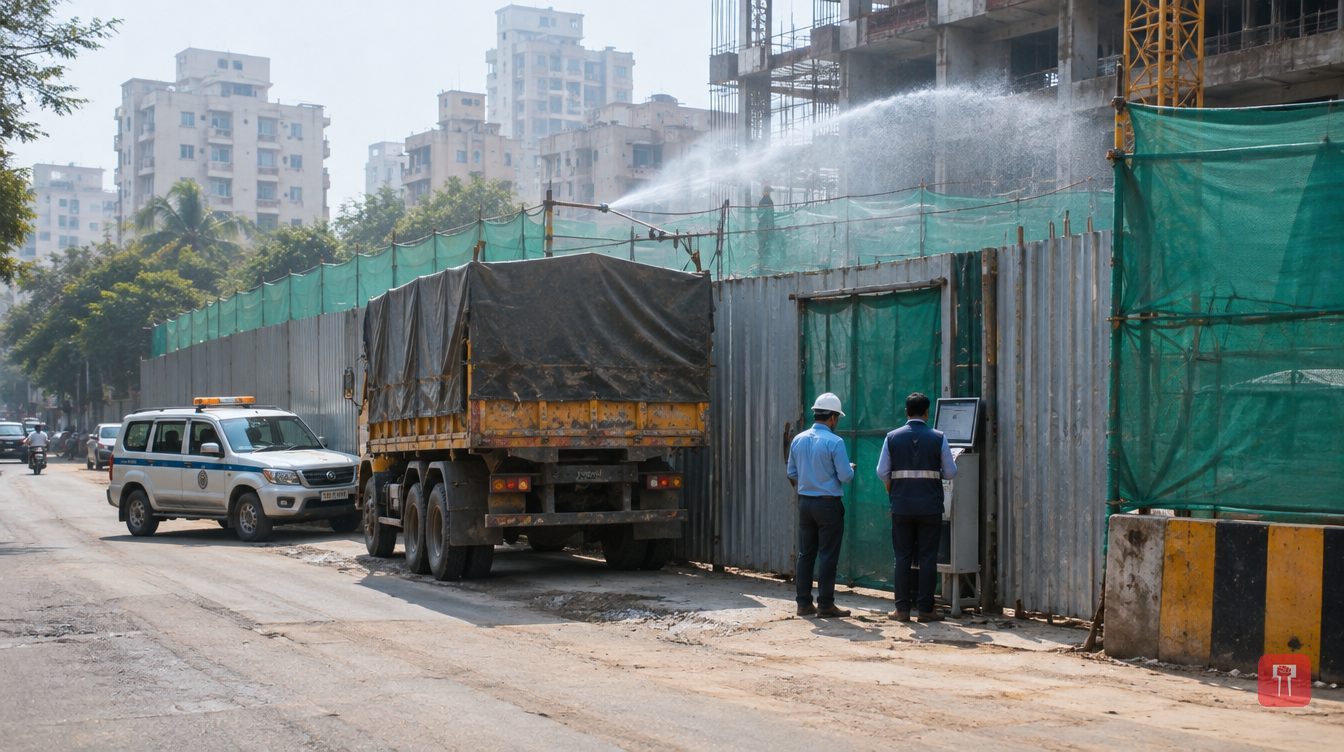
Under the new guidelines, construction sites must be enclosed with green cloth, jute sheets or tarpaulin so that dust does not spread. Structures being demolished must be covered from top to bottom, and water must be sprayed continuously during demolition.
Projects taller than 70 metres and layouts larger than one acre must put up metal-sheet barricades at least 35 feet high. Sites smaller than one acre must have barricades of at least 25 feet.
Developers must run sprinklers or fogging systems while loading and unloading material. Dust-raising work such as cutting, drilling, grinding and sawing should be done in enclosed areas, with continuous water spraying or fogging.
Sensor-based air pollution monitors are mandatory. If readings go above the set limit, developers must take immediate corrective steps. The BMC said 3,166 construction sites have linked their monitors to a central dashboard. CCTV cameras must also be installed on site boundaries to keep track of vehicle movement, tyre cleaning and overloading.
Each ward-level squad must inspect at least two construction sites a day and also carry out follow-up checks at pollution hotspots. Each team has two ward engineers, a policeman, a marshal and a vehicle, and works under a senior ward officer. Violators will be recorded through inspection reports, photographs and videos before any action is taken.
The BMC is using 29 multipurpose vehicles for deep cleaning and regular road cleaning. Developers must clean the surrounding roads, install tyre-washing facilities and ensure that construction material and debris are carried only in covered, non-overloaded vehicles. Where debris is dumped is monitored through the Mumbai Debris Control and Tracking System (MDCTS).
Open burning is banned across Mumbai. Developers must provide workers with food and electric heaters so that they do not burn wood.
According to the civic body, 209 of Mumbai's 593 bakeries were already using cleaner fuel. A further 175 have adopted cleaner fuel, 69 were in the process of switching, 87 were still not complying and eight have shut down. Cleaner fuel will be mandatory for new bakery licences.
The BMC is also installing pollution control devices at 10 crematoriums. It has reiterated the ban on firecrackers in public places such as roads, pavements, lanes and silence zones ahead of Diwali.
This story has published but the live thread has not started. Updates appear here the moment the desk files one.

Comments
No comments yet. Be the first.